Advertisement
Advertisement
May/June 2026
Renal Denervation: Review of Contemporary Data and the Road to Mainstream Adoption
Current clinical evidence, guideline updates, practical considerations, and evolving device-based therapies for renal denervation in hypertension management.
By Aditi Ujjawal, MD; Eric A. Secemsky, MD, MSc, RPVI, FACC, FAHA, FSCAI, FSVM; and Anna K. Krawisz, MD
Hypertension (HTN) remains one of the most prevalent and consequential cardiovascular risk factors worldwide, affecting nearly half of adults in the United States and contributing substantially to global morbidity and mortality from stroke, myocardial infarction (MI), heart failure, and chronic kidney disease.1 As the United States population ages, HTN prevalence also rises sharply (75% in adults aged > 65 years); further, the clinical phenotype becomes increasingly complex with higher multimorbidity burden.1 Uncontrolled blood pressure (BP) has clear cardiovascular consequences. In a large study of 1.3 million outpatient adults (> 36 million BP measurements), higher systolic BP (SBP) ≥ 130 mm Hg was associated with increased risk of MI and stroke. Specifically, each incremental rise in SBP was linked to an 18% higher risk of these events over 8 years, even after adjusting for other risk factors.2
Despite the availability of numerous effective antihypertensive drug classes, BP control rates remain alarmingly low. Based on a National Health and Nutrition Examination Survey study, HTN affects approximately 48% of United States adults, yet only 22% of those with HTN have BP controlled to the guideline-recommended threshold of < 130/80 mm Hg.3 Even among patients actively receiving antihypertensive therapy, medication nonadherence, therapeutic inertia, and side effects contribute to a treatment gap that existing strategies have failed to close.
These challenges push the field toward device-based solutions, with catheter-based renal denervation (RDN) drawing the most attention. By targeting the renal sympathetic nerves-key mediators of both afferent and efferent sympathetic signaling that modulate renin release, sodium reabsorption, and systemic vascular resistance-RDN offers the theoretical advantage of durable BP reduction. This article reviews the contemporary clinical evidence base for RDN, with emphasis on landmark sham-controlled trials and the trajectory of long-term outcomes data; the significance of the recent American Heart Association (AHA) guideline update; and the evolving landscape of device-based HTN therapies.
MECHANISM OF ACTION OF RDN DEVICES
The renal sympathetic nervous system plays a central role in BP regulation through multiple pathways. Efferent renal sympathetic nerve activity stimulates renin release from the juxtaglomerular apparatus, promotes tubular sodium and water reabsorption, and reduces renal blood flow-all of which contribute to systemic HTN. Conversely, afferent renal nerves relay signals of renal ischemia and metabolic stress to the central nervous system, amplifying central sympathetic outflow and perpetuating a cycle of elevated BP.3
Catheter-based RDN disrupts these pathways by delivering energy, either radiofrequency (RF) or ultrasound, to the adventitial and periadventitial layers of the renal arteries, where sympathetic nerve fibers travel within the perivascular fat bundle in close proximity to the vessel wall (Figure 1). The second-generation Symplicity Spyral RF system (Medtronic) uses a helical four-electrode catheter that makes simultaneous contact with the vessel wall; at each position, energy is delivered across all four electrodes simultaneously for 60 seconds, with the catheter repositioned from distal to proximal to achieve approximately 12 ablations per artery across both the main renal artery and first-order branches.4 The Paradise ultrasound system (Recor Medical) uses a balloon-based approach: the balloon is inflated within the proximal renal artery and delivers two to three focused ultrasound pulses per target artery while intraballoon circulating water cools the vessel wall, enabling circumferential 360° energy delivery without direct electrode contact.5 Both strategies target durable ablation of renal sympathetic afferent and efferent fibers, thereby reducing sympathetically mediated contributions to elevated BP.
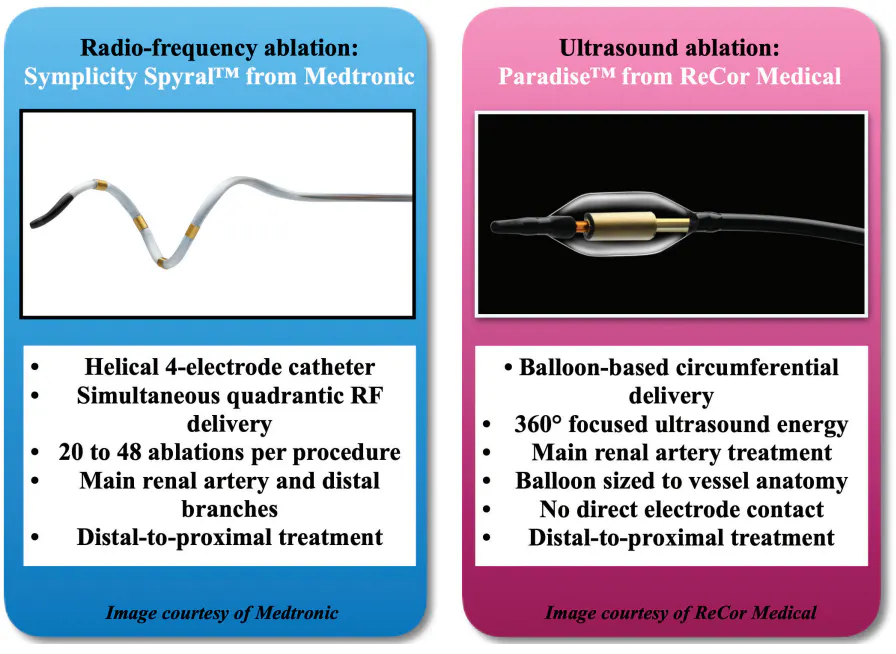
Figure 1. Currently approved catheter-based RDN systems.
SHAM-CONTROLLED TRIALS LEADING TO FDA APPROVAL
RF RDN: The SYMPLICITY and SPYRAL Studies
Early enthusiasm for RDN was tempered by the results of the SYMPLICITY HTN-3 trial, the first large, randomized, sham-controlled study of RF RDN using the first-generation Symplicity Flex catheter (Medtronic) in patients with resistant HTN. At 6 months, no significant difference in office or ambulatory SBP was observed between treatment and sham groups.6 Notably, the first-generation catheter ablated only the main renal artery with a single electrode and a mean of approximately 11 ablations per patient. This is a marked procedural contrast to the second-generation Symplicity Spyral system, which delivers 20 to 48 ablations per patient across both the main and first-order branch renal arteries using a four-electrode helical design. Long-term follow-up from SYMPLICITY HTN-3 ultimately demonstrated that office and ambulatory SBP reductions in the RDN group widened progressively and significantly versus controls at 12, 24, and 36 months, accompanied by a meaningfully lower antihypertensive medication burden in the RDN group by 36 months.7 The resistant HTN subgroup was found to derive the most benefit; at 36 months, these patients demonstrated an approximately 15 mm Hg reduction in ambulatory SBP, raising the possibility that longer follow-up may be necessary to capture the full treatment effect in the more treatment-refractory population.
The SPYRAL HTN-OFF MED program addressed these limitations across two successive randomized, sham-controlled trials enrolling patients off all antihypertensive medications. The 2017 proof-of-concept trial (N = 80) demonstrated between-group differences of 5 mm Hg in 24-hour ambulatory SBP and 7.7 mm Hg in office SBP at 3 months,8 and the 2020 SPYRAL HTN-OFF MED Pivotal trial confirmed these findings with statistically significant reductions of 3.9 mm Hg in 24-hour ambulatory SBP and 6.5 mm Hg in office SBP versus sham, establishing biological proof of principle for the antihypertensive effect of the refined technique and contributing foundational safety data.9
SPYRAL HTN-ON MED extended this evaluation to patients on one to three antihypertensive medications. The 2018 randomized, sham-controlled proof-of-concept trial (N = 80) demonstrated significant between-group differences of 7 mm Hg in 24-hour ambulatory SBP and 6.6 mm Hg in office SBP at 6 months,10 with extended follow-up to 36 months showing progressive divergence-an adjusted treatment difference of -10 mm Hg in 24-hour ambulatory SBP (P = .0039)-despite similar medication burden between groups.11 The subsequent powered expansion trial in 2023 (N = 337) did not meet its primary endpoint. Per the investigators, this was driven largely by disproportionate medication escalation in the sham arm during the COVID-19 pandemic; however, multiple secondary endpoints including office SBP, nighttime BP, and win ratio analysis favored RDN.12
Ultrasound RDN: The RADIANCE Studies
The RADIANCE-HTN program established the efficacy of the Paradise ultrasound system across three trials enrolling patients with varying hypertension severity. RADIANCE-HTN SOLO (2018) enrolled patients with combined systolic-diastolic hypertension withdrawn from up to two antihypertensive medications prior to randomization. At 2 months, RDN reduced daytime ambulatory SBP by 8.5 mm Hg versus 2.2 mm Hg with sham (between-group difference -6.3 mm Hg; 95% CI, -9.4 to -3.1; P = .0001), with no major adverse events in either group.13
RADIANCE-HTN TRIO (2021) enrolled patients with resistant HTN on three or more antihypertensives. Prior to randomization, all patients were switched to a single-pill combination of a calcium channel blocker, angiotensin receptor blocker, and thiazide diuretic, establishing a rigorous threshold for true pharmacologic resistance and exploring a patient phenotype for whom RDN is beneficial. At 2 months, RDN produced a 4.5 mm Hg greater reduction in daytime ambulatory SBP versus sham (95% CI, -8.5 to -0.3; P = .022).14 At 6 months, following blinded medication titration, daytime ambulatory SBP was similar between groups; however, the RDN group achieved comparable BP control with significantly fewer medications, including fewer aldosterone antagonists (40% vs 60.9%; P = .02), and home SBP remained significantly lower (between-group difference -4.3 mm Hg; 95% CI, -8.1 to -0.5; P = .03).15
RADIANCE II (2023) enrolled a larger cohort withdrawn from antihypertensive medications using a 2:1 allocation ratio. At 2 months, RDN produced a 6.3 mm Hg greater reduction in daytime ambulatory SBP versus sham (95% CI, -9.3 to -3.2; P < .001), with improvement in 6 of 7 prespecified secondary BP outcomes and no major adverse events.16
FDA Approvals
Based on the pivotal trials previously mentioned, the FDA approved the Paradise ultrasound RDN on November 7, 2023, and the Symplicity Spyral RDN system on November 17, 2023.17,18
EVOLVING REAL-WORLD EVIDENCE AND LONG-TERM OUTCOMES
The generalizability of RDN has also been extended beyond predominantly Western trial populations. Iberis-HTN, a randomized sham-controlled trial conducted in Chinese patients with uncontrolled HTN using the AngioCare RF ablation device (N = 217), demonstrated a 6-month between-group difference in 24-hour SBP of 9.4 mm Hg, favoring RDN (P < .001). RDN was also associated with significant reductions in office SBP and diastolic BP. The consistency of these findings with the SPYRAL program across a geographically and ethnically distinct population provides important support for the broad applicability of RF RDN.19
The accumulation of extended follow-up data has strengthened the RDN evidence base. A pooled patient-level analysis of 4,155 participants across six studies in the SYMPLICITY clinical trial program-encompassing SYMPLICITY HTN-3,7 SYMPLICITY HTN-Japan,21 the Global SYMPLICITY registry DEFINE cohort,22 SPYRAL first-in-human,23 SPYRAL HTN-OFF MED,8 and SPYRAL HTN-ON MED10,11-demonstrated sustained and consistent BP lowering through 3 years of follow-up using multivariate, mixed linear regression models.20 The single characteristic most consistently associated with greater BP response was higher baseline SBP, a finding with direct implications for patient selection: those with the most uncontrolled HTN appear to derive the largest absolute benefit.
Structured real-world surveillance is now underway through the American College of Cardiology (ACC) National Cardiovascular Data Registry (NCDR) RDN Registry, a national outcomes registry that will capture long-term safety and efficacy data across centers performing RDN in clinical practice, providing a critical complement to the controlled trial evidence base. Beth Israel Deaconess Medical Center pioneered an RDN registry in 2023 that recently integrated into the ACC NCDR-RDN.24
AHA GUIDELINES AND THE CLASS IIB INDICATION
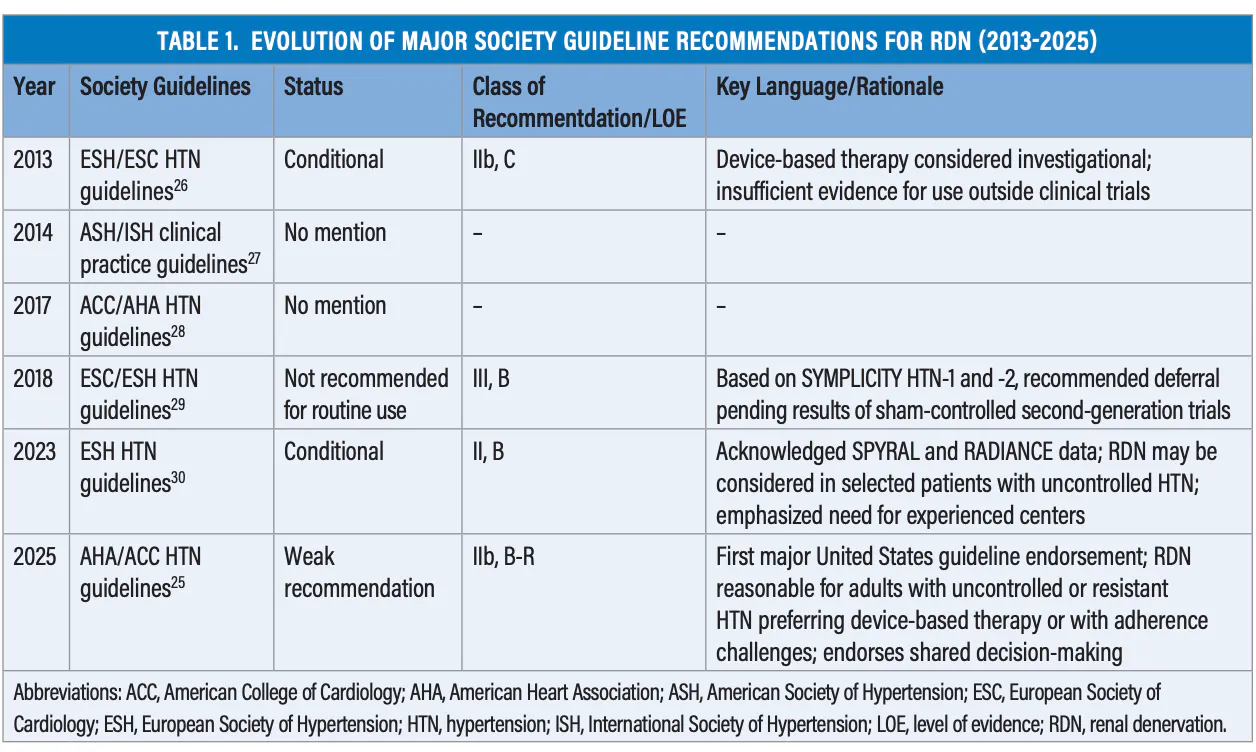
The 2025 AHA HTN guidelines assign a class IIb recommendation for RDN in adults with resistant or uncontrolled HTN who prefer a nonpharmacologic approach or have difficulty adhering to antihypertensive therapy.25 This marks the first formal recognition of RDN as a reasonable therapeutic option within major United States cardiovascular society guidelines (Table 1).25-30 The class IIb designation reflects both biologic plausibility and consistent clinical evidence supporting an antihypertensive effect, while acknowledging limitations in the current evidence base and uncertainty in optimal patient selection. Patient preference and shared decision-making remain central (Figure 2).25
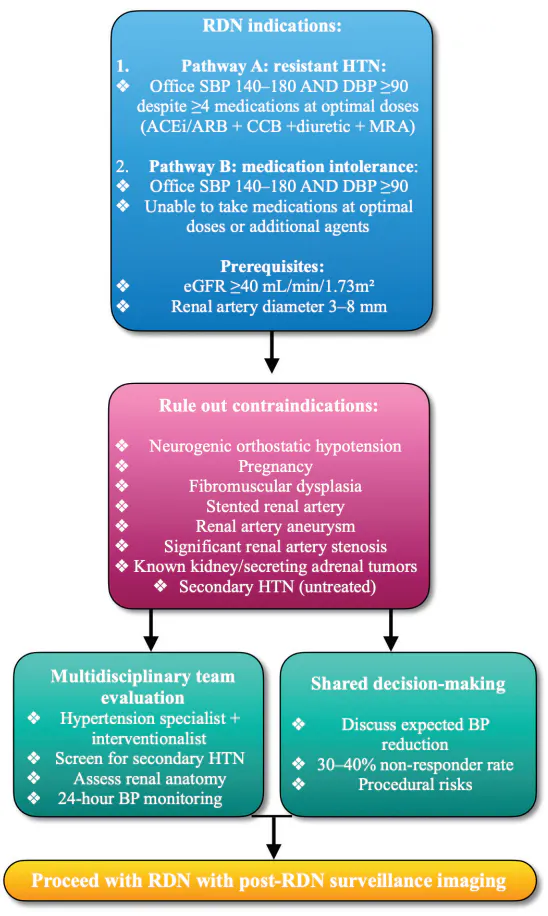
Figure 2. RDN patient selection. ACEi, angiotensin-converting enzyme inhibitor; ARB, angiotensin receptor blocker; CCB, calcium channel blocker; DBP, diastolic blood pressure; eGFR, estimated glomerular filtration rate. Adapted from Writing Committee Members; Jones DW, Ferdinand KC, et al. 2025 AHA/ACC/AANP/AAPA/ABC/ACCP/ACPM/AGS/AMA/ASPC/NMA/PCNA/SGIM guideline for the prevention, detection, evaluation and management of high blood pressure in adults: a report of the American College of Cardiology/American Heart Association Joint committee on clinical practice guidelines. Hypertension. 2025;82:e212-e316. doi: 10.1161/HYP.0000000000000249
HTN DEVICE LANDSCAPE IN 2026
Beyond the two FDA-approved RDN platforms, the device-based HTN landscape is expanding on several fronts. The MobiusHD device (Vascular Dynamics) represents a mechanically distinct approach: a self-expanding nitinol implant placed within the internal carotid artery that amplifies pulsatile carotid sinus wall strain to enhance baroreceptor signaling without electrical stimulation.31 Alcohol-mediated chemical denervation via the Peregrine system (Ablative Solutions) delivers microdoses of dehydrated alcohol to the renal periadventitial space through an infusion catheter, achieving neurolysis at depths of approximately 8 mm without energy delivery or capital equipment. The pivotal TARGET BP I trial met its primary endpoint in April 2024, demonstrating a statistically significant between-group difference of 3.2 mm Hg in 24-hour ambulatory SBP compared to sham (P = .049) in 301 patients with uncontrolled HTN on two to five medications.32 Another novel emerging approach is multiorgan denervation; preclinical data published in EuroIntervention demonstrated that combined hepatic denervation and RDN using the Symplicity Spyral catheter produced sustained reductions in norepinephrine levels in both renal and hepatic tissue at 28 days.33 SPYRAL GEMINI is a first-in-human trial investigating combined common hepatic denervation and RDN that began enrollment in 2025 and may offer additive BP reduction beyond RDN alone.34
CONCLUSION
For the HTN specialist, interventional cardiologist, and interventional radiologist, RDN now represents a guideline-endorsed option in the therapeutic armamentarium. Patient selection remains paramount: those with the highest baseline BP, documented medication nonadherence, or intolerance to pharmacotherapy appear most likely to benefit. As reimbursement pathways mature and real-world experience accumulates, the role of RDN in the management of HTN will continue to be refined and, if outcomes data prove favorable, potentially expanded well beyond its current niche indication.
1. Tsao CW, Aday AW, Almarzooq ZI, et al. Heart disease and stroke statistics-2023 update: A report from the American Heart Association. Circulation. 2023;147:e93-e621. doi: 10.1161/CIR.0000000000001123
2. Flint AC, Conell C, Ren X, et al. Effect of systolic and diastolic blood pressure on cardiovascular outcomes. N Engl J Med. 2019;381:243-251. doi: 10.1056/NEJMoa1803180
3. Essa M, Malik D, Lu Y, et al. Hypertension prevalence, awareness, and control in US adults before and after the COVID-19 pandemic. J Clin Hypertens (Greenwich). 2025;27:e70093. doi: 10.1111/jch.70093
4. Schlaich MP, Sobotka PA, Krum H, et al. Renal sympathetic-nerve ablation for uncontrolled hypertension. N Engl J Med. 2009;361:932-934. doi: 10.1056/NEJMc0904179
5. Mabin T, Sapoval M, Cabane V, et al. First experience with endovascular ultrasound renal denervation for the treatment of resistant hypertension. EuroIntervention. 2012;8:57-61. doi: 10.4244/EIJV8I1A10
6. Bhatt DL, Kandzari DE, O'Neill WW, et al. A controlled trial of renal denervation for resistant hypertension. N Engl J Med. 2014;370:1393-1401. doi: 10.1056/NEJMoa1402670
7. Bhatt DL, Vaduganathan M, Kandzari DE, et al. Long-term outcomes after catheter-based renal artery denervation for resistant hypertension: final follow-up of the randomised SYMPLICITY HTN-3 Trial. Lancet. 2022;400:1405-1416. doi: 10.1016/S0140-6736(22)01787-1
8. Townsend RR, Mahfoud F, Kandzari DE, et al. Catheter-based renal denervation in patients with uncontrolled hypertension in the absence of antihypertensive medications (SPYRAL HTN-OFF MED): a randomised, sham-controlled, proof-of-concept trial. Lancet. 2017;390:2160-2170. doi: 10.1016/S0140-6736(17)32281-X
9. Bohm M, Kario K, Kandzari DE, et al. Efficacy of catheter-based renal denervation in the absence of antihypertensive medications (SPYRAL HTN-OFF MED Pivotal): a multicentre, randomised, sham-controlled trial. Lancet. 2020;395:1444-1451. doi: 10.1016/S0140-6736(20)30554-7
10. Kandzari DE, Bohm M, Mahfoud F, et al. Effect of renal denervation on blood pressure in the presence of antihypertensive drugs: 6-month efficacy and safety results from the SPYRAL HTN-ON MED proof-of-concept randomised trial. Lancet. 2018;391:2346-2355. doi: 10.1016/S0140-6736(18)30951-6
11. Mahfoud F, Kandzari DE, Kario K, et al. Long-term efficacy and safety of renal denervation in the presence of antihypertensive drugs (SPYRAL HTN-ON MED): a randomised, sham-controlled trial. Lancet. 2022;399:1401-1410. doi: 10.1016/S0140-6736(22)00455-X
12. Kandzari DE, Townsend RR, Kario K, et al. Safety and efficacy of renal denervation in patients taking antihypertensive medications. J Am Coll Cardiol. 2023;82:1809-1823. doi: 10.1016/j.jacc.2023.08.045
13. Azizi M, Schmieder RE, Mahfoud F, et al. Endovascular ultrasound renal denervation to treat hypertension (RADIANCE-HTN SOLO): a multicentre, international, single-blind, randomised, sham-controlled trial. Lancet. 2018;391:2335-2345. doi: 10.1016/S0140-6736(18)31082-1
14. Azizi M, Sanghvi K, Saxena M, et al. Ultrasound renal denervation for hypertension resistant to a triple medication pill (RADIANCE-HTN TRIO): a randomised, multicentre, single-blind, sham-controlled trial. Lancet. 2021;397:2476-2486. doi: 10.1016/S0140-6736(21)00788-1
15. Azizi M, Mahfoud F, Weber MA, et al. Effects of renal denervation vs sham in resistant hypertension after medication escalation: prespecified analysis at 6 months of the RADIANCE-HTN TRIO randomized clinical trial. JAMA Cardiol. 2022;7:1244-1252. doi: 10.1001/jamacardio.2022.3904
16. Azizi M, Saxena M, Wang Y, et al. Endovascular ultrasound renal denervation to treat hypertension: The RADIANCE II randomized clinical trial. JAMA. 2023;329:651-661. doi: 10.1001/jama.2023.0713
17. US Food and Drug Administration. Paradise ultrasound renal denervation system - P220023. Accessed March 25, 2026. https://www.fda.gov/medical-devices/recently-approved-devices/paradise-ultrasound-renal-denervation-system-p220023.
18. US Food and Drug Administration. Premarket approval (PMA). Accessed March 25, 2026. https://www.accessdata.fda.gov/scripts/cdrh/cfdocs/cfpma/pma.cfm?id=P220026.
19. Jiang X, Mahfoud F, Li W, et al. Efficacy and safety of catheter-based radiofrequency renal denervation in Chinese patients with uncontrolled hypertension: the randomized, sham-controlled, multi-center Iberis-HTN trial. Circulation. 2024;150:1588-1598. doi: 10.1161/CIRCULATIONAHA.124.069215
20. Mahfoud F, Townsend RR, Kandzari DE, et al. Long-term, patient-level analysis of radiofrequency renal denervation in the SYMPLICITY clinical trial program. JACC Adv. 2025;4:101606. doi: 10.1016/j.jacadv.2025.101606
21. Kario K, Ogawa H, Okumura K, et al. SYMPLICITY HTN-Japan - first randomized controlled trial of catheter-based renal denervation in Asian patients. Circ J. 2015;79:1222-1229. doi: 10.1253/circj.CJ-15-0150
22. Mahfoud F, Mancia G, Schmieder RE, et al. Outcomes following radiofrequency renal denervation according to antihypertensive medications: subgroup analysis of the global SYMPLICITY registry DEFINE. Hypertension. 2023;80:1759-1770. doi: 10.1161/HYPERTENSIONAHA.123.21283
23. Whitbourn R, Harding SA, Walton A. Symplicity multi-electrode radiofrequency renal denervation system feasibility study. EuroIntervention. 2015;11:104-109. doi: 10.4244/EIJV11I1A18
24. American College of Cardiology. ACC, Smith Center to collaborate to advance renal denervation knowledge. Accessed May 11, 2026. https://www.acc.org/Latest-in-Cardiology/Articles/2025/06/10/19/09/ACC-Smith-Center-to-Collaborate-to-Advance-Renal-Denervation-Knowledge
25. Writing Committee Members, Jones DW, Ferdinand KC, et al. 2025 AHA/ACC/AANP/AAPA/ABC/ACCP/ACPM/AGS/AMA/ASPC/NMA/PCNA/SGIM guideline for the prevention, detection, evaluation and management of high blood pressure in adults: A Report of the American College of Cardiology/American Heart Association Joint Committee on Clinical Practice Guidelines. Hypertension. 2025;82:e212-e316. doi: 10.1161/HYP.0000000000000249
26. Mancia G, Fagard R, Narkiewicz K, et al. 2013 ESH/ESC guidelines for the management of arterial hypertension. Eur Heart J. 2013;34:2159-2219. doi: 10.1093/eurheartj/eht151
27. Weber MA, Schiffrin EL, White WB, et al. Clinical practice guidelines for the management of hypertension in the community. J Clin Hypertens (Greenwich). 2014;16:14-26. doi: 10.1111/jch.12237
28. Whelton PK, Carey RM, Aronow WS, et al. 2017 ACC/AHA/AAPA/ABC/ACPM/AGS/APhA/ASH/ASPC/NMA/PCNA guideline for the prevention, detection, evaluation, and management of high blood pressure in adults. Hypertension. 2018;71:e13-e115. doi: 10.1161/HYP.0000000000000065
29. Williams B, Mancia G, Spiering W, et al. 2018 ESC/ESH Guidelines for the management of arterial hypertension. Eur Heart J. 2018;39:3021-3104. doi: 10.1093/eurheartj/ehy339
30. Mancia G, Kreutz R, Brunstrom M, et al. 2023 ESH Guidelines for the management of arterial hypertension. J Hypertens. 2023;41:1874-2071. doi: 10.1097/HJH.0000000000003480
31. van Kleef MEAM, Devireddy CM, van der Heyden J, et al. Treatment of resistant hypertension with endovascular baroreflex amplification: 3-year results from the CALM-FIM study. JACC Cardiovasc Interv. 2022;15:321-332. doi: 10.1016/j.jcin.2021.12.015
32. Kandzari DE, Weber MA, Pathak A, et al. Effect of alcohol-mediated renal denervation on blood pressure in the presence of antihypertensive medications: primary results from the TARGET BP I randomized clinical trial. Circulation. 2024;149:1875-1884. doi: 10.1161/CIRCULATIONAHA.124.069291
33. Mahfoud F, Tunev S, Kandzari DE, et al. A preclinical study of combined hepatic and renal artery denervation. EuroIntervention. 2025;21:e1028-e1036. doi: 10.4244/EIJ-D-25-00349
34. SPYRAL GEMINI Pilot Study (SPYRAL GEMINI). ClinicalTrials.gov website. Accessed March 29, 2026. https://clinicaltrials.gov/study/NCT06907147
Advertisement
Advertisement