Advertisement
Advertisement
May/June 2026
Sponsored by Nipro Medical Corporation
Guide Catheter Extensions: A Brief, Practical User’s Guide
Enhancing device delivery and procedural success through guide catheter extension techniques.
As equipment and guide catheters (GCs) for percutaneous coronary intervention (PCI) became smaller and the 6-F GC became standard, operators faced many limitations during PCI procedures. Chief among these limitations was the relatively poor backup support provided by smaller GCs for advancing equipment through and intervening upon challenging anatomy, such as tortuosity, calcium, and chronic total occlusions (CTOs). Over 20 years ago, operators attempted to overcome this by placing a 5-F Heartrail GC (Terumo Interventional Systems) through a standard 6-F GC to extend the reach of the GC, allowing for more distal delivery of equipment.1 This “five-in-six” system with a smaller inner catheter advanced through a larger outer one (so-called “mother and daughter” setup) proved especially useful in CTO PCI.2
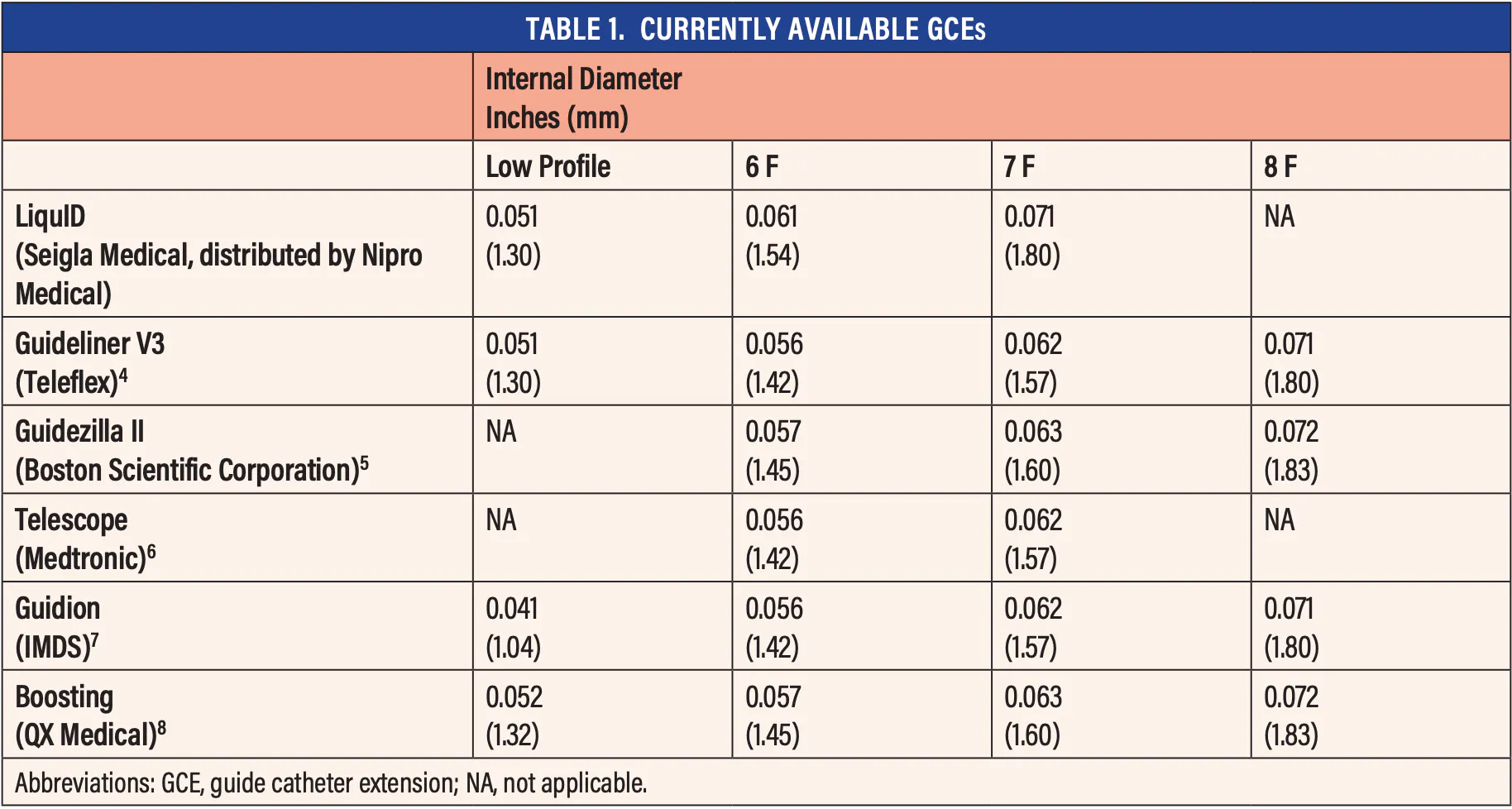
With further evolution of this technique, a specific rapid-exchange catheter was developed: the GuideLiner GC extension (GCE) by Vascular Solutions (now Teleflex).3 This progression is precisely analogous to the progression from over-the-wire balloons and stents to rapid-exchange systems, allowing for better wire control to maintain access to the distal vessel with improved device delivery. Just as balloon catheters transitioned from having the wire lumen exit the catheter at the very proximal hub to partway down the shaft, so too did the GuideLiner truncate the “inner catheter” to only 20 cm, transitioning via a collar to a long pushrod that allowed for advancement from beyond the hemostatic valve at the GC proximal hub. Beyond the GuideLiner, the current era of GCEs offers many options for clinicians to choose from, some with significant differences (Table 1).4-8
TECHNIQUES FOR USE
A GCE is a unique tool that the operator can use to facilitate delivery using adjunctive balloon techniques. A coronary angioplasty balloon can apply the necessary hydraulic force to “clear the way,” and, in certain situations, provide a tether to “apply tension” when advancing through tortuosity and vessels with high plaque burden, including extreme calcium.
While use of GCEs may seem intuitive, there are several techniques that may help operators use them more effectively.
“Just Push”
The most common method of advancing a GCE is simply pushing it into the coronary artery over the coronary guidewire. Despite its near-ubiquitous use, pushing the GCE alone over a coronary guidewire can both hamper deliverability and increase the likelihood of GCE-associated complications. Owing to a combination of a significant gap between the sharp edge of the GCE and the wire and the bias toward the outer curvature of the vessel, the GCE will scrape along the (often diseased) lining of the coronary artery. This can easily lead to GCE-induced dissection. Better practice is consistently delivering the GCE over other equipment, such as a balloon catheter, which can keep the GCE off the vessel wall and allow for easier and safer distal delivery.
Anchoring
Often, GCEs have difficulty traversing down diseased or tortuous vessels, beyond just advancing over a balloon catheter. In such instances, using the balloon as a distal anchor can vastly improve deliverability.9,10 After advancing an appropriately sized balloon distally, the GCE is advanced while the balloon is inflated (Video 1). This technique may include gently pulling on the balloon catheter shaft to act as a “tether,” drawing the system toward the inner curve. This combines the advantage of keeping the GCE off the wall as mentioned previously, while offering the additional advantage of securing guide stability in having equipment fixed in location with the inflated balloon. The GCE can often be delivered as far as one wants and may be combined with the “inchworm” technique discussed next for even more distal delivery. After the GCE is delivered, stents may then be positioned appropriately with the GCE withdrawn proximal to the stent (“unsheathing” the stent).
Video 1. In this video, both the anchoring and inchworming techniques are demonstrated. A 2.5-mm balloon is inflated within a distal stent as an anchor, allowing easy delivery of the 6-F LiquID guide extension through tortuous previously placed stents. Once the LiquID reaches the proximal edge of the balloon, the balloon is deflated while simultaneously applying forward pressure on the LiquID, such that the LiquID is able to smoothly track over the deflating balloon for more distal placement.
Once the GCE is advanced into the vessel, especially distally, it is important to avoid contrast injections. Injecting directly into the smaller distal vessel, even if the pressure waveform “looks ok,” carries a significant risk of barotrauma, causing dissection and/or perforation. After stent positioning, it is advised to withdraw the GCE if angiography is warranted prior to deployment, or simply use previously obtained reference images to guide placement.
Balloon-Assisted Tracking (“Inchworm”)
An additional method used alternatively or in conjunction with anchoring is balloon-assisted tracking,11 sometimes colloquially referred to as “inchworming” due to the stepwise forward motion. Unlike anchoring, a balloon sized 1:1, or preferably larger, to the GCE lumen is advanced only immediately distal to the GCE, even if the balloon size is less than would otherwise be used in that portion of the vessel. After a brief balloon inflation, the GCE is advanced to, and forcibly pushed against, the proximal balloon edge. Upon deflation, additional forward pressure on the GCE is applied such that the GCE slides smoothly over the deflating balloon (Video 1). In doing this, the balloon is essentially acting as a collapsible dilator to clear the way, which can improve distal delivery both by keeping the GCE off the vessel wall and smoothly navigating areas of heavy disease or tortuosity. If one is unable to advance the GCE using this method, then a larger-size balloon often helps or even longer balloons that may allow the GCE to cover more distance tracking over a deflated balloon. Retracting the GCE and applying traction to the balloon as an anchor, biasing the system toward the inner curvature, and then advancing again and inchworming can also help overcome difficulties.
Wrap-Avoidance Protocol
Owing to a combination of pushrod stiffness, natural tortuosity in the path from femoral access to the coronary, and the sequential grip and release of the pushrod during advancement, the rod itself inevitably twists as the GCE moves forward (Video 2). This results in the pushrod wrapping around the coronary guidewire to greater or lesser extent (Video 2). Although balloons are often able to track over the wire wrap if not too severe, less pliable equipment (including stents) are unable to do so. This may result in the often-frustrating experience of being able to balloon but not stent through a distally delivered GCE.
Video 2. When a guide extension is advanced as usual, the forward push through natural large vessel tortuosity from peripheral access to the coronary causes rotation of the guide extension, easily seen by watching the proximal tab rotate. This results in the push rod wrapping around the guidewire, hampering equipment delivery. Note that while balloons may often track wire wrap and be deliverable (if wrap not too severe), stents are other stiffer equipment do not.
A simple preventive measure is the wrap-avoidance protocol (Video 3). A hemostat or similar device is clamped to the end tab. Prior to insertion through the hemostatic valve, the proximal collar is checked for orientation and wire wrap. If wire wrap is present, the wire is unwound prior to insertion. Operator preference determines if one should reorient the taper at the proximal end of the catheter, with the clamp rotated appropriately. It is often easier to have the taper opposite the operator, such that the rod and tab may be pushed away after insertion; if the tab is pushed opposite the taper, wire wrap may reoccur. As the GCE is advanced, the weight of the clamp maintains GCE orientation relative to the wire, preventing wire wrap.
Video 3. Using the wrap-avoidance protocol (WAP): a hemostat is clamped on the proximal tab, which prevents rotation of the guide extension during advancement. Using WAP ensures appropriate orientation of the guide extension, avoiding wire wrap, and allowing for easier equipment delivery and use of the guide catheter extension as intended.
WHAT FITS?
The two questions every operator asks about GCEs are: How deliverable is it, and what can fit in it? While deliverability is a factor of material composition, including flexibility and lubricity, using the above techniques will enable any operator to deliver essentially any GCE to the intended location, limited only by vessel anatomy (especially calcification/compliance and degree of untreated obstruction).
A general rule for “what fits” is the “minus 1” principle: a GCE typically accommodates the equipment used with a GC that is 1 F smaller. For example, a 6-F GCE generally supports the equipment used with a 5-F GC (ie, typically one coronary guidewire and one balloon or stent catheter). The exception to this is the LiquID GCE series (Figure 1), which has wall thickness nearly half that of other GCEs, and thus it can generally fit equipment directly correlating to GC size (ie, a 6-F LiquID allows for the equipment burden of a 6-F GC). However, I should note that the “minus 1” rule does apply to the lower-profile 6-F LiquID LP, which is tapered and designed for more flexibility. Table 1 summarizes differences in sizing among currently available GCEs. Figure 1 provides a guide to equipment compatibility in LiquID guide extensions.
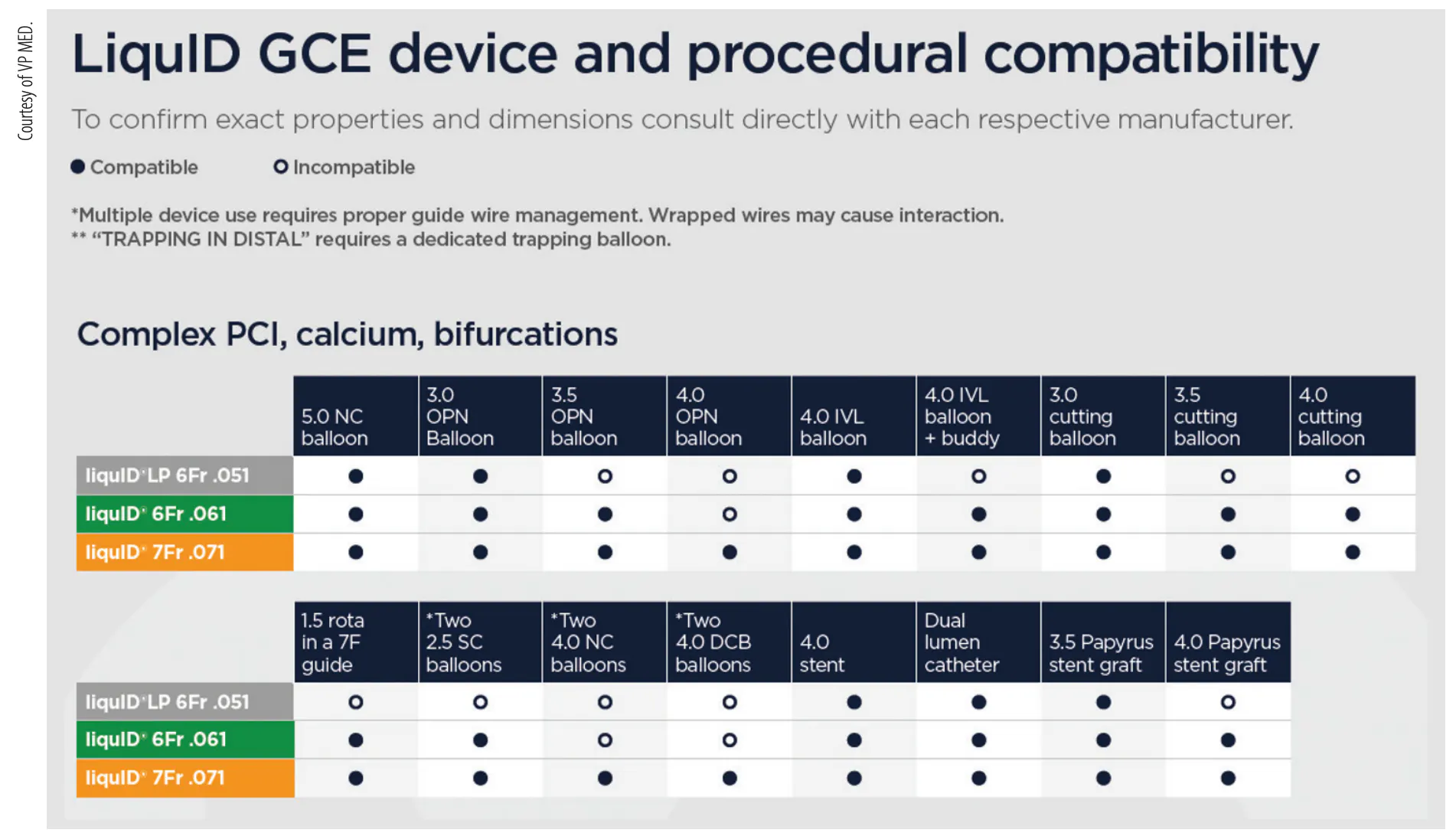
Figure 1. A guide to equipment compatibility in LiquID GCEs. DCB, drug-coated balloon; IVL, intravascular lithotripsy; NC, noncompliant; SC, semicompliant.
CONCLUSION
The development and continued evolution of GCEs represented a huge leap toward completion of ever more complex PCIs. Although significant differences exist among modern options, among their use are basic techniques that can easily decrease frustration and increase operator success.
1. Takahashi S, Saito S, Tanaka S, et al. New method to increase a backup support of a 6 French guiding coronary catheter. Catheter Cardiovasc Interv. 2004;63:452-456. doi: 10.1002/ccd.20223
2. Mamas MA, Fath-Ordoubadi F, Fraser D. Successful use of the Heartrail III catheter as a stent delivery catheter following failure of conventional techniques. Catheter Cardiovasc Interv. 2008;71:358-363. doi: 10.1002/ccd.21395
3. Mamas MA, Fath-Ordoubadi F, Fraser DG. Distal stent delivery with GuideLiner catheter: first in man experience. Catheter Cardiovasc Interv. 2010;76:102-111. doi: 10.1002/ccd.22458
4. Teleflex Incorporated. Beyond tried. True. GuideLiner® V3 Catheter. Accessed April 29, 2026. https://www.teleflex.com/usa/en/product-areas/interventional/coronary-interventions/guide-extensioncatheters/guideliner-v3-catheter/GuideLiner-Product-Brochure-MC-003856-Rev-0.1.pdf
5. Boston Scientific. GUIDEZILLA™ II guide extension catheter indications. Accessed April 29, 2026. https://www.bostonscientific.com/en-US/products/catheters--guide/guidezilla-II-guide-extension-catheter/guidezilla-II-indications-safety-and-warnings.html
6. Medtronic. Telescope™ guide extension catheter. Accessed April 29, 2026. https://www.medtronic.com/en-us/healthcare-professionals/products/cardiovascular/coronary-catheters/telescope-guide-extension-catheter.html
7. IMDS. Guidion Hydro. Accessed April 29, 2026. https://imds.nl/guidion-hydro-rapid-exchange-guideextension/
8. QXMédical. Boosting catheter guide extension. Accessed April 29, 2026. https://www.qxmedical.com/products/boosting-catheter
9. Andreou C, Karalis I, Maniotis C, et al. Guide extension catheter stepwise advancement facilitated by repeated distal balloon anchoring. Cardiovasc Revasc Med. 2017;18:66-69. doi: 10.1016/j.carrev.2016.07.010
10. Chen L, Cheng Y, Yang Y, et al. A simple practical balloon anchoring technique within the guide catheter for chronic total occlusion (CTO) of the coronary artery. J Biomed Res. 2015;29:423-425. doi: 10.7555/JBR.29.20150068
11. Elbarouni B, Moussa M, Kass M, et al. GuideLiner balloon assisted tracking (GBAT): a new addition to the interventional toolbox. Case Rep Cardiol. 2016;2016:6715630. doi: 10.1155/2016/6715630

Advertisement
Advertisement