Advertisement
Advertisement
March/April 2026
The Cath Lab Cliff: A Warning Sign of a System in Fracture
Workforce shortages, complex demographics, and shrinking volumes signal a pivotal moment for the interventional cardiology workforce pipeline and an opportunity to redefine its future.
Nearly 50 years ago in Zurich, Switzerland, Dr. Andreas Gruentzig performed the first coronary angioplasty on a conscious human patient. In doing so, he forever altered the role of the cardiologist in treating heart and vascular disease. Since that defining moment, clinical innovation has been breathtaking, moving from balloons to drug-eluting stents and now the explosive growth of structural heart interventions.
However, as is typical in modern medicine, clinical innovation has far exceeded the administrative and infrastructural capacity needed to sustain it. We are now seeing one of many cracks forming in the foundation of our health care system. If left unaddressed, the consequences for patient care may be irreparable.
THE MIRROR OF THE MATCH
For decades, interventional cardiology (IC) recruitment was characterized by “exploding offers” and a chaotic timeline that forced fellows to choose a career path before they had even mastered general cardiology. The implementation of the formal IC match, a massive effort led by the Society of Cardiovascular Angiography & Interventions (SCAI), was the long-overdue infrastructure upgrade we needed to bring fairness and equity to the process.1
Now that the mechanism is working, the match has revealed an unexpected problem: a shrinking pipeline. The 2025 match results for the 2026 academic year were a wake-up call. Despite a 97% match rate among applicants, 71 positions across 49 programs remained unfilled—evidence that training capacity is exceeding the number of physicians willing to train.2
A DEMOGRAPHIC COLLISION COURSE
This pipeline shortage is colliding with a demographic reality we can no longer ignore. We have more patients requiring complex cardiac care than we have practicing cardiologists to treat them. This deficit is calculated before accounting for the fact that about 25% of currently practicing cardiologists are aged > 61 years and on the verge of slowdown and/or retirement.3 An analysis of data from MedAxiom members and the Accreditation Council for Graduate Medical Education found that the United States health care system is losing approximately 500 cardiology full-time equivalents (FTEs) per year (Table 1).4
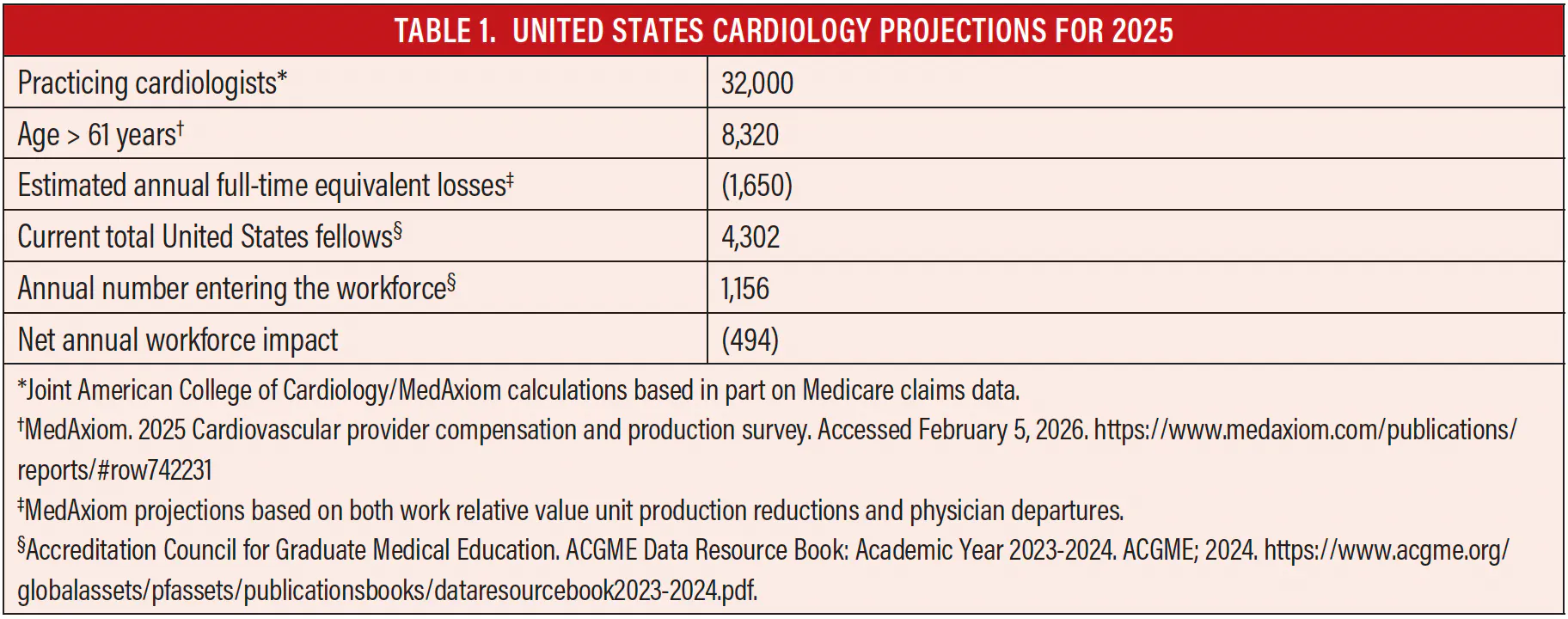
As this quarter of the workforce exits, they leave behind a patient population that is simultaneously aging and growing in complexity. We are not just failing to grow; we are actively shrinking while the “silver tsunami” of heart disease reaches its peak.
THE FINANCIAL DISINCENTIVE: IS TRAINING STILL WORTH IT?
We must also confront a new and uncomfortable financial reality. In the past few years, the salaries for general cardiologists have increased substantially, narrowing the gap between those who stop after 3 years of fellowship and those who pursue the rigors of interventional and structural training. We have reached a point where we must ask: Have we made it financially “not worth it” to pursue the extra year(s) of high-stress training?
MedAxiom data show that at the median total compensation for integrated physicians, which now includes most cardiologists, a full-time interventional cardiologist has earned from 16% to 23% more than a full-time general/noninvasive physician over the last 10 years.3 In 2024, the median total compensation for a full-time integrated general noninvasive cardiologist was $678,439. By comparison, the median total compensation for a full-time integrated interventional cardiologist was $803,766, a difference of $125,327 per year. When the return on investment—measured in both dollars and years of life—dwindles, the incentive to take on the added liability and physical toll of the cath lab evaporates. For many, perhaps the math simply doesn’t add up anymore.
The value of a new cardiologist has risen dramatically over the past decade. The median compensation for a new cardiologist jumped from $214,000 in 2014 to $586,769 in 2024.3 This means that a first- or second-year cardiologist is now earning 92% of the overall median, the narrowest delta ever recorded by MedAxiom.
Perhaps part of the story is the reduction in interventional volumes on a per capita population basis. MedAxiom data show that catheterization volumes per 1,000 active cardiology patients decreased from a median of 75 in 2018 to 60 in 2024, representing a 20% reduction.3 In other words, for a program to reach a volume of 1,000 catheterizations in 2018, it would have had to manage a population of 13,300 cardiology patients. To achieve 1,000 catheterizations in 2024 requires nearly 17,000 active patients.
Likewise, percutaneous coronary interventions (PCIs) decreased from a median of 31 per 1,000 active cardiology patients in 2018 to 22 in 2024.3 These procedural reductions are real and may be in the minds of medical students as they contemplate their futures.
A FRAGILE ECOSYSTEM AND THE RIPPLE EFFECT
To view fellows simply as “learners” ignores the reality that they are essential engines of the workforce. Our hospital systems have built their efficiency on the assumption of a full fellowship roster. When those spots go empty, the work doesn’t disappear—it shifts.
This creates a systemic ripple effect. The absence of fellows forces attending physicians to absorb frontline logistical and clinical burdens, eroding the “seamless system” we strive to maintain. This creates a vicious cycle. As the remaining workforce is stretched to the breaking point, the educational environment suffers. The palpable burnout among mentors serves as a grim advertisement to potential applicants, poisoning the pipeline for years to come.
THE RURAL ACCESS CRISIS
The consequences of this fracture are most acute in rural and underserved communities. Although national PCI volumes have shifted, the burden of “the call” has not. Rural programs must staff for the ST-segment elevation myocardial infarction (STEMI) call burden, ensuring 24/7 coverage for emergency heart attacks, not necessarily for total case volume. When a program fails to fill a slot, that coverage burden falls on an already stretched faculty member, making local care increasingly unsustainable.
Furthermore, the backbone of United States rural cardiovascular care has long relied on international medical graduates fulfilling visa requirements (such as the J-1 Visa Waiver) in underserved areas. However, current immigration policies have caused many international medical students to reconsider coming to the United States for training. This creates an additional external obstacle. We are losing a primary source of labor for the very communities that need it most. We are looking at a future where geography determines your survival of a MI, as specialized care retreats into urban hubs.
THE GATEWAY TO AN UNFIXABLE CRISIS
If the interventional pipeline dries up, the structural heart pipeline evaporates with it. We are facing a supply-demand mismatch that suggests we are heading toward a workforce cliff. This isn’t isolated to the cath lab. Heart failure, another specialty critical to our aging population, also failed to fill its training slots.5 We are looking at a future where we have the technology to save lives but no one left to operate it.
THE PERSISTENCE OF DETERRENCE AND THE GENERATIONAL SHIFT
For years, the literature has cited tangible “quality-of-life” concerns, radiation, orthopedic strain, and the relentless STEMI pager. The paradox is that these obstacles have always existed. However, we are now meeting a new generation of physicians who strive for a different work-life balance and operate under a different work ethic than the pioneers of the field.
The “old deal” of sacrificing one’s body and time for the glory of the lab is no longer a viable trade for the modern trainee. This creates a hidden math problem for programs. A retiring 1.0 FTE physician is not equivalent to a 1.0 new hire. Where a retiring interventionalist might have shouldered a heavier workload by modern standards, the new generation is rightfully demanding a sustainable 1.0. This means that even if we replace every retiree one-for-one, we are still losing ground.
IS THE DAMAGE REVERSIBLE?
We cannot let the 50th anniversary of Gruentzig’s breakthrough mark the beginning of a permanent decline. Organizations like SCAI are pivoting to “fix the job” by modernizing radiation protection and promoting wellness.
We must be honest; this is a crack in a much larger levee. If we don’t address the structural burnout, lifestyle imbalance, and physical toll, we aren’t just looking at empty fellowship desks. We are looking at a future where the patient Gruentzig sought to save has no one left to answer the call. The bridge to the next 50 years of innovation must be built now, or we may find the gap is too wide to close.
1. Drachman DE, Addo T, Applegate RJ, et al. The path to a match for interventional cardiology fellowship: a major SCAI initiative. J Soc Cardiovasc Angiogr Interv. 2024;3:101980. doi: 10.1016/j.jscai.2024.101980
2. Mathewes F. Cardiologists react to specialty’s unfilled residency slots. Becker’s ASC Review. December 18, 2025. Accessed February 5, 2026. https://www.beckersasc.com/cardiology/cardiologists-react-to-specialtys-unfilled-residency-slots/
3. MedAxiom. 2025 Cardiovascular provider compensation and production survey. Accessed February 5, 2026. https://www.medaxiom.com/publications/reports/#row742231
4. Accreditation Council for Graduate Medical Education. ACGME Data Resource Book: Academic Year 2023-2024. ACGME; 2024. https://www.acgme.org/globalassets/pfassets/publicationsbooks/dataresourcebook2023-2024.pdf.
5. Golob S. For the FITs | heart failure fellowship and the failure of recruitment. American College of Cardiology. June 1, 2025. Accessed February 5, 2026. https://www.acc.org/Latest-in-Cardiology/Articles/2025/06/01/01/For-the-FITs-Heart-Failure-Fellowship
Advertisement
Advertisement
Interested in reading more interviews?
To read more interviews with thought leaders in the interventional cardiology field, check out our Profiles & Perspectives hub.
Read More