Advertisement
Advertisement
July/August 2026
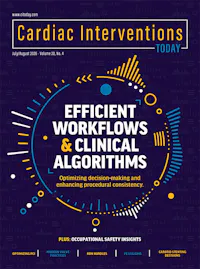
Efficient Workflows & Clinical Algorithms

In recent years, health systems across the country have faced increasing challenges regarding access to care, operational throughput, resource allocation, and workforce needs. In an aging United States population, there are greater demands for advanced cardiovascular care, including complex coronary, vascular, and structural heart disease therapies. Hospital and physician leaders are often tasked with finding ways to optimize efficiency using limited resources, while also trying to preserve both high-quality outcomes and fiscal solvency. This issue of Cardiac Interventions Today highlights these key health system issues, featuring perspectives and innovative approaches from interventional cardiology physicians across the country.
Rhian Davies, MD; Alexander Fanaroff, MD; and Jennifer Rymer, MD, kick us off with a conversation on percutaneous coronary intervention workflows, highlighting how intravascular imaging, coronary physiology, artificial intelligence, and individualized treatment strategies are improving procedural planning and execution.
Then, Mazen Albaghdadi, MD, and Natalia C. Berry, MD, examine how leading programs are optimizing imaging, patient evaluation, multidisciplinary collaboration, and procedural efficiency across aortic, mitral, and tricuspid interventions.
Yousif Ahmad, MBBS; Tara L. Jones, MD; Dhaval S. Kolte, MD; and John T. Saxon, MD, follow with a panel on minimalist transcatheter aortic valve replacement (TAVR). They consider how streamlined workflows, selective sedation, and multidisciplinary care can improve efficiency while maintaining excellent patient outcomes within a minimalist pathway.
In a piece on renal denervation (RDN), Sundeep Kumar, MD; Jun Li, MD; Jay Giri, MD; and Eric A. Secemsky, MD, summarize practical challenges of referral development, patient selection, reimbursement, and physician education and share solutions for a successful RDN program.
Next, Andrew J. P. Klein, MD; Sanjum S. Sethi, MD, MPH; and Catalin Toma, MD, highlight common barriers to timely treatment along the pulmonary embolism (PE) patient journey and how to overcome them, including pulmonary embolism response team (PERT) activation, timely anticoagulation, and emerging clinical evidence.
Finally, J. Antonio Gutierrez, MD, and Sameh Sayfo, MD, review practical decision-making across carotid endarterectomy, transfemoral carotid stenting, transcarotid artery revascularization, and optimal medical therapy. They stress the importance of multidisciplinary collaboration, shared decision-making, and standardized follow-up to optimize periprocedural and long-term outcomes.
Elsewhere in this issue, we explore the ins and outs of radiation safety. First, Amit N. Vora, MD, shares insights into ALARA+ (as low and light as reasonably achievable), a collaborative, multisociety approach to radiation safety that focuses on not only dose reduction but also orthopedic strain and long-term occupational risk. Then, Mina S. Makary, MD, and Giorgio A. Medranda, MD, discuss their perspectives on the steps needed to translate awareness of radiation and musculoskeletal risks into action. Finally, an interview with physicist Ehsan Samei, PhD, provides advice on what clinicians should know about exposure, risk, and protection in the catheterization laboratory.
In our Today’s Practice column, Denise Busman, MSN, walks us through prioritizing radiation safety in the cath lab and building a sustainable program using planning, technology, real-time monitoring, and team-based safety practices.
We close this issue by interviewing Jesse Kane, MD, who discusses simulation-based training for interventional cardiology, innovation in complex PCI and CTO, and the importance of team growth and development in the cath lab.
This edition of Cardiac Interventions Today offers pragmatic insights and operational strategies—spanning the field of interventional cardiology—that can be employed at both a service line and individual physician level. From honing minimalist TAVR to optimizing PERT systems of care to refining RDN referral pathways, these are just a few programmatic examples by which regional patient care can be impacted at scale. Furthermore, this issue emphasizes the need to embrace forward-thinking innovation, whether it is artificial intelligence to relieve documentation burdens or radiation safety technologies to promote workforce sustainability. As such, service line leaders, physicians, and allied health providers can be empowered to deliver first-in-class care to patients of all backgrounds, unencumbered by rising economic, workforce, and resource limitations.
Michael N. Young, MD
Guest Chief Medical Editor
Advertisement
Advertisement