Advertisement
Advertisement
2026 Digital Exclusive No. 2
Device-Based Neuromodulation in Heart Failure: Who Benefits and When?
New and emerging options aim to meet persistent unmet needs in heart failure.
By Yusra Minahil Nasir, MD; Khawaja Hassan Akhtar, MD; and Mohit Pahuja, MD, FACC, FSCAI
Despite recent advances in guideline-directed medical therapy (GDMT), patients with heart failure (HF) experience impaired quality of life (QOL), recurrent hospitalization, and high mortality. Even among patients receiving quadruple therapy, many continue to experience persistent symptoms and ventricular dysfunction.1,2
HF is associated with chronic sympathetic nervous system activation and parasympathetic downregulation, resulting in neurohormonal dysfunction, ventricular remodeling, and worsening circulatory failure.3,4 Although conventional therapies such as β-blockers and renin-angiotensin-aldosterone system inhibitors partially counter these pathways, residual autonomic imbalance leads to poor outcomes in these patients.5
Device-based neuromodulation therapies aim to restore autonomic balance through modulation of sympathetic and parasympathetic activity. Several technologies have emerged recently, ranging from baroreflex activation therapy (BAT) and cardiac contractility modulation (CCM) to vagus nerve stimulation (VNS), splanchnic nerve modulation (SNM), and renal denervation (RDN).6 Recent advances in device-based neuromodulation may represent an important frontier in HF management, particularly for patients who remain limited despite medical therapy.
CURRENT NEUROMODULATION THERAPIES
Baroreflex Activation Therapy
Among currently available neuromodulation therapies, BAT remains the only neuromodulation therapy approved by the United States FDA for use in HF.7 BAT functions through stimulation of carotid sinus baroreceptors, leading to suppression of sympathetic outflow and upregulation of parasympathetic activity. Downstream effects include reduced neurohormonal activation and improved vascular tone.8,9
The commercially available system (Barostim, CVRx, Inc.) consists of a unilateral carotid sinus lead connected to a pulse generator implanted in the infraclavicular region. Compared with earlier bilateral systems, newer-generation devices are less invasive and have demonstrated favorable safety profiles.8 In a proof-of-concept study by Gronda et al, BAT was associated with improvement in New York Heart Association (NYHA) functional class, QOL, 6-minute walk distance (6MWD), and left ventricular ejection fraction (LVEF), along with reduction in muscle sympathetic nerve activity.10
The HOPE4HF trial randomized patients with HF with reduced ejection fraction (HFrEF) and NYHA class III symptoms to BAT plus GDMT versus GDMT alone. BAT demonstrated significant improvements in QOL, 6MWD, and serum N-terminal pro–B-type natriuretic peptide (NT-proBNP) levels.11 Similar findings were observed in the BeAT-HF trial, which enrolled patients with NYHA class II or III HFrEF who were not candidates for cardiac resynchronization therapy (CRT). BAT significantly improved exercise capacity and QOL, while reducing NT-proBNP levels.12
Furthermore, subsequent analyses have shown that the greatest benefit of BAT may occur in patients with persistent symptoms despite GDMT who are not receiving CRT and have NT-proBNP levels < 1,600 pg/mL.13 These findings highlight practical implications for patient selection.
From a clinical perspective, the ideal BAT candidate may include:
- Symptomatic HFrEF despite optimal GDMT
- NYHA class III symptoms
- Ineligibility for CRT
- Persistent exercise intolerance and impaired QOL
Studies on BAT suggest that it is successful in improving QOL and functional capacity rather than reducing mortality. Nevertheless, the consistent improvement in QOL makes BAT particularly appealing for advanced HF patients with persistent symptoms despite conventional therapy.14
Cardiac Contractility Modulation
CCM is a device-based neuromodulation therapy for HFrEF patients who remain symptomatic despite optimal medical therapy, particularly those with narrow QRS complexes who are not candidates for CRT.
The CCM Optimizer Smart system (Impulse Dynamics) delivers biphasic electrical impulses during the absolute refractory period, enhancing calcium handling and myocardial contractility without initiating a new depolarization.15
Clinical studies on CCM have demonstrated improvements in exercise tolerance, QOL, peak oxygen consumption, and NYHA functional class among appropriately selected patients.16 The FIX-HF-5 trial and subsequent analyses suggested that patients with LVEF between 25% and 45% and persistent symptoms despite GDMT derive the greatest benefit from CCM therapy.17
CCM represents a unique therapeutic modality in modern HF management. Many patients with symptomatic HFrEF have a narrow QRS interval and therefore do not qualify for conventional CRT despite life-limiting symptoms. CCM provides a therapeutic option for this important patient population.
Potential candidates for CCM include:
- NYHA class III symptoms despite GDMT
- LVEF of approximately 25% to 45%
- Narrow QRS interval (noncandidates for CRT)
- Persistent limiting symptoms
Although the long-term mortality benefit remains uncertain, CCM carries the potential to provide improvement in symptoms and functional status in carefully selected patients.17
NEUROMODULATION THERAPIES AT A GLANCE
Baroreflex Activation Therapy
Carotid baroreceptor stimulation to reduce sympathetic outflow and increase vagal activity
Cardiac Contractility Modulation
Improves myocardial contractility without initiating depolarization
Splanchnic Nerve Modulation
Modifies splanchnic sympathetic tone to reduce stressed blood volume and congestion
Renal Denervation
Catheter-based ablation of renal sympathetic nerves to reduce global sympathetic activity
Low-Level Tragus Stimulation/Vagal Modulation
Noninvasive vagal stimulation to improve autonomic balance
Therapeutic Goal
Restore autonomic balance, improve functional capacity and quality of life, and reduce HF hospitalizations.
EMERGING NEUROMODULATION THERAPIES
Vagus Nerve Stimulation
VNS aims to restore autonomic balance by increasing parasympathetic activity and reducing sympathetic overactivation. Although preclinical studies have demonstrated improvement in ventricular remodeling and mortality, clinical trials have shown mixed results.18,19 NECTAR-HF and INOVATE-HF demonstrated improvements in QOL and NYHA functional class but failed to show consistent reductions in hard clinical outcomes.20,21 Differences in stimulation protocols and device programming may partially explain the variability in outcomes observed across studies.
Although VNS remains an investigational therapy in HF management, interest persists because of its favorable effects on autonomic regulation and systemic inflammation.6
Splanchnic Nerve Modulation
SNM has emerged as a particularly promising strategy, especially in patients with HF with preserved ejection fraction (HFpEF). The splanchnic venous system serves as a major blood reservoir, and sympathetic-mediated vasoconstriction can rapidly shift blood into the central venous system, increasing intracardiac filling pressures.22
Early studies evaluating temporary or permanent greater splanchnic nerve blockade demonstrated reductions in pulmonary capillary wedge pressure (PCWP) and improvements in symptoms and QOL.23-25 Preliminary findings from the REBALANCE-HF study have also been encouraging.26
Because elevated filling pressures during exertion are central to HFpEF pathophysiology, SNM may eventually become an important therapy for selected HFpEF patients with exercise-induced congestion.
Renal Denervation
RDN reduces sympathetic signaling through catheter-based ablation of renal sympathetic nerves. Although initially developed for resistant hypertension, RDN has been evaluated in HF patients because of the close interaction between the sympathetic nervous system and the renin-angiotensin-aldosterone system.27 Early studies have demonstrated favorable effects on serum NT-proBNP levels, functional capacity, and ventricular remodeling.28,29 However, evidence remains limited, and larger sham-controlled studies are needed before widespread adoption can be considered.
Low-Level Tragus Stimulation
Low-level tragus stimulation (LLTS) represents a noninvasive method of vagal neuromodulation. Small studies have demonstrated improvements in inflammatory markers, endothelial function, and myocardial strain parameters.30,31 Because LLTS is noninvasive and relatively inexpensive, it may eventually become an attractive adjunctive therapy if larger trials confirm clinical benefit.
WHICH PATIENTS MIGHT BENEFIT?
As the field evolves, careful patient selection is of paramount importance to provide maximum benefit of neuromodulation to HF patients. Not all HF phenotypes demonstrate the same degree of autonomic dysregulation and hemodynamic dysfunction.32
A practical framework for patient selection may include:
- BAT: Symptomatic HFrEF with persistent symptoms despite optimal medical therapy, particularly patients who are not candidates for CRT
- CCM: HFrEF patients with narrow QRS intervals and persistent symptoms despite optimal medical therapy
- SNM: HFpEF patients with exercise-induced elevation in filling pressures
- VNS/LLTS: Patients with autonomic dysfunction and inflammatory phenotypes
The future of neuromodulation will likely depend on appropriate patient selection, identifying phenotype-specific targets rather than applying therapies broadly across all HF populations (Figure 1).6,32
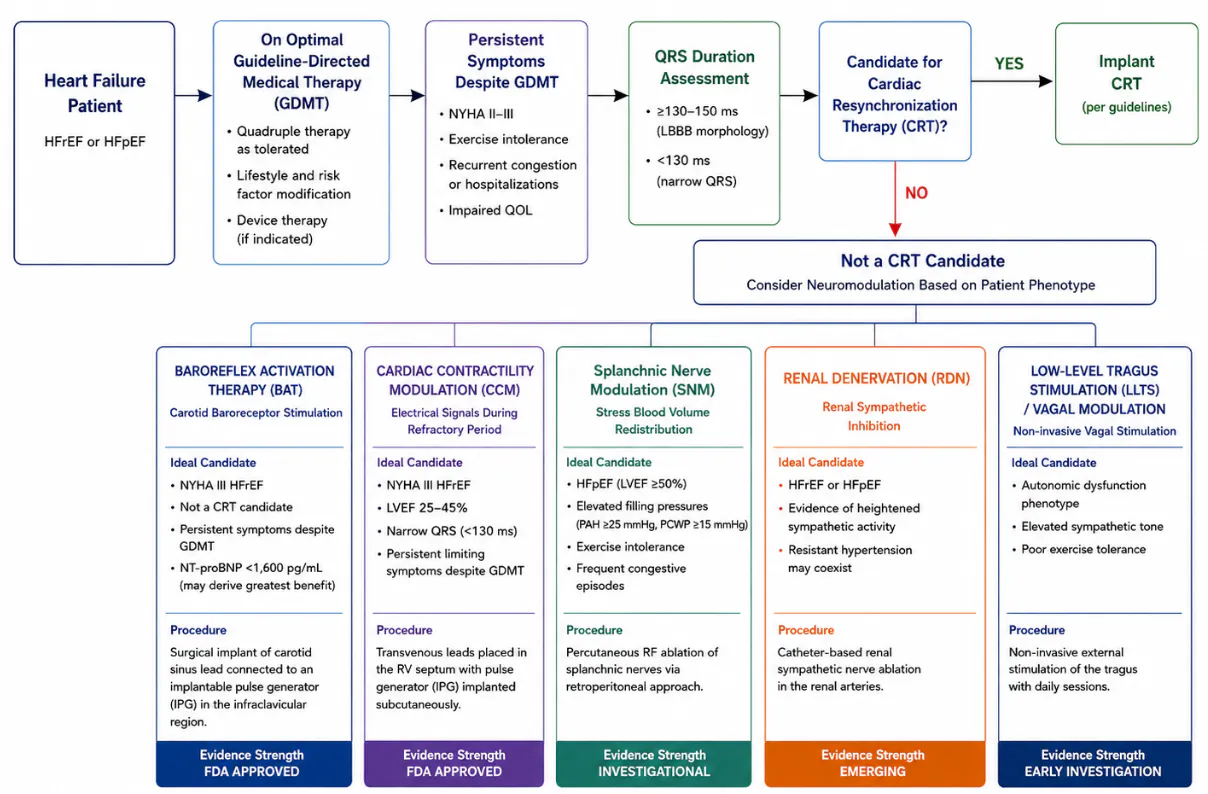
Figure 1. A patient selection and treatment pathway for neuromodulation in HF. Abbreviations: 6MWD, 6-minute walk distance; CPET, cardiopulmonary exercise testing; CRT, cardiac resynchronization therapy; GDMT, guideline-directed medical therapy; HF, heart failure; HFpEF, heart failure with preserved ejection fraction; HFrEF, heart failure with reduced ejection fraction; MCS, mechanical circulatory support; NT-proBNP, N-terminal pro-B-type natriuretic peptide; NYHA, New York Heart Association.
REMAINING CHALLENGES
Despite encouraging results of device-based neuromodulation, several important challenges remain. Most studies have demonstrated improvements in symptoms, exercise capacity, and QOL rather than reductions in mortality or HF hospitalization. Placebo effect and difficulties with sham-controlled trial design further limit the interpretation of existing data.6,14
Furthermore, HF itself represents a heterogeneous syndrome with multiple underlying phenotypes, making generalized treatment strategies difficult. Practical barriers, including procedural cost, device implantation expertise, reimbursement, and integration into existing HF treatment strategies, may also limit widespread adoption.
THE FUTURE OF NEUROMODULATION IN HF
Device-based neuromodulation represents a rapidly evolving frontier in HF management. Although BAT currently has the strongest evidence as well as regulatory approval, multiple emerging technologies continue to demonstrate promising physiologic and clinical signals.6,14
Future progress will likely depend on improved patient selection, invasive hemodynamic assessment, and optimization of stimulation protocols. As understanding of autonomic dysregulation in HF continues to evolve, neuromodulation therapies may become increasingly integrated into precision-based HF management.32
For now, the greatest opportunity appears to lie in carefully selected symptomatic patients who remain limited despite optimized GDMT and conventional device therapy. In these patients, neuromodulation may offer an important opportunity to improve functional status, exercise capacity, and QOL.
1. Heidenreich PA, Bozkurt B, Aguilar D, et al. 2022 AHA/ACC/HFSA guideline for the management of heart failure: a report of the American College of Cardiology/American Heart Association joint committee on clinical practice guidelines. Circulation. 2022;145:e895-e1032. doi: 10.1161/CIR.0000000000001063
2. McDonagh TA, Metra M, Adamo M, et al. 2021 ESC guidelines for the diagnosis and treatment of acute and chronic heart failure. Eur Heart J. 2021;42:3599-3726. doi: 10.1093/eurheartj/ehab368
3. Packer M. The neurohormonal hypothesis: a theory to explain the mechanism of disease progression in heart failure. J Am Coll Cardiol. 1992;20:248-254. doi: 10.1016/0735-1097(92)90167-L
4. Floras JS. Clinical aspects of sympathetic activation and parasympathetic withdrawal in heart failure. J Am Coll Cardiol. 1993;22:72A-84A. doi: 10.1016/0735-1097(93)90466-E
5. Goldsmith SR. Interactions between the sympathetic nervous system and the RAAS in heart failure. Curr Heart Fail Rep. 2004;1:45-50. doi: 10.1007/s11897-004-0024-5
6. Chatterjee NA, Singh JP. Novel interventional therapies to modulate autonomic tone in heart failure. JACC Heart Fail. 2015;3:786-802. doi: 10.1016/j.jchf.2015.05.008
7. Fudim M, Abraham WT, von Bardeleben RS, et al. Device therapy in chronic heart failure: JACC state-of-the-art review. J Am Coll Cardiol. 2021;78:931-956. doi: 10.1016/j.jacc.2021.06.040
8. Iliescu R, Tudorancea I, Lohmeier TE. Baroreflex activation: from mechanisms to therapy for cardiovascular disease. Curr Hypertens Rep. 2014;16:453. doi: 10.1007/s11906-014-0453-9
9. Halbach M, Fritz T, Madershahian N, et al. Baroreflex activation therapy in heart failure with reduced ejection fraction: available data and future perspective. Curr Heart Fail Rep. 2016;13:71-76. doi: 10.1007/s11897-016-0286-8
10. Gronda E, Seravalle G, Brambilla G, et al. Chronic baroreflex activation effects on sympathetic nerve traffic, baroreflex function, and cardiac haemodynamics in heart failure: a proof-of-concept study. Eur J Heart Fail. 2014;16:977-983. doi: 10.1002/ejhf.138
11. Abraham WT, Zile MR, Weaver FA, et al. Baroreflex activation therapy for the treatment of heart failure with a reduced ejection fraction. JACC Heart Fail. 2015;3:487-496. doi: 10.1016/j.jchf.2015.02.006
12. Zile MR, Lindenfeld J, Weaver FA, et al. Baroreflex activation therapy in patients with heart failure with reduced ejection fraction. J Am Coll Cardiol. 2020;76:1-13. doi: 10.1016/j.jacc.2020.05.015
13. Coats AJS, Abraham WT, Zile MR, et al. Baroreflex activation therapy with the Barostim device in patients with heart failure with reduced ejection fraction: a patient-level meta-analysis of randomized controlled trials. Eur J Heart Fail. 2022;24:1665-1673. doi: 10.1002/ejhf.2573
14. Schwartz PJ, La Rovere MT, De Ferrari GM, et al. Autonomic modulation for the management of patients with chronic heart failure. Circ Heart Fail. 2015;8:619-628. doi: 10.1161/CIRCHEARTFAILURE.114.001964
15. Borggrefe M, Burkhoff D. Clinical effects of cardiac contractility modulation (CCM) as a treatment for chronic heart failure. Eur J Heart Fail. 2012;14:703-712. doi: 10.1093/eurjhf/hfs078
16. Kadish A, Nademanee K, Volosin K, et al. A randomized controlled trial evaluating the safety and efficacy of cardiac contractility modulation in advanced heart failure. Am Heart J. 2011;161:329-337.e2. doi: 10.1016/j.ahj.2010.10.025
17. Abraham WT, Kuck KH, Goldsmith RL, et al. A randomized controlled trial to evaluate the safety and efficacy of cardiac contractility modulation. JACC Heart Fail. 2018;6:874-883. doi: 10.1016/j.jchf.2018.04.010
18. Li M, Zheng C, Sato T, et al. Vagal nerve stimulation markedly improves long-term survival after chronic heart failure in rats. Circulation. 2004;109:120-124. doi: 10.1161/01.CIR.0000105721.71640.DA
19. Zhang Y, Popovic ZB, Bibevski S, et al. Chronic vagus nerve stimulation improves autonomic control and attenuates systemic inflammation and heart failure progression in a canine model. Circ Heart Fail. 2009;2:692-699. doi: 10.1161/CIRCHEARTFAILURE.109.873968
20. Zannad F, De Ferrari GM, Tuinenburg AE, et al. Chronic vagal stimulation for the treatment of low ejection fraction heart failure: results of the NECTAR-HF randomized controlled trial. Eur Heart J. 2015;36:425-433. doi: 10.1093/eurheartj/ehu345
21. Gold MR, Van Veldhuisen DJ, Hauptman PJ, et al. Vagus nerve stimulation for the treatment of heart failure: the INOVATE-HF trial. J Am Coll Cardiol. 2016;68:149-158. doi: 10.1016/j.jacc.2016.03.525
22. Fudim M, Ponikowski PP, Burkhoff D, et al. Splanchnic nerve modulation in heart failure: mechanistic overview, initial clinical experience, and safety considerations. Eur J Heart Fail. 2021;23:1076-1084. doi: 10.1002/ejhf.2196
23. Fudim M, Ganesh A, Green C, et al. Splanchnic nerve block for decompensated chronic heart failure: splanchnic-HF. Eur Heart J. 2018;39:4255-4256. doi: 10.1093/eurheartj/ehy682
24. Fudim M, Boortz-Marx RL, Ganesh A, et al. Splanchnic nerve block for chronic heart failure. JACC Heart Fail. 2020;8:742-752. doi: 10.1016/j.jchf.2020.04.010
25. Málek F, Gajewski P, Zymliński R, et al. Surgical ablation of the right greater splanchnic nerve for the treatment of heart failure with preserved ejection fraction: first-in-human clinical trial. Eur J Heart Fail. 2021;23:1134-1143. doi: 10.1002/ejhf.2209
26. Fudim M, Fail PS, Litwin SE, et al. Endovascular ablation of the right greater splanchnic nerve in heart failure with preserved ejection fraction: early results of the REBALANCE-HF trial roll-in cohort. Eur J Heart Fail. 2022;24:1410-1414. doi: 10.1002/ejhf.2559
27. Böhm M, Ewen S, Kindermann I, et al. Renal denervation and heart failure. Eur J Heart Fail. 2014;16:608-613. doi: 10.1002/ejhf.83
28. Hopper I, Gronda E, Hoppe UC, et al. Sympathetic response and outcomes following renal denervation in patients with chronic heart failure: 12-month outcomes from the Symplicity HF feasibility study. J Card Fail. 2017;23:702-707. doi: 10.1016/j.cardfail.2017.06.004
29. Gao JQ, Yang W, Liu ZJ. Percutaneous renal artery denervation in patients with chronic systolic heart failure: a randomized controlled trial. Cardiol J. 2019;26:503-510. doi: 10.5603/CJ.a2018.0028
30. Dasari TW, Csipo T, Amil F, et al. Effects of low-level tragus stimulation on endothelial function in heart failure with reduced ejection fraction. J Card Fail. 2021;27:568-576. doi: 10.1016/j.cardfail.2020.12.017
31. Stavrakis S, Elkholey K, Morris L, et al. Neuromodulation of inflammation to treat heart failure with preserved ejection fraction: a pilot randomized clinical trial. J Am Heart Assoc. 2022;11:e023582. doi: 10.1161/JAHA.121.023582
32. Pahuja M, Akhtar KH, Krishan S, et al. Neuromodulation therapies in heart failure: a state-of-the-art review. J Soc Cardiovasc Angiogr Interv. 2023;2:101199. doi: 10.1016/j.jscai.2023.101199
Advertisement
Advertisement

Latest Digital Exclusives