Advertisement
Advertisement
September/October 2025
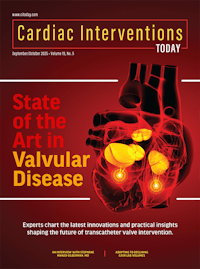
State of the Art in Valvular Disease


As interventional cardiology enters its next chapter, nowhere is the momentum and maturity more evident than in structural valvular heart disease. Over the past 2 decades, ingenuity in device design and clinical trial rigor established the safety and efficacy of transcatheter approaches. Today, the frontier has shifted. The field has moved from proving concepts to refining techniques; from treating prototypical anatomies to tailoring solutions for complex variants; and from episodic procedural success to durable, patient-centered outcomes across the continuum of care. This issue of Cardiac Interventions Today surveys the state of the art in 2025—highlighting practical strategies, multidisciplinary workflows, and the nuanced decision-making that elevates structural interventions from “possible” to “predictable.”
To open the issue, we feature a discussion on performing transcatheter aortic valve replacement (TAVR) in challenging anatomies and complex scenarios, including bicuspid aortic valves, valve-in-valve procedures, and small aortic annuli. Toby Rogers, MD; Hemal Gada, MD; Gilbert Tang, MD; Christopher Bruce, MD; and Jeremy D. Rier, MD, tackle this topic in a Q&A format and short case presentation.
Transitioning from the aortic to the mitral valve, Nodari Maisuradze, MD; Nikoloz Shekiladze, MD; John C. Lisko, MD; and George S. Hanzel, MD, provide a comprehensive overview of transcatheter mitral valve repair and replacement technologies, including procedural considerations, trial data, and future directions. Building on this discussion, Sachin S. Goel, MD; Anita W. Asgar, MD; Himanshu Agarwal, MD; and Anu Tununguntla, MD, dive into functional and degenerative mitral regurgitation and its key challenges, from patient screening and imaging to procedural complications and postprocedural care.
Shifting to the tricuspid realm, Dhiran Verghese, MD; Ada C. Stefanescu Schmidt, MD; and Dhaval Kolte, MD, walk us through the rapidly evolving field of transcatheter tricuspid valve therapies, highlighting current device data and clinical outcomes for repair and replacement devices, criteria for patient and device selection, and insights into tricuspid regurgitation assessment.
Continuing this theme, a discussion with Mackram F. Eleid, MD; James McCabe, MD; Firas Zahr, MD; Sameer Gafoor, MD; and Molly Szerlip, MD, then distills lessons on building a tricuspid intervention program. These early adopters share tips on building a collaborative, multidisciplinary team structure, targeted imaging and procedural training, developing a referral network, and navigating reimbursement and workflow challenges.
In our Today’s Practice column, Joel Sauer, MBA, analyzes the decline in cath lab volumes and emphasizes the importance of cardiology programs to adapt to deliver high-quality, patient-centered intervention while maintaining sustainable economic growth.
Finally, we close this issue with an interview with Stephane Manzo-Silberman, MD, who discusses her core interests of coronary artery disease in women and cardiogenic shock, her role as Chair of the EAPCI Patient Advocacy Committee, barriers deterring women entering the interventional cardiology field, and more.
The collective expertise in these pages underscores how far the field has come—and how thoughtfully it is evolving. Our contributors translate evidence into execution, offering concrete approaches for patient selection, imaging-guided planning, intraprocedural decision-making, and longitudinal follow-up. As cath lab volumes shift and reimbursement landscapes change, sustaining excellence will require disciplined quality metrics, durable training pathways, value-conscious adoption, and a steadfast commitment to equity and access. A vibrant discipline is one that harnesses the full talent of its community; addressing the barriers faced by women and other underrepresented groups is not ancillary to progress—it is essential to it.
Looking ahead, the priorities are clear: Deepen multidisciplinary collaboration, integrate advanced imaging and computational tools to better predict risk and optimize device selection, generate robust long-term outcomes data that reflect real-world complexity, and invest in team-based training that elevates consistency and safety across centers. If we remain focused on technical mastery, evidence-driven practice, and inclusive teamwork, structural heart interventions will continue to expand safely and responsibly, bringing transformative therapies to patients who need them most.
Triston Smith, MD, MGM
Ranya Sweis, MD, MSc
Guest Chief Medical Editors
Advertisement
Advertisement