Advertisement
Advertisement
May/June 2025
The State of Reimbursement for Renal Denervation in the United States
As renal denervation is adopted across the United States for patients with uncontrolled or resistant hypertension, the dubious state of reimbursement presents a barrier to both health systems and patients seeking the procedure.
By Catherine Vanchiere, MD, MA; Tayyab Shah, MD; Debbie L. Cohen, MD; Jay Giri, MD, MPH; Brian Fulton, MD; and Taisei Kobayashi, MD
Hypertension (HTN) remains a highly prevalent and highly morbid diagnosis in the United States, affecting close to 120 million adults. Nearly half of these individuals meet criteria for refractory or uncontrolled HTN, which over time has lasting effects on multiple organ systems, leading to increased health care burden and cost.1 Renal denervation (RDN), a catheter-based procedure for treating HTN, has the potential to improve individual patient health as well as population-level morbidity and mortality. Conceptually, RDN uses one of several different treatment modalities to target and destroy the sympathetic nerves surrounding the renal arteries, leading to reduction in blood pressure.2 These reductions in blood pressure have been associated with lower rates of stroke, myocardial infarction, and all-cause mortality.3-14
Despite encouraging clinical data, growing familiarity among interventional cardiologists, and multiple catheter options on the market, RDN has been adopted slowly across the country. This is due in part to the uncertain financial landscape associated with the procedure. The state of reimbursement for RDN currently hangs in a delicate balance, with important implications for the eventual accessibility of the procedure.
FDA APPROVAL
In November of 2023, the United States FDA approved RDN for patients with uncontrolled HTN. There are two systems approved for use: the Symplicity Spyral system (Medtronic) and the Paradise system (Recor Medical).15,16 These two systems differ in the modality used to deliver heat energy, using radiofrequency and ultrasound, respectively, for destruction of nerve tissue.4,6,17 Of note, the FDA’s instructions for use for both devices are the same, stating, “[RDN] is indicated to reduce blood pressure as an adjunctive treatment in patients with hypertension in whom lifestyle modifications and antihypertensive medications do not adequately control blood pressure.”15,16 This broad language allows for maximal flexibility in utilizing this paradigm-shifting technology to treat hundreds of millions of Americans.
CPT CODE ASSIGNMENT
The FDA is primarily focused on the clinical efficacy and safety of emerging technologies in their considerations for approval. They do not participate in any decisions on payment structures. Payment for emerging technologies is complex and there are multiple participating entities, starting with the American Medical Association (AMA), which assigns Current Procedural Technology (CPT) billing codes to categorize clinician work in relative value units (RVUs) (Table 1). RVUs are considered but not directly linked to payment. At present, RDN is associated with temporary category III CPT codes 0338T (unilateral) and 0339T (bilateral). Category III codes are assigned to track the use of emerging and experimental technologies before assignment of a permanent category I CPT code. The current RDN CPT codes map to a Centers for Medicare & Medicaid Services (CMS) level 2 endovascular procedure Ambulatory Payment Classification (APC) code that reimburses an average unadjusted rate of around $5,500. This is meager in comparison to the direct costs of the consumable product (catheter) and the capital investment (generator) required to perform RDN with both devices. At present, additional Healthcare Common Procedure Coding System (HCPCS) codes have been designated by CMS to delineate radiofrequency (C1735) versus ultrasound (C1736) modalities for performing renal denervation. These codes can be utilized for payers to process claims related to the procedures and are a departure from the device-agnostic language used in the CPT coding for RDN.
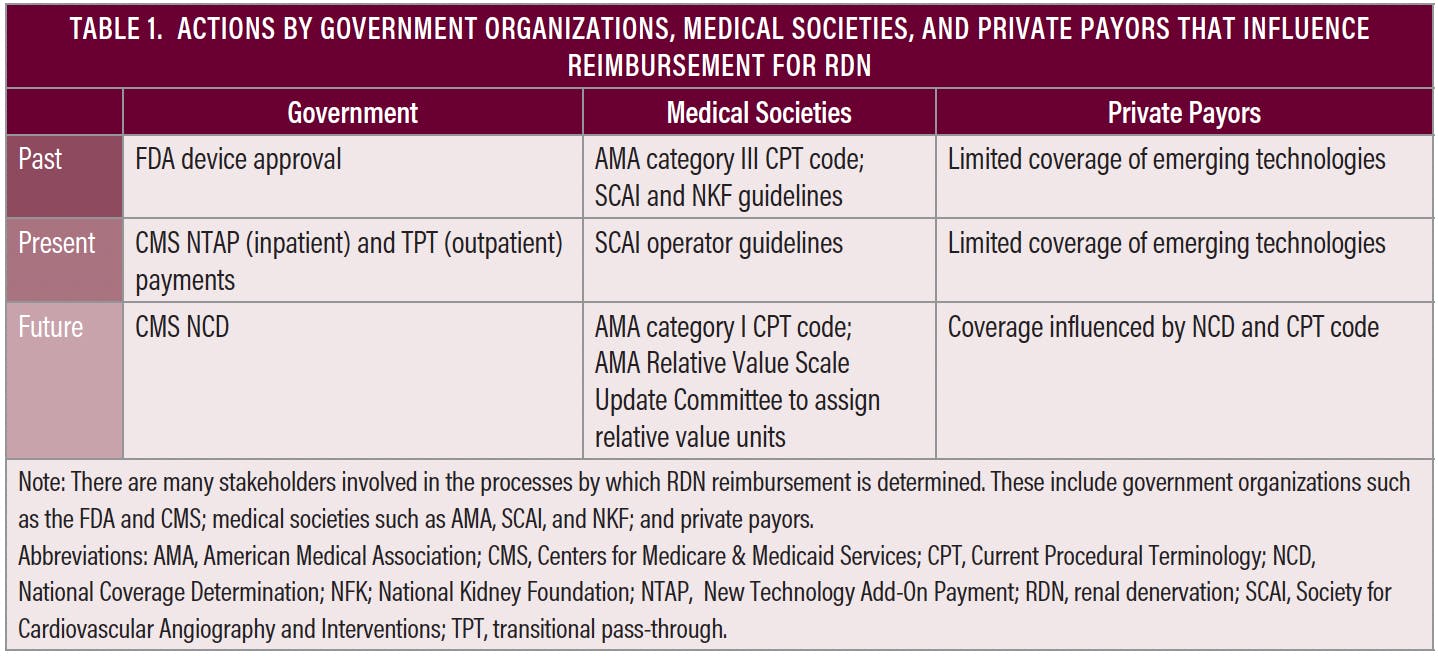
CPT categorization affects payment most notably for patients under private payors, many of which do not reimburse for category III procedures, leaving the cost burden on the institution and ultimately the patient (Table 1). Furthermore, RVUs are not assigned to temporary category III CPT codes, as these codes do not identify the effort required to provide the service and are not valued by the Relative Value Scale Update Committee (RUC). The AMA is anticipated to convene a panel to review RDN in the coming year for consideration of conversion to a permanent category I CPT code. Although it would not be effective immediately, this category reassignment—reserved for proven, efficacious devices with real-world experience—would facilitate higher reimbursement for the procedure and open eligibility for patients covered under private payors. It should also be noted that the HCPCS code, as described previously, that delineates the modality of energy utilized for RDN can change when the CPT code for this procedure changes to category I.
In addition to the AMA, other medical societies such as the Society for Cardiovascular Angiography and Interventions, the American Heart Association, and the National Kidney Foundation influence the uptake of new technologies by publishing guidelines about their appropriate clinical application. While guidelines exist, there are currently no formal recommendations from these societies for use of RDN in the clinical management of HTN (Table 1), and this could affect the pace of coverage from private payors.
CONSIDERATIONS FOR EMERGING TECHNOLOGIES
While awaiting more permanent payment structures, devices such as RDN catheters may be granted several financial incentives that offer a reprieve for breakthrough technologies to encourage scaling. For outpatient procedures, a transitional pass-through (TPT) payment provides incremental reimbursement from CMS in addition to the APC payment to cover the cost of the device.18,19 The TPT payment is determined on a case-by-case basis, taking into account the amount a hospital charges for a device, the hospital’s specific cost-to-charge ratio, and the device offset or device-related portion of the relevant HCPCS procedure code. For RDN, a TPT payment for both Medtronic and Recor RDN systems was granted by CMS, effective January 1, 2025, covering around $15,000 to $20,000.20 The payment from CMS to a hospital for outpatient RDN procedures is the total of the APC plus TPT payment. It should be noted that TPT payments are temporary, meant for breakthrough technologies, so they last for only 3 years.
CMS also assigns the APC codes, with levels 1 to 4 correlating to increasing complexity and likewise correlating to higher reimbursement. These codes are permanent but may be updated annually, reflecting changes in technology, procedures, and costs over time. The APC code for RDN is currently a level 2 endovascular procedure code, the same as percutaneous transluminal coronary angioplasty without stent, for example.21 Level 3 includes percutaneous coronary angioplasty with drug-eluting stent placement. Level 4 often includes multiple procedural steps, such as percutaneous coronary atherectomy with angioplasty and drug-eluting stent placement.21 If RDN remains at level 2, it is likely to remain unprofitable for hospitals, particularly as the temporary incremental TPT payments expire after 3 years.
For inpatient procedures, a similar payment is made to the hospital by CMS in cases of new technologies, as determined by diagnostic-related group (DRG) code. This is called a New Technology Add-On Payment (NTAP).22 Starting on January 1, 2025, CMS assessed an NTAP through the Medicare Hospital Inpatient Prospective Payment System for both approved RDN devices, between $10,000 to $15,000 to cover device costs.22 Similar to TPT payments, the NTAP is determined on a case-by-case basis to cover incremental costs of a device when added to the DRG payment. While temporary payments are beneficial as RDN awaits CPT code conversion, these payments remain inadequate, making early adoption of the procedure into a hospital’s offerings an ongoing challenge. Institutions considering business models for RDN in this current state must take lessons from previous new technologies, such as transcatheter aortic valve replacement or left atrial appendage occlusion devices.
NEXT STEPS
While the FDA has deemed RDN safe and efficacious, they did not define clinical eligibility for the procedure. This information is expected within this next year as a National Coverage Determination (NCD) from CMS. In this process, a committee will assign clinical criteria for patients to be eligible for coverage for RDN. These criteria are independent of the initial FDA approval indications for RDN devices and will take into account the patients reflected in the studied population, among other factors. While this decision will apply directly to patients with Medicare and Medicaid coverage, private payors often follow the lead of CMS. Thus, the coverage of RDN for patients nationwide will be driven in part by this decision.23,24 Although it is possible for Medicare Administrative Contractors to make local coverage determinations while awaiting the national determination, additional reimbursement via this mechanism has not come to fruition.
Between the anticipated NCD from CMS and CPT code conversion by the AMA, this coming year has the potential to affect the scalability of RDN across the nation (Table 1). Lastly, for operators to receive credit for their procedures, we await the AMA convening a RUC to develop RVUs associated with RDN. Until that point, even if the NCD and CPT code are favorable for the financial solvency of an institution offering RDN, there would remain no standard RVU accrual for proceduralists performing RDN.
CONCLUSION
RDN has the potential to improve health outcomes for millions of Americans by decreasing the rates of uncontrolled HTN and highly morbid sequelae such as myocardial infarction, stroke, and death.1-14 However, for RDN to positively impact patients, it must be economically feasible for health systems to develop high-quality RDN programs. In the coming year, we await AMA and CMS decisions as they assess CPT code, NCD, and RVU assignment for the procedure, which will vastly change the financial viability and landscape of how this procedure is embraced nationally.17-24
1. Million Hearts. Estimated hypertension prevalence, treatment, and control among U.S. adults. Accessed March 27, 2025.https://millionhearts.hhs.gov/data-reports/hypertension-prevalence.html
2. Kiuchi MG, Esler MD, Fink GD, et al. Renal denervation update from the international sympathetic nervous system summit: JACC state-of-the-art review. J Am Coll Cardiol. 2019;73:3006-3017. doi: 10.1016/j.jacc.2019.04.015
3. Cluett JL, Blazek O, Brown AL, et al. Renal denervation for the treatment of hypertension: a scientific statement from the American Heart Association. Hypertension. 2024;81:e135-e148. doi: 10.1161/HYP.0000000000000240
4. Swaminathan RV, East CA, Feldman DN, et al. SCAI position statement on renal denervation for hypertension: patient selection, operator competence, training and techniques, and organizational recommendations. J Soc Cardiovasc Angiogr Interv. 2023;2:101121. doi: 10.1016/j.jscai.2023.101121
5. Mancia G, Kreutz R, Brunström M, et al. 2023 ESH Guidelines for the management of arterial hypertension The Task Force for the management of arterial hypertension of the European Society of Hypertension: Endorsed by the International Society of Hypertension (ISH) and the European Renal Association (ERA). J Hypertens. 2023;41:1874-2071. doi: 10.1097/hjh.0000000000003480
6. Barbato E, Azizi M, Schmieder RE, et al. Renal denervation in the management of hypertension in adults. A clinical consensus statement of the ESC Council on Hypertension and the European Association of Percutaneous Cardiovascular Interventions (EAPCI). Eur Heart J. 2023;44:1313-1330. doi: 10.1093/eurheartj/ehad054
7. Azizi M, Sharp ASP, Fisher NDL, et al. Patient-level pooled analysis of endovascular ultrasound renal denervation or a sham procedure 6 months after medication escalation: the RADIANCE clinical trial program. Circulation. 2024;149:747-759. doi: 10.1161/circulationaha.123.066941
8. Vukadinović D, Lauder L, Kandzari DE, et al. Effects of catheter-based renal denervation in hypertension: a systematic review and meta-analysis. Circulation. 2024;150:1599-1611. doi: 10.1161/CIRCULATIONAHA.124.069709
9. Ettehad D, Emdin CA, Kiran A, et al. Blood pressure lowering for prevention of cardiovascular disease and death: a systematic review and meta-analysis. Lancet. 2016;387:957-967. doi: 10.1016/S0140-6736(15)01225-8
10. Azizi M, Saxena M, Wang Y, et al. Endovascular ultrasound renal denervation to treat hypertension: the RADIANCE II randomized clinical trial. JAA. 2023;329:651-661. doi: 10.1001/jama.2023.0713
11. Kandzari DE, Townsend RR, Kario K, et al. Safety and efficacy of renal denervation in patients taking antihypertensive medications. J Am Coll Cardiol. 2023;82:1809-1823. doi: 10.1016/j.jacc.2023.08.045
12. Bhatt DL, Vaduganathan M, Kandzari DE, et al. Long-term outcomes after catheter-based renal artery denervation for resistant hypertension: final follow-up of the randomised SYMPLICITY HTN-3 trial. Lancet. 2022;400:1405-1416. doi: 10.1016/S0140-6736(22)01787-1
13. Safdar NZ, Shah MU, Ali A, Naqvi SY. Super-response to renal denervation in treatment-resistant essential hypertension. BMJ Case Rep. 2024;17:e260945. doi: 10.1136/bcr-2024-260945
14. Mahfoud F, Mancia G, Schmieder RE, et al. Cardiovascular risk reduction after renal denervation according to time in therapeutic systolic blood pressure range. J Am Coll Cardiol. 2022;80:1871-1880. doi: 10.1016/j.jacc.2022.08.802
15. U.S. Food and Drug Administration. Paradise Ultrasound renal denervation system – P220023. Accessed April 10, 2025. www.fda.gov/medical-devices/recently-approved-devices/paradise-ultrasound-renal-denervation-system-p220023
16. U.S. Food and Drug Administration. Premarket approval (PMA) for Symplicity SpyralTM renal denervation system. Accessed April 10, 2025. www.accessdata.fda.gov/scripts/cdrh/cfdocs/cfpma/pma.cfm?id=P220026
17. Kandzari DE, Cao KN, Ryschon AM, et al. Catheter-based radiofrequency renal denervation in the United States: cost-effectiveness analysis based on contemporary evidence. J Soc Cardiovasc Angiogr Interv. 2024;3:102234. doi: 10.1016/j.jscai.2024.102234
18. Federal Register. Medicare and Medicaid Programs: hospital outpatient prospective payment and ambulatory surgical center payment systems; quality reporting programs, including the hospital inpatient quality reporting program; health and safety standards for obstetrical services in hospitals and critical access hospitals; prior authorization; requests for information; Medicaid and CHIP continuous eligibility; Medicaid clinic services four walls exceptions; individuals currently or formerly in custody of penal authorities; revision to Medicare special enrollment period for formerly incarcerated individuals; and all-inclusive rate add-on payment for high-cost drugs provided by Indian Health Service and Tribal Facilities. November 27, 2024. Accessed February 16, 2025. https://www.federalregister.gov/documents/2024/11/27/2024-25521/medicare-and-medicaid-programs-hospital-outpatient-prospective-payment-and-ambulatory-surgical
19. Moneer O, Johnston JL, Rathi VK, et al. Medical devices applying for outpatient medicare supplemental payments. JAMA Health Forum. 2024;5:e244016. doi: 10.1001/jamahealthforum.2024.4016
20. Vascular News. CMS Launches review of coverage for renal denervation. January 14, 2025. Accessed April 10, 2025. vascularnews.com/cms-launches-review-of-coverage-for-renal-denervation/
21. Boston Scientific. Procedural payment guide – 2025. Accessed April 10, 2025. www.bostonscientific.com/content/dam/bostonscientific/Reimbursement/interventional/pdf/Cardiovascular_Procedure_Coding_and_Payment_Guide.pdf
22. Federal Register. Medicare and Medicaid programs and the children’s health insurance program; hospital inpatient prospective payment systems for acute care hospitals and the long-term care hospital prospective payment system and policy changes and fiscal year 2025 rates; quality programs requirements; and other policy changes. August 28, 2024. Accessed February 16, 2025. https://www.federalregister.gov/d/2024-17021
23. Straube BM. How changes in the Medicare coverage process have facilitated the spread of new technologies. Health Aff (Millwood). 2005;24(suppl):W5-314-W5-316. doi: 10.1377/hlthaff.w5.314
24. O’Neill BP, O’Neill WW, Williams D, et al. Impact of CMS coverage decision on access to transcatheter aortic valve replacement. Catheter Cardiovasc Interv. 2014;84:114-121. doi: 10.1002/ccd.25394
Advertisement
Advertisement