Advertisement
Advertisement
May/June 2025
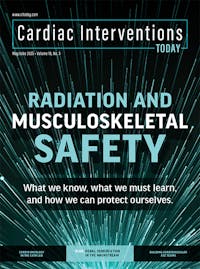
Radiation and MSK Safety in the Real World
Reflections on the historical lack of awareness regarding radiation and musculoskeletal issues and what is changing the conversation, the hospital’s role in ensuring staff safety, and ideal next steps.
With Ajar Kochar, MD, MHS; Sheila Sahni, MD, FACC, FSCAI; and William A. Gray, MD, MSCAI, FACC



Why has it taken so long to generate real interest in ensuring clinician safety, from both radiation- and musculoskeletal (MSK)-related issues?
Dr. Kochar: There are several reasons. First, until very recently, there has been relatively modest innovation in the radiation/orthopedic injury space for interventional cardiology. In the absence of alternatives, it is natural for cath lab team members to simply “soldier on.” Many interventional cardiologists and staff love their jobs and are deeply committed to patient care, often overlooking the potential harm to themselves. Additionally, there is a widespread lack of awareness regarding the true prevalence of both orthopedic- and radiation-related pathology in the interventional community. Finally, there has traditionally been an absence of focus and widespread support to address these issues.
Dr. Sahni: Historically, the culture in procedural specialties has emphasized patient outcomes and procedural volume over clinician well-being. Concerns about radiation or MSK strain were often seen as individual issues rather than systemic ones. For women—especially those considering pregnancy—these conversations have been even more difficult, given the lack of tailored protective strategies or clear guidance. It is only recently that the field has begun to acknowledge that protecting the operator is essential to sustaining a healthy and diverse workforce.
Dr. Gray: This is really the first generation of human beings who have stood in front of radiation for 40-plus years of their life, and I think it’s only now with increasing volumes that we’re seeing the toll that this takes, not just from an MSK standpoint but also potentially related to cancer. We thought the lead shielding in the cath lab and wearing lead aprons and gowns made us impermeable to radiation, but it really did not. We are now dealing with antiquated concepts of radiation protection and not enough real-world experience to know where we’re falling short.
In recent years, there has been more focus on these topics at conferences and from societies. What is changing the conversation?
Dr. Kochar: There are several factors that have boosted interest in radiation and MSK safety in interventional cardiology. The first is storytelling. We owe a great debt of gratitude to the pioneers of interventional cardiology, yet many of these distinguished individuals have suffered severe health consequences. These include malignancies, ophthalmologic issues, and debilitating orthopedic injuries such as severe spinal injuries resulting in paralysis. Drs. Dean Kereiakes, Kenneth Rosenfield, Bob Foster, and others have very graciously and openly shared their personal stories to highlight the potential ramifications of a career spent working with radiation while wearing heavy lead. The recent docu-series Scattered Denial was also eye-opening and powerful.
Second, we finally have several alternative solutions to the standard cath lab equipment, as discussed later. Third, there are emerging data highlighting the magnitude of the problem. Professional societies such as Society for Cardiovascular Angiography & Interventions (SCAI) have conducted serial surveys to help quantify the burden of workplace-related injuries in the cardiac cath lab. The 2023 SCAI survey on occupational health hazards was both an important update and a sobering reality check.1 The findings suggested that 66% of respondents experienced MSK discomfort related to work, 60% had an orthopedic injury, and 34% had lumbar spinal injuries. Last, professional societies such as SCAI, leaders such as Dr. James Hermiller, and new organizations such as Occupational Radiation Safety in Interventional Fluoroscopy have prioritized mitigating the occupational hazards of the cath lab as a major focus. This attention has helped further raise awareness of these radiation and MSK risks and is helping prompt more directed action.
Dr. Gray: I think what changed the conversation was the realization that the prior protection was both inadequate and injurious. We have also seen new scatter radiation protection technology that has allowed us to consider different methodologies of reducing radiation, not just for the operator but for everyone in the room. We are also thinking about how we can go not necessarily leadless but to a much lower weight of lead, with the same or better degree of radiation protection.
Dr. Sahni: We’re seeing a generational shift in expectations around safety, work-life balance, and inclusivity. As more women and younger physicians enter the field, there is increasing recognition that traditional norms need to evolve. Societies and conferences are responding by dedicating space for these discussions and highlighting innovations in radiation protection and lab ergonomics. There’s also broader awareness that these aren’t niche concerns—they affect everyone in the lab.
How would you characterize the status of currently available data on radiation exposure for cath lab staff? And, that of various radiation protection measures?
Dr. Gray: The only data we have currently are the badges we wear above and below our aprons. We follow the ALARA (as low as reasonably achievable) guidelines. But the reality is, not everyone wears the badges or turns them in. They get lost, or people don’t wear them for fear of being pulled out of the lab. There is some monitoring of radiation exposure, but it’s measured on a month-by-month basis, not cumulative radiation exposure over a lifetime.
Dr. Sahni: We have foundational data, but much of it is dated or not reflective of real-world, cumulative exposure—especially over a career. Data specific to reproductive risks or long-term MSK outcomes are even more limited. Although several protective tools exist (eg, lead alternatives, shielding systems, robotic assistance), their adoption has been inconsistent, and head-to-head comparisons remain limited. We need better, more inclusive data to guide meaningful change.
Dr. Kochar: We need significantly more data in this space, and funding for studies in this area is critically needed. Our group at Brigham and Women’s Hospital became really interested in understanding the ergonomic strain on cath lab operators. In doing background research, we realized that there is truly a dearth of data quantifying the ergonomic risk for cath lab operators. In response, we designed the ERGO-CATH pilot study (funded by Rampart) to better understand these risks. In ERGO-CATH, we used several different measurement tools, including inertial monitoring units, surface electromyography, discomfort scales, and real-time radiation dosimetry, to assess a variety of cath lab staff (interventional attendings, general fellows, interventional fellows, physician assistants).2 We compared two conditions: wearing traditional lead versus a leadless environment with the Rampart system. Additionally, we conducted a substudy involving nurses and cath lab techs, hypothesizing that their ergonomic strain pattern may be very different than primary or secondary operators. We hope this research will be a stepping stone to additional work in this space. More scientifically, understanding the root of these problems will allow us to optimally design solutions.
Key findings from ERGO-CATH, formally presented at SCAI 2025, include the following3:
- At the cervical joint, cath lab operators were in a high-risk axial rotation position for about 34% of case time.
- Fellows were placed in high-risk positions for a higher proportion of time compared to attendings.
- There was a dramatic reduction in radiation with use of the Rampart device (0.5 mrem) versus traditional lead (0.73 mrem).
We now have several options, including the Rampart system (Rampart), the EggNest-XR system (Egg Medical), the Radiaction system (Radiaction Medical), the Protego radiation protection system (Image Diagnostics, Inc.), and Zero-Gravity lead (Biotronik). Although they each have their own advantages and disadvantages, as a “class” they result in dramatic reduction in radiation and allow operators to completely eliminate lead or use ultra-light lead options. Even relatively simple measures such as systematic use of RadPad (Worldwide Innovations & Technologies, Inc.) can reduce scatter radiation by up to 50%.4,5
Outside of data, what is needed to drive further adoption of protective measures?
Dr. Sahni: Culture change is key. We need to normalize the use of protective tools and shift away from the idea that enduring physical strain is part of the job. It also starts with education—many of us were never formally taught about radiation safety. There’s currently no standardized curriculum, and that’s a major gap that needs to be addressed early in training and reinforced throughout our careers.
Dr. Gray: We need to recognize that the orthopedic issues are real, pervasive, and serious, and the next generation of interventionalists should not need to suffer with these issues that we already know they will get if nothing changes. There’s no reason for that. I think we do a disservice to that generation if we don’t step up and make a decision about doing something different.
Dr. Kochar: Regarding solutions to the high occupational hazard in interventional cardiology, a multipronged approach is necessary. Utilizing some newer technologies will allow operators to either shed their lead completely or use ultra-light lead. This will help reduce the cumulative axial load on the spines of cath lab operators and dramatically decrease the amount of radiation exposure. Working with dedicated physical therapy/ergonomic experts in monitoring behaviors in the cath lab may unearth poor habits that can be corrected. Finally, dedicated exercise and physical therapy regimens focused on minimizing common cath lab injuries may also have a role in maximizing career longevity.
What is the hospital/employer’s role in ensuring staff safety? What are the roles of the professional societies regarding education? How is this conversation evolving in the current climate?
Dr. Gray: The professional societies are currently driving the conversation to a very constructive degree and to an endpoint that I think is the right one: to raise awareness and establish guideline statements or summary statements about radiation protection. I think this that will raise the awareness at the hospital level.
Currently, hospitals believe, rightly so, that they are providing adequate protection: lead, glasses, No-Brainer caps (Worldwide Innovations & Technologies, Inc.), equipment provided by the imaging companies, etc. We are saying that this is not enough and/or injurious.
To their credit, a lot of the imaging companies have been working hard to reduce radiation exposure while maintaining image quality, but that doesn’t solve our current predicament. It doesn’t get us out of the heavy lead or reduce our radiation exposure cumulatively to the extent that we need.
Dr. Kochar: There is a massive role for the employer/hospital. Unequivocally, the most valuable resource of the hospital in providing excellent patient care is the incredibly highly specialized members of the cath lab team. Protecting interventional cardiologists, supporting physicians (imaging cardiologists, anesthesiologists), nurses, techs, and other staff members is of paramount importance. Furthermore, especially with respect to these newer innovations, the benefit would extend to our electrophysiology, interventional radiology, and vascular surgery colleagues.
This is important if for no other reason than purely financial—in the 2023 SCAI survey, 20% of respondents missed work due to orthopedic injuries.1 This results in substantial loss of revenue and/or amplified costs in coverage for the out-of-work colleague. Minimizing the risk of radiation or orthopedic injuries should be of the highest importance to hospital administrators and leadership. Of note, 80% of respondents in the SCAI 2023 survey stated that administrative barriers/cost limited the adoption of newer technologies. Along with the safety of our patients, the safety of our colleagues must be priority number one.
Dr. Sahni: Hospitals must provide both the equipment and the infrastructure to support operator safety, from proper fitting lead to pregnancy-specific accommodations. Employers also set the tone: When leadership values safety, it becomes part of the culture. Professional societies have an important role in offering consistent education, sharing best practices, and advocating for safety standards. These conversations are thankfully becoming more common and more visible across specialties.
What further calls to action are necessary? Should there be an evolution in residency training?
Dr. Gray: It would be great to have modules of radiation training. I didn’t undergo any official training on this—my attendings would simply tell me how to shield myself.
Increasingly, we are seeing things like more formalized training, the presence of radiation safety protection officers, and lectures within fellowships. Ultimately, you can still get a lot of radiation protection just by using what’s in the field, but again, this requires a lot of lead. The bottom line is that we need to develop the conversation more, see more protection options become available, and, frankly, have more data with those new options. Some data are starting to emerge from the various options for radiation scatter protection. This is novel and will allow us to start thinking about how we might do better.
Dr. Sahni: Yes, training is the ideal place to start. Radiation safety and MSK preservation should be taught and modeled from day 1, not left to on-the-job learning. Creating a standardized curriculum, including specific education on pregnancy and fertility considerations, would be a meaningful step forward. Long term, we need continued research, better data, and a commitment to making safety an essential, not optional, part of interventional training and practice.
1. Abudayyeh I, Dupont AG, Hermiller KB, et al. Occupational health hazards in the cardiac catheterization laboratory: results of the 2023 SCAI survey. J Soc Cardiovasc Angiogr Interv. Published online March 4, 2025. doi: 10.1016/j.jscai.2024.102493
2. Herzig MS, Kochar A, Hermiller JB, et al. Real-world reductions in lead-free radiation exposure with the Rampart system during endovascular procedures. Am J Cardiol. Published online May 15, 2025. doi: 10.1016/j.amjcard.2025.02.019
3. Kochar A. Orthopedic risks to cardiac catheterization operators wearing traditional lead protection versus using novel lead-less solutions: insights from the prospective ERGO-CATH study. Presented at: SCAI 2025; May 1-3, 2025; Washington, DC.
4. Medranda GA. The impact of the RADPAD protection drape in reducing radiation exposure in a contemporary cardiac catheterization laboratory: the ATTENUATE trial. Presented at: CRT 2025; March 8, 2025; Washington, DC.
5. Vlasta W, Delewi R, Sjauw KD, et al. Efficacy of the RADPAD protection drape in reducing operators' radiation exposure in the catheterization laboratory: a sham-controlled randomized trial. Circ Cardiovasc Interv. 2017 Nov;10(11):e006058. doi: 10.1161/CIRCINTERVENTIONS.117.006058
Disclosures
Dr. Kochar: Receives research grant funding from Rampart.
Dr. Sahni: None.
Dr. Gray: Consultant to Philips and Radiaction.
Advertisement
Advertisement