Advertisement
Advertisement
May/June 2025
MSK Injuries: What the Next Generation Must Understand Now
The effects of radiation protection on musculoskeletal injury and how the field has responded, changes to alleviate the burden of lead, recommendations for younger practitioners, and the role of administrators and industry.

What has been your personal experience with radiation protection? What impact has it had on you?
I’ve lived with radiation protection my entire professional life, 35 years or so. At the very beginning, the primary protective device option was a very heavy lead apron, heavier than they are now. Back in those days, I was literally hugging the image-intensifier tube so I could be as close as possible close to the patient. I was wearing my lead thinking that was protection enough. As it turns out, not only was it not protecting me fully in terms of radiation scatter but it also caused orthopedic issues, as I twisted and stretched my torso in an attempt to get access to the patient. As time went on, I started to realize how much effect this was having on me.
When did you first realize you were encountering these musculoskeletal (MSK) injury issues, and how did you respond?
From the outset of performing procedures, I was experiencing backaches and orthopedic-related issues. Fortunately, I have not had any of the cancer-related issues that have sadly affected some of my colleagues. But, even from the beginning, after a long day in lead and doing all kinds of contortions with my body to try to perform procedures, I would have aches in my lower back and sometimes in my neck. That gradually got worse. It was less notable when I was young and doing a lot of exercises; but as time has gone on, it’s been much more noticeable (Figure 1).
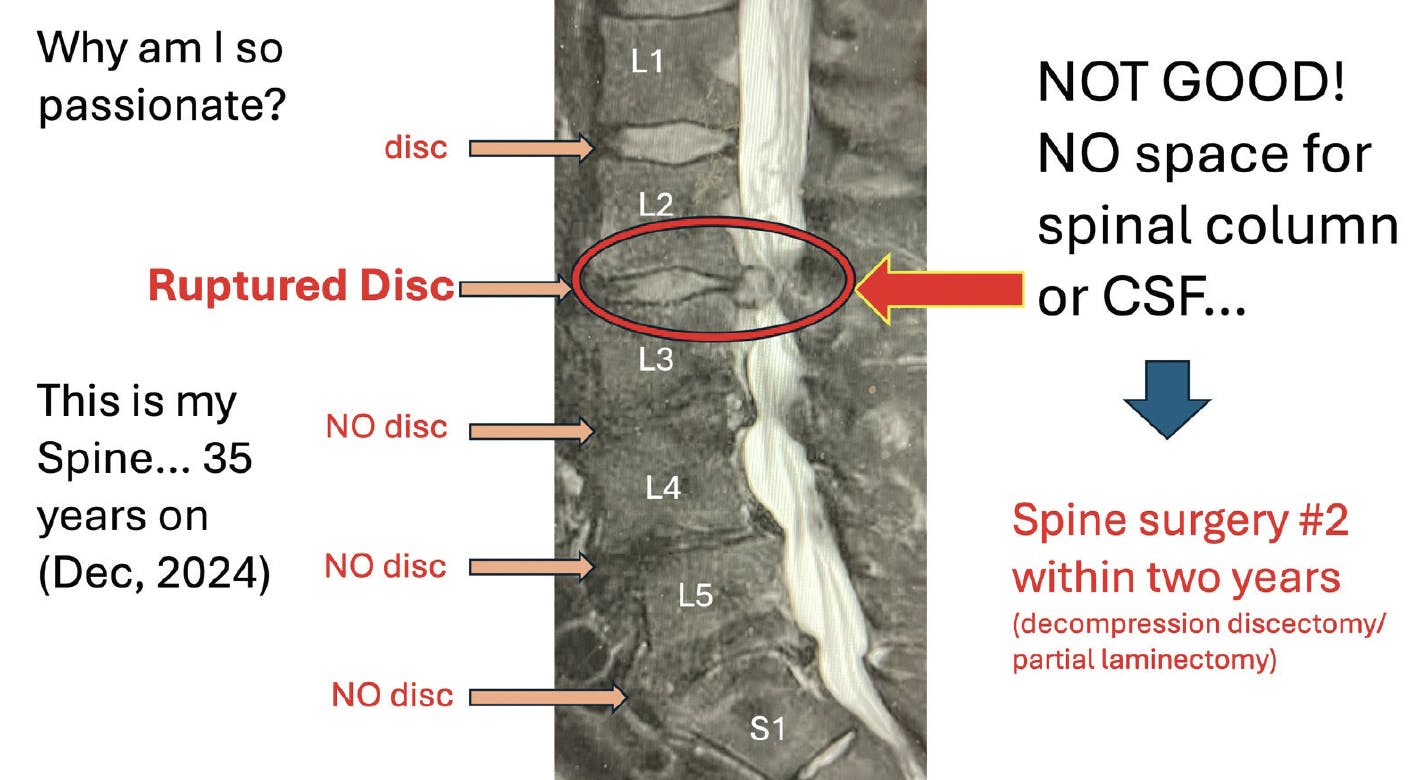
Figure 1. The author’s spine after 35 years in the cath lab (December 2024). CSF, cerebral spinal fluid.
What changes have you made to alleviate the burden of wearing lead during procedures?
I think it will be imperative for all of us moving forward to try to lighten the load. This doesn’t necessarily mean lead-free but rather having a lighter load on us than 20 or 30 lb. The good news is that new shielding and lead technologies are being developed to enable the next generation, and even the current generation of interventionalists, to lighten their load and reduce the negative impact on the MSK system.
To alleviate the burden of wearing heavy lead, I do exercises that will “protect me” from the problems associated with wearing lead. I do regular “core-strengthening” exercises and participate in physical therapy. I also try to focus on my actions during procedures. For example, even focusing on posture during a procedure makes a big difference: turning my body toward the access site and the imaging screen as opposed to twisting the torso; standing up straight and not bending over the patient. I avoid “hunching” over the patient…instead, I stand erect and keep my hands down low. You can still see your hands and the equipment even when you‘re standing up perfectly erect.
I now spend a lot of time talking to my fellows about how to modify their posture and adjust the table so as to make it as comfortable as possible during the procedure. Ultimately, this is beneficial not only to you but also to your patient. You will be focusing on the patient instead of being worried about your aching back or neck.
How do you see the overall field of interventional medicine evolving in response to the health concerns of physicians and other staff exposed to radiation?
First and foremost, as interventionalists, we are now paying attention to this in a way we weren’t previously. The first part of solving any problem is recognizing that it is indeed a problem, and this has happened in a big way. We are now in the stage of developing solutions.
Physician leaders are encouraging postural changes and exercises for not just our physicians but our entire staff, as they are equally at risk. We are also seeing development of mechanical solutions to address these issues. Imaging companies have done a spectacular job of reducing radiation doses while improving images. Now, they are finally paying attention to the orthopedic issues associated with radiation protection and recognizing that it’s not just our problem, this is their problem as well. We share responsibility for this together with our industry partners, and we are now collaborating to make things as safe and effective as possible, while not interfering with workflow.
What are your recommendations to younger practitioners to ensure their physical health while maintaining adequate radiation protection?
Prioritizing your own physical health (and mental well-being too!) is crucial for anyone who will be exposed to scatter radiation and wearing burdensome lead or even standing for prolonged periods of time during procedures. Focusing on core strengthening prepares you for wearing lead and other physical stress of cath lab work. Set aside time to do regular exercise, with an emphasis on stretching and core strengthening (eg, planks, sit-ups, push-ups, Pilates, yoga).
Although I ran and biked, I was not tuned into this early in my career, and I think it clearly needs to be part of our basic training and curriculum. This job is not just mentally and technically challenging—it’s also physically challenging. And yet this physical component is not built into our training. Aside from maintaining your own health, it is important to recognize that, if you’re not in physical condition to be in the cath lab to wear lead painlessly, you may not be able to focus on the patient and are potentially compromising your ability to deliver the best care possible. Training on radiation protection and physical preparation should be part of our formal curriculum in some way, shape, or form.
This also applies to our nursing and tech staff in the cath lab. Some labs set aside 10 to 15 minutes for exercise and stretching. Although this takes time and may be a little nontraditional, it ultimately preserves the workforce, builds that physical strength, and encourages camaraderie and teamwork. I hope to see this built into the workflow of more labs.
How should employers (hospitals and practices) protect their teams?
This includes financially investing in new equipment that abides by the ALARA (as low as reasonably achievable) principle while ensuring that staff, physicians, and nurses are feeling okay. Ask about back pain, neck pain, etc. It is incumbent upon our employers and hospitals to make sure we have access to proper medical treatment and physical therapy.
Hospitals should also leverage their buying power with imaging companies to compel them to be on board. Sometimes companies distance themselves, believing their purpose is to simply provide the imaging equipment, not to be concerned with protection of users, but this is shortsighted. I would love to see institutions that are about to make large capital purchases hold x-ray vendors' feet to the fire and ensure they are completely engaged with providing measures to protect the users.
I believe imaging companies (as well as hospitals) have a moral, ethical, and financial responsibility to ensure that what they are providing is as safe as possible, not just for the patient but also for the physicians. They should partner with us to ensure the development of protection systems that not only protect us, but optimally sync with our workflow.
Although ensuring the health of patients and health care professionals is paramount, what are the cost implications for practices and administrators, and how can these be mitigated to ensure safety?
Bluntly, hospitals should immediately be mandated to incorporate shielding systems into every lab, to better protect the workforce, both from scatter radiation and from orthopedic injuries by “lightening the load.” Now that we have shined a light on this problem, it can no longer be ignored. Of course, buying new systems for X number of labs will be costly. But at the end of the day, it will ultimately be highly cost-effective. When a physician retires early or can’t work due to MSK injury, they are not generating relative value units in the lab, and the hospital misses out on that revenue. I experienced this myself this year, with 24 weeks where I was not in the lab. I was essentially a “wasted resource” for the hospital for half a year.
To maximize productivity for our staff and our physicians, we must maintain the physical and mental health of those individuals. This requires paying attention to their emotional well-being and being concerned about their physical well-being in the lab. If part of the job is wearing lead, we must make sure we are providing the safest environment for all staff. Importantly, I am not referring to physicians only—some of the current systems protect the doctors but not necessarily the rest of the staff in the room. We need to think about the entire environment when we are addressing this.
Ultimately, making investments to ensure staff are safe and healthy can save money in the long run.
What should the next generation understand about MSK injuries in the cath lab?
First and foremost, they need to be aware of this—it needs to be front and center. Many of us are so committed to caring for our patients and put our own health and needs second. But when it comes to MSK injury and radiation protection, you must put your physical well-being at the forefront. It must be prioritized. I think we were missing the mark previously. These issues must be addressed early in one's career. I focus on this with my fellows and trainees much more now than I ever did before.
One of my fellows is already having daily back pain. He never mentioned it—I only found out because I specifically asked. Trainees don’t want to complain to their mentors. So, as senior physicians, we need to actually ask them these questions and help our mentees understand these occupational issues to enable them to have a long and healthy careers. It’s paramount that our future generations get into the right habits and learn how to protect themselves from the beginning.
Advertisement
Advertisement