Advertisement
Advertisement
May/June 2025
Literature Highlights: Study Finds Lower Operator Radiation Exposure With Left Radial Versus Hyperadducted Right Radial Artery Approach
With Richard Casazza, MAS; Arsalan T. Hashmi, MD; Bilal Malik, MD; and Jacob Shani, MD
In a study evaluating operator radiation exposure, Casazza et al found that using a left radial artery (LRA) approach resulted in lower levels of cumulative and normalized radiation to multiple anatomic locations as compared with a hyperadducted right radial artery (RRA) approach. The results were published online in Circulation: Cardiovascular Interventions.1
Investigators conducted a randomized controlled trial at a single urban tertiary center from November 2022 to February 2024, evaluating operator radiation exposure during the diagnostic portion of elective cardiac catheterization in patients aged ≥ 18 years deemed suitable for a radial approach. Patients were excluded if they presented with ST-segment myocardial infarction (STEMI), non-STEMI, hemodynamic instability, previous coronary artery bypass grafting, hemodialysis arteriovenous fistulas, or nonpalpable radial pulses.
KEY FINDINGS
- Operators experienced significantly less radiation exposure at the thorax, abdomen, left eye, and right eye with use of a LRA approach versus hyperadducted RRA approach.
- Overall, normalized radiation was significantly lower at all anatomic locations for operators using LRA access versus hyperadducted RRA access.
Thirteen operators participated in the study (experience, 4-30 years; operator height, 160-188 cm). If percutaneous coronary intervention (PCI), physiologic coronary assessment, or intravascular ultrasound were required, radiation dosimeters were removed.
Patients were randomized to either the LRA or hyperadducted RRA approach. Procedures were performed on the right side of the patient, and access was obtained using a modified Seldinger technique with an 18-gauge needle and a 5- or 6-F hydrophilic Glidesheath Slender radial sheath (Terumo Interventional Systems). Standard projections included left anterior oblique and anteroposterior (AP) cranial views for the right coronary artery and right anterior oblique caudal, left anterior oblique caudal, AP cranial, and right AP oblique cranial views for the left coronary artery, in various degrees of angulation and keeping in mind associated radiation exposure.
The setup for both hyperadducted RRA and LRA approaches are described in detail in the article. Briefly, for the hyperadducted RRA group, the RRA was placed as close to the right flank as possible, ideally running parallel to the right femoral artery. If distal RRA access was used, the hand was hyperadducted and secured to the right flank before access. For the LRA group, the left arm was abducted 90°, a standard swivel arm board was used, and the arm was elevated by a chuck or folded sheet to allow the hand to hyperextend. For distal LRA access, a 10- or 16-cm slender sheath was used. For conventional LRA access, a 16-cm slender sheath was used with 6 to 8 cm out of the body and secured with sterile transparent adhesive.
Four radiation dosimeters were placed outside of lead aprons at the thorax, abdomen, left eye, and right eye to capture radiation exposure in real time. All operators wore the same radiation protection. Two fluoroscopic units with identical shielding, software, and radiation output algorithms were used for the duration of the study. The standard ALARA (as low as reasonably achievable) protocol was used.
Primary outcome measures were the primary operator’s cumulative radiation (CR) exposure (in µSv) at the thorax, abdomen, left eye, and right eye and normalized radiation exposure (CR/dose area product [DAP]) at each anatomic location.
Of 534 patients included in the study, 269 were randomized to LRA and 265 were randomized to hyperadducted RRA. One patient in the LRA group and three patients in the hyperadducted RRA group crossed over to the opposite group.
Results of mean CR dose and mean CR/DAP dose to the operator by group and anatomic location are noted in Table 1. The LRA group had a significantly lower mean CR dose as compared with the hyperadducted RRA group for all anatomic locations evaluated. Similarly, mean CR/DAP dose was significantly lower in the LRA group versus the hyperadducted RRA group for all anatomic locations.
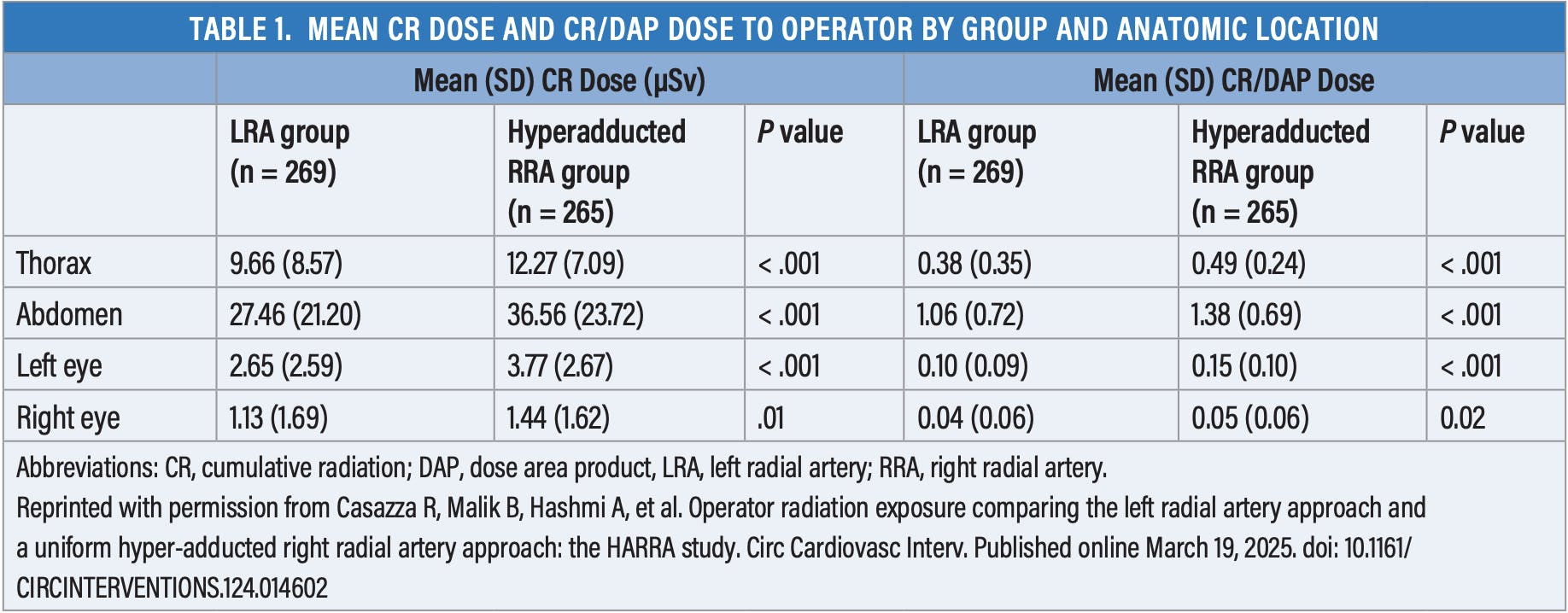
In multivariate linear regression analyses, hyperadducted RRA access was significantly associated with higher CR values versus LRA access for all anatomic locations (all P < .001). This was similar for CR/DAP comparisons, in which hyperadducted RRA access was significantly associated with greater doses than LRA access for all anatomic locations (P < .001) except the right eye (P = .006).
As noted by the investigators, the study had some limitations, including that it was conducted at a single center; potential differences in LRA and hyperadducted RRA setups, as well as selective coronary angiography techniques, device selection, and ceiling-mounted lead shielding at other centers and between operators; and that PCI procedures were not included in the analysis, which may involve differences in radiation exposure patterns.
Based on this study’s results of lower cumulative and normalized radiation exposure, interventional cardiologists should consider using the LRA approach more frequently for cardiac catheterization, noted the investigators.
CARDIAC INTERVENTIONS TODAY ASKS…
Study investigator Richard Casazza, MAS, with Maimonides Medical Center in Brooklyn, New York, discusses the findings, implications for real-world practice in terms of room setup and equipment, patient selection considerations, and opportunities for future research.
The study’s results suggest that operators might benefit from shifting from a primarily RRA approach to an LRA approach for cardiac catheterization to reduce radiation exposure. What are the implications for a change in approach in terms of room setup, staff, and equipment? What other practical impediments might operators face in making the change?
In our institution, we developed an LRA setup system that is composed of a radial access sleeve (Tesslagra Design Solutions) and the Cobra board (TZ Medical) that enhances our ability to use the LRA as an access point and preserve ergonomics from that approach. This setup as well as the “peekaboo” technique allows us to use this approach despite patient body habitus while reproducing satisfactory ergonomics.
Typically, when there is RRA failure, operators will retreat to a femoral approach. Becoming proficient in the LRA approach requires little repetition, and the benefits in terms of reduced bleeding complications, operational costs, and increased patient satisfaction are substantial.
What patient selection considerations might there be when opting for LRA versus RRA approach? If RRA access is required, are there risk mitigation measures that might help reduce exposure?
Our study specifically used a hyperadducted RRA setup, as this has been shown to reduce operators’ radiation exposure 10-fold.2 We wanted to see if there was any equipoise in operator radiation exposure with this setup versus the LRA approach. Several studies observed radiation reductions in the past with the use of LRA.
Observational studies have shown us that patients aged > 65 years, hypertension, short stature, and high body mass index all are clinical indicators of right subclavian tortuosity, which is a significant “anatomic obstacle” in operating from the RRA approach. The use of adjunctive radioprotection technologies can further mitigate deterministic and stochastic risks associated with occupational radiation exposure.
What knowledge and research gaps regarding radiation exposure and operator experience should be explored next?
Future studies should look at the usage of dedicated radioprotection devices and the potential reductions in radiation exposure they provide to operators and staff.
1. Casazza R, Malik B, Hashmi A, et al. Operator radiation exposure comparing the left radial artery approach and a uniform hyper-adducted right radial artery approach: the HARRA study. Circ Cardiovasc Interv. Published online March 19, 2025. doi: 10.1161/CIRCINTERVENTIONS.124.014602
2. Sciahbasi A, Frigoli E, Sarandrea A, et al. Determinants of radiation dose during right transradial access: insights from the RAD-MATRIX study. Am Heart J. 2018;196:113-118. doi:10.1016/j.ahj.2017.10.014
Advertisement
Advertisement