Advertisement
Advertisement
July/August 2025
Reimagining the Role of Surgeons in Structural Heart Procedures
The vital role of a skilled surgeon on a structural heart team, and advice for structural heart surgeons for leveraging their unique expertise and skill sets to better individualize patient care.
By Scott DeRoo, MD, and Jennifer Chung, MD
The advent of transcatheter valve technologies in the early 2000s fundamentally changed the way valvular heart disease is treated. Pathologies that were once treated exclusively with open heart surgery are now amenable to a minimally invasive approach. In the early days, interventional cardiologists, cardiac surgeons, and interventional radiologists collaborated to achieve procedural success. This interdisciplinary collaboration was largely in contrast to the established model of clinical practice, whereby specialties operated as autonomous units. Major clinical trials, such as PARTNER I, led to formalization of the heart team approach to facilitate communication, shared decision-making, and procedural success and safety in the face of a new technology and high-risk patient cohort.
Since that time, transcatheter technologies have undergone a rapid evolution, with transcatheter aortic valve replacement (TAVR) now the preferred treatment modality for most patients with aortic stenosis worldwide.1 Concomitant with the rapid proliferation of transcatheter devices has been the widespread acceptance of the heart team model as a core principle in the treatment of patients with valvular heart disease.2
A Need to redefine THE HEART TEAM
Although universally implemented and touted as a paradigm of multidisciplinary collaboration and success, the specifics of the heart team, as well as its evolving role, remain somewhat undefined. The modern heart team is composed of multidisciplinary members, including interventional cardiologists, cardiac surgeons, imagers, electrophysiologists, radiologists, anesthesiologists, coordinators, and administrative staff. Its role is to aid in initial diagnosis and decision-making, procedural planning, intraprocedural decision-making and execution, and postprocedure management and data tracking.
The Historical Role of the Surgeon and Structural Training
Although the heart team approach has been nearly universally implemented, the role of the surgeon in the team remains variable and institution specific.3 In the initial era of transcatheter therapies, cardiac surgical training provided little exposure to catheter-based skills, whereas interventional cardiologists were well-versed in peripheral access and catheter-based coronary interventions. Many surgeons thus gravitated toward a role in decision-making and took a less active role in the execution of the procedure. Surgeon participation in TAVRs was largely thought to be necessary only in the rare instances of emergent conversion to an open heart procedure, and many surgeons were content to remain peripherally involved. Structural heart interventions thus became primarily the domain of the interventional cardiologists, and dedicated cardiology training and fellowship pathways emerged.
Perhaps largely as a response to the interventional cardiology–driven model of structural training, several hybrid training programs for surgeons were established in the mid to late 2000s. These programs were generally structured as year-long “super fellowships” that offered formal training in structural heart procedures after completion of a general cardiac surgery residency/fellowship. Although philosophically supported, lack of funding and limited interest among cardiac surgical graduates eventually led to many programs closing. Interestingly, this temporally coincided with a new minimum requirement by the American Board of Thoracic Surgery for graduates of cardiac surgical training programs to have participated in TAVR. Unfortunately, the number of required cases is low (15 total, 10 assistant, 5 primary operator), such that graduates cannot reasonably be assumed to have acquired any real procedural proficiency.
IDEAL ROLE OF THE SURGEON ON THE STRUCTURAL HEART TEAM
As the depth and reach of transcatheter structural heart interventions continue to expand, what is the role of the surgeon on the structural heart team? What is the ideal training pathway for a surgical structuralist, and what is the ongoing relevance of the heart team in an era of well-established transcatheter devices? Guidelines are now fairly well-established regarding modality of treatment, cases of true procedural uncertainty are becoming rarer, and the conversion rate from a transcatheter procedure to an emergent open-heart surgery is now approximately 1% for most transcatheter procedures.4 In an era of declining reimbursement and ongoing Medicare/Medicaid cuts, there is a clear push to minimize expenses, and questions remain as to the necessity of conducting TAVR as a two-operator procedure.
Core Principles and Opportunities for the Modern Structural Heart Surgeon
Although nearly all structural heart teams are heavily cardiology driven, we believe that surgeons remain relevant, beneficial, and necessary for a program to function at its highest level. But in turn, surgeons must be committed and active participants in their structural program and develop the endovascular skills necessary to be a valued partner to their interventional colleagues. To this end, we have identified three core principles for surgeons participating in modern structural heart programs:
1. Adequate endovascular skill set and familiarity with new/evolving technologies
2. Dedicated time for structural procedures that does not conflict with surgical cases and other clinical duties
3. Active participation and commitment to heart team meetings for patient selection, device selection, and procedural planning
The fundamental purpose of the heart team is to provide a panel of diverse expertise for each patient requiring a structural heart intervention, such that a balanced and informed decision can be made regarding the best treatment pathway, and the recommended therapy can be executed with the participation of operators with overlapping and complementary, yet divergent, skill sets (Figure 1).
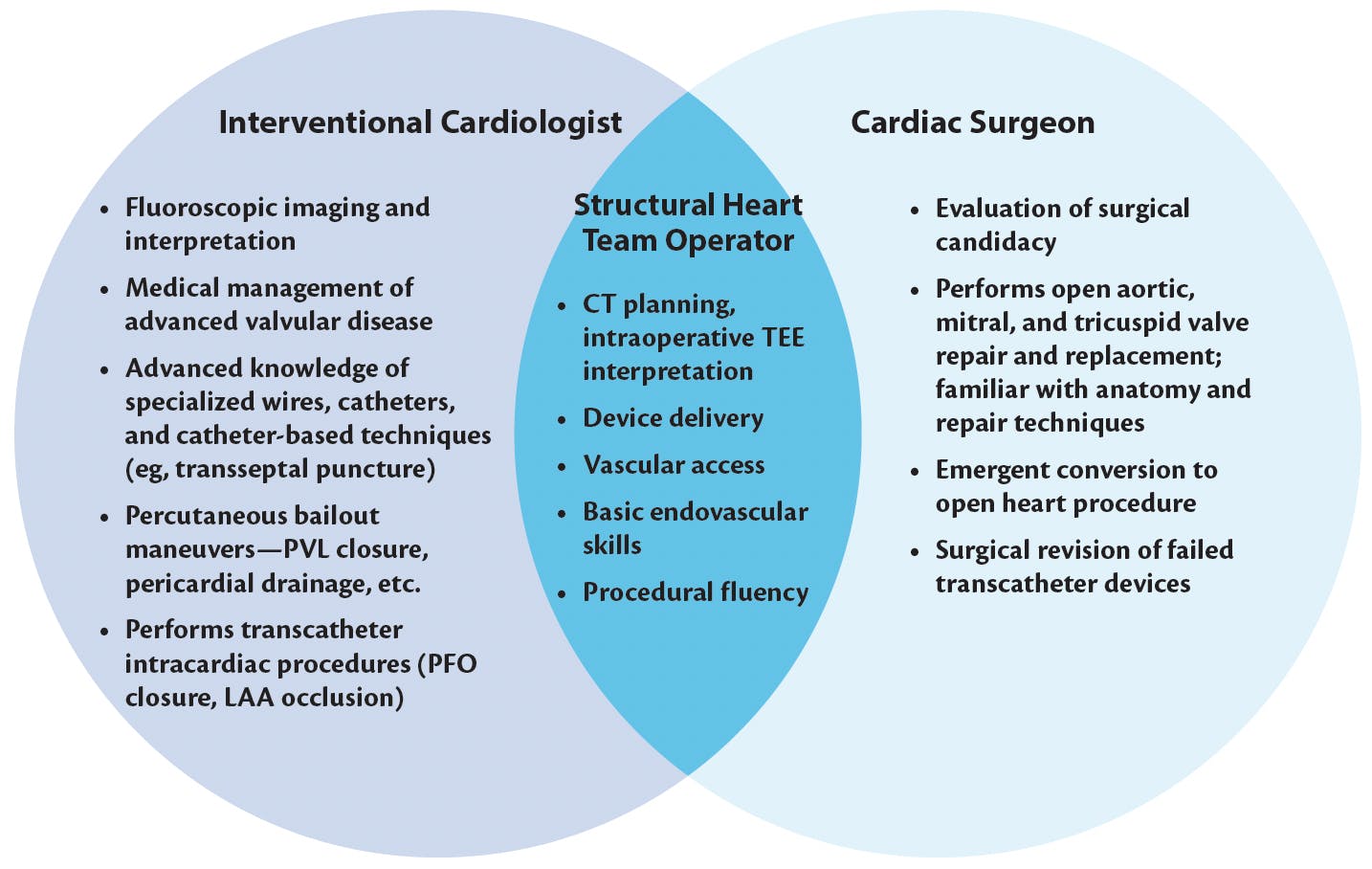
Figure 1. The ideal structural heart team is composed of clincians with overlapping, complementary, and divergent skills, knowledge, and experience. LAA, left atrial appendage; PFO, patent foramen ovale; PVL, paravalvular leak; TEE, transesophageal echocardiography.
To this end, surgeons on the structural heart team must understand the nuances of procedural considerations that may increase the risk or decrease the chances of an optimal result with a transcatheter approach and ultimately send the patient along a transcatheter versus a surgical pathway. When structural cardiac surgeons operate on patients who are poor candidates for transcatheter approaches due to features such as low coronaries or a small annulus, they can leverage their specialized knowledge to tailor surgery to address these anatomic challenges and increase the chances of favorable anatomy for a low-risk valve-in-valve TAVR as a subsequent procedure, or to counsel patients regarding the option of a mechanical prosthesis. Given that transcatheter valve deployment can occur in a matter of seconds, two sets of well-trained eyes and hands can be the difference between a well-seated or an embolized valve.
Furthermore, surgical input can help determine when alternative access may be preferred over transfemoral access, and a heart team surgeon should gain familiarity and comfort with performing axillary and carotid exposures, as well as with groin cutdowns for femoral artery exposure. As momentum for the application of TAV-in-TAV increases, the heart team surgeon must remain knowledgeable about the current literature and be able to provide patients with objective information to help guide decision-making in this evolving area with limited long-term data; similar unknowns will arise in the application of newer valvular therapies whose long-term durability and outcomes are yet to be fully vetted.
Although interventional cardiologists often have greater experience and are more facile with many of the procedural steps necessary for catheter-based structural procedures, surgeons are more experienced in the treatment of conditions such as aortic insufficiency or tricuspid and mitral regurgitation, and they have greater familiarity with the anatomy and physiology of patients undergoing valvular interventions. As long as surgical repair/replacement remains the gold standard for many of these conditions, the participation of a surgeon in determining which patients are candidates for open repair is necessary to prevent the inappropriate application of therapies outside their approved scope.
A NEW ERA OF STRUCTURAL TRAINING
Given the previously noted lack of surgical training programs in transcatheter structural heart interventions, many of the most proficient cardiac surgeons involved in structural teams at present have acquired their training on the job and thus have demonstrated that this is a viable pathway to becoming a facile endovascular operator. However, as transcatheter technologies continue to evolve, there may be benefits to revisiting a formal structural surgical training pathway to guarantee that minimum standards are met regarding procedural experience and/or operator skill. This can be achieved via a formal curriculum with increased emphasis on procedural planning and problem solving prior to time spent in the angiography suite. At present, opportunities for formal training within the cardiac surgical pathway remain limited; program directors and trainees alike feel the pressure of achieving proficiency in open surgical skills in the face of increasingly complex cases, which ironically are driven by conditions such as failed/infected transcatheter devices or patients deemed unsuitable for endovascular therapy.
However, as more cardiac surgeons are trained via integrated 6-year pathways directly from medical school, this offers a more longitudinal training environment that is well-suited to incorporating both structural/endovascular and open surgical skills.5 Additionally, cardiac surgeons have an increasing number of applications for a catheter-based skill set, as endovascular interventions for the treatment of aortic pathology are also rapidly advancing. Increasingly, more surgeons have experience with ultrasound-guided, large-bore vascular access for diverse applications, such as percutaneous mechanical circulatory support devices and aortic endografts. More than any defined number of required procedures, the cardiac surgical community must commit to an increased emphasis on building of an endovascular skill set.
SUMMARY
A functioning heart team requires a knowledgeable and skilled surgeon able to participate in patient selection, case preparation, and device selection, and present and scrubbed into each case. Rotating roles and responsibilities from case to case allows for the acquisition of specific skills, such as vascular access, angiography, wire management, positioning of a temporary pacing wire, and eventually positioning and deployment of a transcatheter valve. Although many surgeons may quickly become proficient in the purely technical and mechanical aspects of catheter-based procedures, it is important to realize that the more subtle aspects of understanding correct wire placement, appropriate application of force to prevent a perforation, and interpretation of fluoroscopic images represent a deeper mastery of transcatheter procedures that is a unique and specialized skill set requiring dedicated effort and repetition to achieve. Both trainees and practicing surgeons can also leverage their relationships with industry to take advantage of the educational and training resources available to improve comfort and knowledge of the various devices and procedural considerations.
As structural surgeons mature in their roles and skill sets, they can provide a valuable and singular perspective as the only member of the heart team able to assess a patient from the vantage point of being able to perform all available therapeutic procedures and having an intimate understanding of the pros and cons of each approach for each individual patient. If cardiac surgeons rise to the occasion and fully capitalize on the opportunities available to them as a member of the structural heart team, they have the opportunity to accelerate and help guide the successful application of the rapidly evolving transcatheter technologies to patients who may benefit the most. Both surgeons and their interventional colleagues should have a vested interest in developing a new generation of surgeons who have a broad understanding of valvular pathologies and the myriad open, transcatheter, and hybrid approaches that can be applied to develop individualized therapeutic approaches for each patient.
1. Carroll JD, Mack MJ, Vemulapalli S, et al. STS-ACC TVT registry of transcatheter aortic valve replacement. J Am Coll Cardiol. 2020;76:2492-2516. doi: 10.1016/j.jacc.2020.09.595
2. Arjomandi Rad A, Streukens S, Vainer J, et al. The current state of the multidisciplinary heart team approach: a systematic review. Eur J Cardiothorac Surg. 2024;67:ezae461. doi: 10.1093/ejcts/ezae461
3. Pirelli L, Grubb KJ, George I, et al. The role of cardiac surgeons in transcatheter structural heart disease interventions: the evolution of cardiac surgery. J Thorac Cardiovasc Surg. Published online October 28, 2024. doi: 10.1016/j.jtcvs.2024.10.037
4. Pineda AM, Harrison JK, Kleiman NS, et al. Incidence and outcomes of surgical bailout during TAVR: insights from the STS/ACC TVT registry. JACC Cardiovasc Interv. 2019;12:1751-1764. doi: 10.1016/j.jcin.2019.04.026
5. Han JJ, Brown CR. The heart team: a powerful paradigm for the future training of cardiovascular surgeons. J Am Coll Cardiol. 2018;71:2702-2705. doi: 10.1016/j.jacc.2018.05.001
Advertisement
Advertisement