Advertisement
Advertisement
July/August 2025
Interatrial Shunts: A Promising Therapy for HFpEF or Disappointing Mirage?
Highlighting the potential of interatrial shunting in a population with limited therapeutic options.
The incidence of heart failure (HF) continues to rise, with an estimated 6.7 million Americans aged ≥ 18 years with the diagnosis—this prevalence is estimated to increase to 8.7 million Americans afflicted by 2030 and 11.4 million by 2050.1 A clear definition of HF can be challenging; however, the Universal Definition and Classification of HF defines it as a clinical syndrome with symptoms and/or signs caused by a structural and/or functional abnormality and corroborated by elevated natriuretic peptide levels and/or objective evidence of pulmonary or systemic congestion.2 Classification of HF by left ventricular ejection fraction (LVEF) was also revised and defined as:2
- HF with reduced ejection fraction (HFrEF): Symptomatic HF with LVEF < 40%
- HF with mildly reduced ejection fraction (HFmrEF): Symptomatic HF with LVEF of 41% to 49%
- HF with preserved ejection fraction (HFpEF): Symptomatic HF with LVEF ≥ 50%
- HF with improved ejection fraction (HFimpEF): Symptomatic HF with a baseline ≤ 40%, a ≥ 10-point increase from baseline LVEF, and a second measurement of LVEF > 40%
Although there are differences in LVEF, patients with HFpEF present with similar signs and symptoms as patients with HFrEF, and data from the Framingham Heart Study and Cardiovascular Health study show that patients with HFpEF and HFrEF share similar mortality risk.1 Despite this, there is limited medical therapy for HFpEF, with the established four pillars of guideline-directed medical therapy primarily directed at treating patients with HFrEF.
DIAGNOSIS OF HFpEF
Diagnosis of HFpEF can be challenging, given the significant heterogeneity in the etiology, treatment, or presentation, especially in men versus women. Traditionally, the diagnosis of HFpEF involves symptoms of shortness of breath with objective evidence of elevated filling pressures such as findings on echocardiography, including abnormal relaxation patterns (septal e’ < 7 cm/second, lateral e’ < 10 cm/second, left atrial volume index of > 34 mL/m2); or invasive hemodynamics including elevated pulmonary pressures and pulmonary capillary wedge pressures (PCWPs).3,4 Exercise provocation is critical, as resting filling pressures may be normal and falsely exclude the diagnosis (Figure 1).4,5
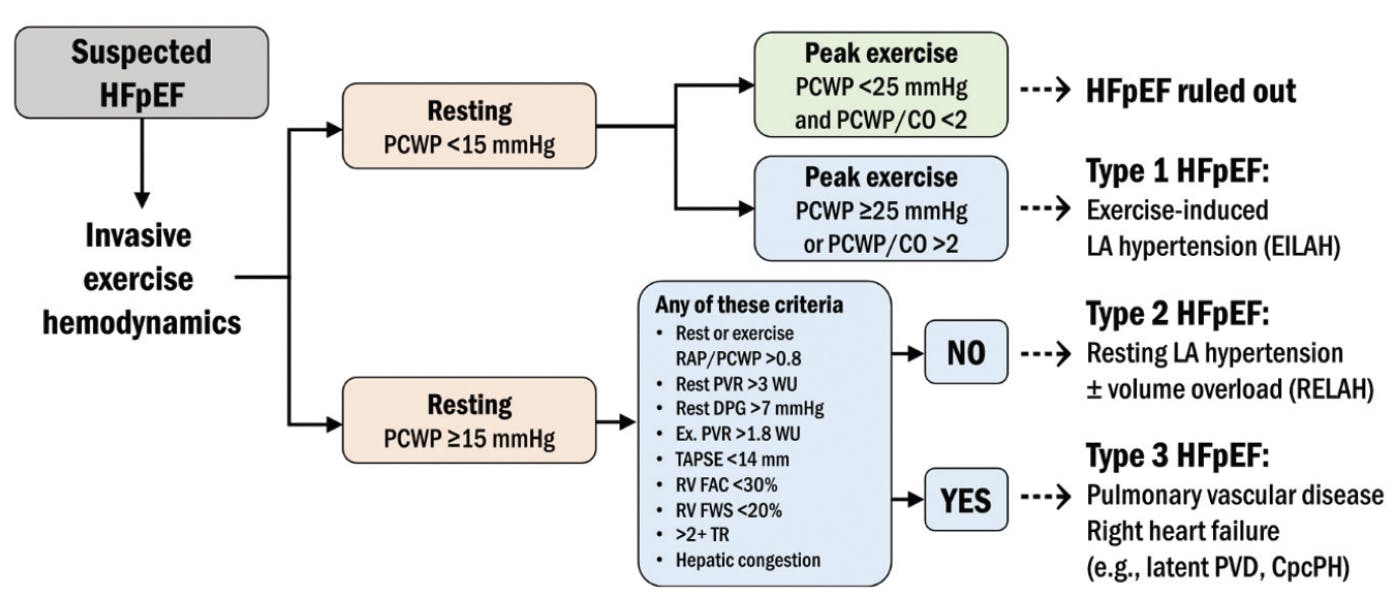
Figure 1. Exercise hemodynamics and HFpEF phenotypes. CO, cardiac output; CpcPH, combined postcapillary and precapillary pulmonary hypertension; EILAH, exercise-induced left atrial hypertension; Ex, exercise; FAC, fractional area change; FWS, free wall strain; PCWP, pulmonary capillary wedge pressure; PVR, pulmonary vascular resistance; RAP, right atrial pressure; RELAH, resting left atrial hypertension; RV, right ventricular; TAPSE, tricuspid annular plane systolic excursion; TR, tricuspid regurgitation. Reprinted from Jagadeesan V, Gray WA, Shah SJ. Atrial shunt therapy for heart failure: an update. J Soc Cardiovasc Angiogr Interv. 2023;2:101203.
Establishing the diagnosis of HFpEF can still be elusive, as structural abnormalities may not always be present on an echocardiogram, may not correlate with symptoms or corroborating biomarkers such as natriuretic peptides, and can be falsely low such as in patients with obesity.3 In such cases, the use of a scoring system can offer a more practical way to diagnose HFpEF. The H2FPEF score, the most practical system used for establishing the diagnosis of HFpEF, incorporates objective data and risk factors most commonly associated with the development of HFpEF, with a score of ≥ 6 being highly suggestive of HFpEF.3
LEFT ATRIAL DECOMPRESSION
Given the limited options for medical therapy, device-based therapies have become increasingly attractive for this patient population, given the possibility of improving quality of life (QOL), decreasing symptom burden, and preventing adverse events. Transcatheter atrial shunt therapies, designed to create a conduit from the left atrium (LA) to the right atrium (RA), have been investigated as a possible treatment for HFpEF in an attempt to unload the LA and reduce pressure at both rest and exertion.6
The rationale for interatrial shunt therapy is founded on the pathophysiology of HFpEF, which is characterized by increased left ventricular (LV) mass leading to impaired relaxation, decreased LV stroke volume, and resultant left-sided elevated filling pressures.7 Given that the right ventricle is inherently designed to receive systemic preload and is generally preserved in early stages of HFpEF, shunting to the RA theoretically could improve right-sided afterload, decrease LV preload, and improve pulmonary venous congestion.3,4,8
DEVICES
The InterAtrial Shunt Device (IASD; Corvia Medical Inc.) and the V-Wave Ventura interatrial shunt system (V Wave Inc.) are the two most well-studied devices to date, although there are others currently under investigation (Figure 2).4 The IASD consists of a nitinol stent-like barrel with LA and RA flanges and central hole for creating an 8-mm interatrial shunt. The V-Wave Ventura device is a nitinol hourglass shape with expanded polytetrafluorethylene encapsulation and three pericardial leaflets sutured to ensure unidirectional flow with a shunt size of 5 mm.9 Additional devices that are currently being studied include the Atrial Flow Regulator (Occlutech Inc.), a nitinol braid with a central orifice that is currently undergoing evaluation in FROST-HF and PROLONGER trials, as well as a prospective registry (AFtER Registry) to monitor safety and effectiveness. An additional device, the Apture Shunt (Edwards Lifesciences), although also a nitinol device, differs from the other devices by creating a shunt from the LA to the coronary sinus.10 It is currently being investigated in the ALT-FLOW II clinical trial to study safety, performance, and efficacy.
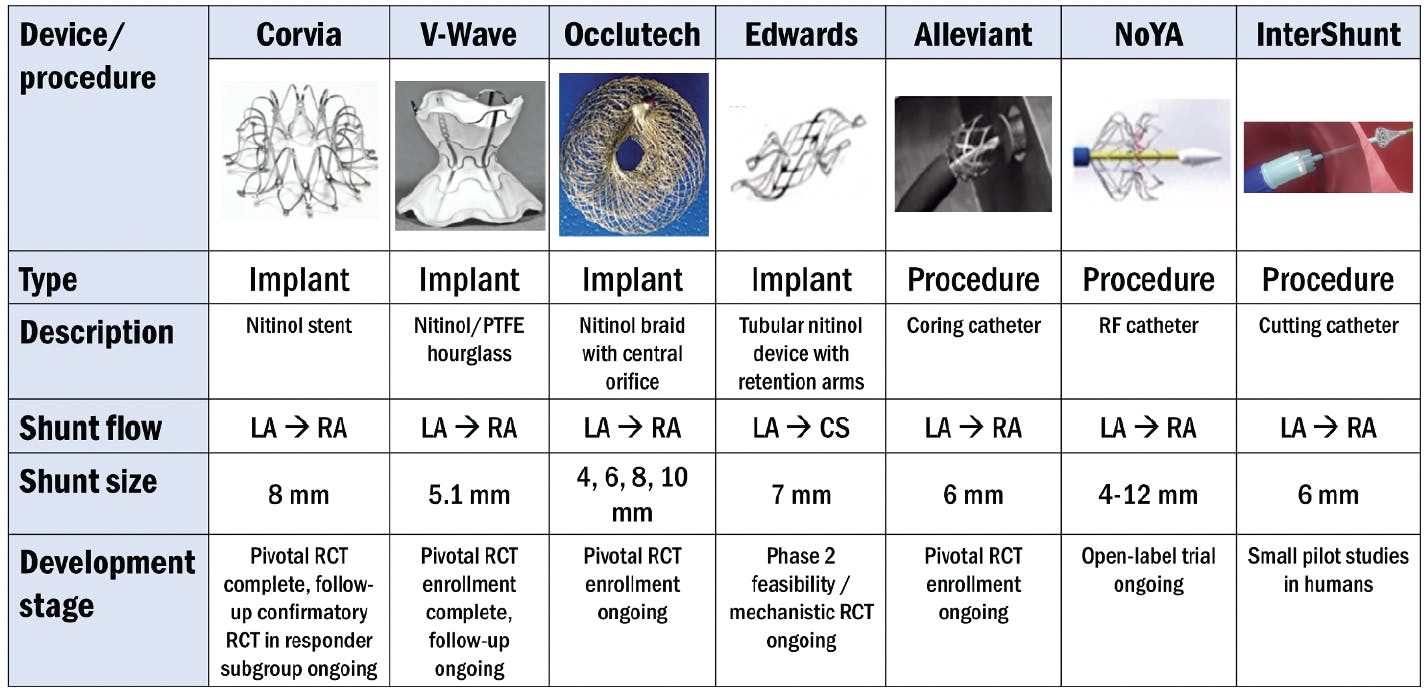
Figure 2. Interatrial shunt devices. CS, coronary sinus; LA, left atrium; PTFE, polytetrafluoroethylene; RA, right atrium; RCT, randomized clinical trial, RF, radiofrequency. Reprinted from Jagadeesan V, Gray WA, Shah SJ. Atrial shunt therapy for heart failure: an update. J Soc Cardiovasc Angiogr Interv. 2023;2:101203.
Typically, shunts are implanted via a transseptal puncture with a 14- to 16-F sheath advanced into the LA and device deployment through a delivery system. Although variable based on the device, either indefinite antiplatelet therapy with aspirin, dual antiplatelet therapy with aspirin and P2Y12 inhibitor, or direct oral anticoagulation therapy or warfarin for 6 months postprocedure is utilized.
CLINICAL TRIALS
Current evidence of the use of interatrial shunts is limited, although rapidly expanding with many ongoing pivotal trials. Designing clinical trials for patients with HFpEF has been historically challenging given the wide and varied phenotypes of HFpEF. Thus, knowing which therapeutic strategy can be beneficial for a particular phenotype of HFpEF can be difficult to predict.
IASD Trials and Results
The first study of the IASD was a pilot study including 11 patients with LVEF > 45% with New York Heart Association (NYHA) class III/IV symptoms.11 The study was notable for a significant decrease in PCWP without change in right atrial or pulmonary pressures, a significant improvement of QOL, 6-minute walk test (6MWT), and NYHA class at 30-day follow-up. This pilot study demonstrated device safety.11
REDUCE LAP-HF I was a sham-controlled, double-blinded study consisting of 44 patients, in which patients were randomized to IASD versus medical therapy.12 At 30-day follow-up, patients in the IASD group had a significant reduction in PCWP compared to the sham control group and a greater reduction in PCWP during exercise (P = .028). However, both arms had an improvement in QOL and exercise capacity, with no significant difference in functional status. The study was also notable for similar rates of survival at 12 months with one death in each group.12
This led to the pivotal REDUCE-LAP HF II study, a randomized, sham-controlled, double-blinded trial of the IASD versus medical therapy. The trial randomized 626 patients with both HFpEF and HFmrEF, with primary endpoints of cardiovascular mortality, nonfatal ischemic stroke, total rate of HF events (defined as hospital admissions or acute health care facility visits), and change in Kansas City Cardiomyopathy Questionnaire (KCCQ) baseline summary score.13 At 2 years of follow-up, there was no difference in the primary endpoints of cardiovascular death or nonfatal ischemic stroke, total HF events, or change in KCCQ score between patients treated with IASD (n = 309) versus the sham control (n = 312) group. However, the shunt demonstrated patency at 2 months in 98% of the shunt group, and a low rate of safety events was noted in the trial.13 A subset of patients identified as the “responders,” defined as exercise peak pulmonary vascular resistance < 1.74 Wood units and without cardiac implantable electronic device, demonstrated clinical benefit. This formed the basis of the RESPONDER-HF trial, which is ongoing to assess if narrowing the specific HFpEF type will lead to favorable results in patients receiving interatrial shunt therapy.
V-Wave Ventura Trials and Results
The V-Wave Ventura interatrial shunt is the first interatrial device that was investigated in both HFreF and HFpEF cohorts. In the first open-label, feasibility study, 38 patients were enrolled (n = 30 for HFrEF patients; n = 8 for HFpEF patients).14 In this study, patients were followed for a median of 28 months. Patients implanted with the V-Wave Ventura device had an improvement in their NYHA class and 6MWT (28 ± 83 m) at 12 months, with improvement of QOL as early as within the first 3 months after implantation. Notably, there was a 14% (n = 5) occlusion rate and 36% (n = 13) stenosis rate due to pannus infiltration of the bioprosthetic valve inside the V-Wave Ventura shunt. However, patients without occlusion or pannus formation demonstrated improvement in PCWP (23.3 ± 5.4 mm Hg at baseline to 18.0 ± 4 mm Hg at 12 months; P = .011).14
The follow-up trial, RELIEVE-HF, was a pivotal trial for the second-generation V-Wave Ventura shunt. In the open label/roll in cohort trial, 97 patients were enrolled, with both HFpEF (n = 48) and HFrEF (n = 49).15 Although the trial findings included improvement in LV end systolic and diastolic volume, LVEF, and right ventricular (RV) function as measured by TAPSE (tricuspid annular plane systolic excursion) and RV fractional area change in both arms, the trial did not demonstrate a benefit in the primary endpoint, a composite of all-cause death, need for LV assist device or heart transplant, HF hospitalization, or QOL change (defined as worsening HF events; annualized rate of events in the shunt group: 55.7% vs 56.0% for placebo; relative risk [RR], 1.0; 95% CI, 0.83-1.20; P = .96).15 In the HFpEF group (EF > 40%), patients implanted with the shunt had a greater risk for all-cause cardiovascular events (shunt vs placebo: 60.2% vs 35.9%; RR, 1.68; 95% CI, 1.29-2.19; P = .001). Interestingly, the study also noted improvements in the KCCQ score and 6MWT in both arms.
ANALYSIS AND FUTURE DIRECTIONS
Comparisons across trials is hard to perform when fundamental trial designs differ and recruit different populations. Unlike REDUCE-LAP II, the RELIEVE-HF trial enrolled both HFpEF and HFrEF patients and included a population with more advanced disease. This was reflected in the difference in their biomarker profile, with RELIEVE-HF trial enrolling patients with a B-type natriuretic peptide (BNP) > 300 pg/mL or N-terminal pro–B-type natriuretic peptide (NT-proBNP) of > 1,500 pg/mL, compared to REDUCE-LAP II in which the natriuretic peptide cutoff was a BNP > 50 pg/mL or NT-proBNP of 150 ng/mL.4 Additionally, RELIEVE-HF had more stringent hemodynamic inclusion criteria, with REDUCE-HF allowing for inclusion if PCWP elevation occurred with rest (< 25 mm Hg). Last, patients enrolled in RELIEVE-HF had a greater degree of ischemic disease and overall worse hemodynamics compared to patients in REDUCE-LAP II.
SUMMARY
Interatrial shunting holds promise in a landscape that is barren for therapeutic options, especially in HFpEF. This population in particular has a poor QOL and high symptom/pill burden. The primary challenge is appropriately identifying the particular HFpEF phenotype that may benefit from interatrial shunt therapy. This phenotypic differentiation can be elucidated with exercise provocation during invasive hemodynamic testing. The current existing evidence for shunt therapy is largely small randomized trials and those focused on demonstrating efficacy and safety.
Reminiscent of the decades of trials that went into identifying the exact patient profile to benefit from cardiac resynchronization therapy, interatrial shunt therapy continues on a similar journey. Although exciting and novel, its most profound benefit has to be refined and honed through iterative large randomized clinical trials. This space is in need of continued investigation with large, multicenter, sham-controlled trials that exhibit standardized inclusion criteria. Consistent clinical trial design is key to shortening the overall investigative journey for improving the morbidity, functional impairment, pill burden, and QOL in a challenging patient population.
1. Bozkurt, Ahmad T, Alexander K, et al. HF STATS 2024: heart failure epidemiology and outcomes statistics an updated 2024 report from the Heart Failure Society of America. J Card Fail. 2025;31:66-116. doi: 10.1016/j.cardfail.2024.07.001
2. Bozkurt B, Coats AJ, Tsutsui H, et al. Universal definition and classification of heart failure: a report of the Heart Failure Society of America, Heart Failure Association of the European Society of Cardiology, Japanese Heart Failure Society and Writing Committee of the Universal Definition of Heart Failure. J Card Fail. 2021:S1071-9164(21)00050-6. doi: 10.1016/j.cardfail.2021.01.022
3. Lilly SM, Zahr F, Belkin MN, et. Device therapy for heart failure with preserved ejection fraction: the problem, the mechanism, the device, the trial. Catheter Cardiovasc Interv. Published online May 28, 2025. doi: 10.1002/ccd.31638
4. Jagadeesan V, Gray W, Shah S. Atrial shunt therapy for heart failure: an update. J Soc Cardiovasc Angiogr Interv. 2023;2:101203. doi: 10.1016/j.jscai.2023.101203
5. Pieske B, Tschöpe C, de Boer RA, et al. How to diagnose heart failure with preserved ejection fraction: the HFA–PEFF diagnostic algorithm: a consensus recommendation from the Heart Failure Association (HFA) of the European Society of Cardiology (ESC). Eur Heart J. 2019;40:3297-3317. doi: 10.1093/eurheartj/ehz641
6. Malek F, Neuzil P, Gustafsson F, et al. Clinical outcome of transcatheter treatment of heart failure with preserved or mildly reduced ejection fraction using a novel implant. Int J Cardiol. 2015;187:227-228. doi: 10.1016/j.ijcard.2015.03.198
7. Obokata M, Reddy YNV, Shah SJ, et al. Effects of interatrial shunt on pulmonary vascular function in heart failure with preserved ejection fraction. J Am Coll Cardiol. 2019;74:2539-2550. doi: 10.1016/j.jacc.2019.08.1062
8. Lam CSP, Roger VL, Rodeheffer RJ, et al. Pulmonary hypertension in heart failure with preserved ejection fraction. J Am Coll Cardiol. 2009;53:1119-1126. doi: 10.1016/j.jacc.2008.11.051
9. Guimaraes L, Lindenfeld J, Sandoval J. Interatrial shunting for heart failure: current evidence and future perspectives. EuroIntervention. 2019;15:164-171. doi: 10.4244/EIJ-D-18-01211
10. Hibert B, Zahr F, Simard T, et al. Left atrial to coronary sinus shunting for treatment of symptomatic heart failure. JACC Cardiovasc Interv. 2023;16:1369-1380. doi: 10.1016/j.jcin.2023.03.012
11. Søndergaard L, Reddy V, Kaye D, et al. Transcatheter treatment of heart failure with preserved or mildly reduced ejection fraction using a novel interatrial implant to lower left atrial pressure. Eur J Heart Fail. 2014;16:796-801. doi: 10.1002/ejhf.111.
12. Feldman T, Mauri L, Kahwash R, et al. Transcatheter interatrial shunt device for the treatment of heart failure with preserved ejection fraction (REDUCE LAP-HF I): a phase 2, randomized, sham-controlled trial. Circulation. 2018;137:364-375. doi: 10.1161/CIRCULATIONAHA.117.032094
13. Shah SJ, Borlaug BA, Chung ES, et al. Atrial shunt device for heart failure with preserved and mildly reduced ejection fraction (REDUCE LAP-HF II): a randomised, multicentre, blinded, sham-controlled trial. Lancet. 2022;399:1130-1140. doi: 10.1016/S0140-6736(22)00016-2
14. Rodes-Cabau J, Bernier M, Amat-Santos IJ, et al. Interatrial shunting for heart failure: early and late results from the first-in-human experience with the V-Wave system. JACC Cardiovasc Interv. 2018;11:2300-2310. doi: 10.1016/j.jcin.2018.07.001
15. Stone GW, Lindenfeld J, Rodés-Cabau J, et al. Interatrial shunt treatment for heart failure: the randomized RELIEVE-HF trial. Circulation. 2024;150:1931-1943. doi: 10.1161/circulationaha.124.070870
Advertisement
Advertisement