Advertisement
Advertisement
July/August 2025
Building Multidisciplinary Teams in Interventional Cardiology
Exploring the benefits and challenges of a multispecialty team approach to optimize patient outcomes in the areas of pulmonary embolism, renal denervation, limb salvage, and carotid disease.
Multidisciplinary program building is a cornerstone of comprehensive cardiovascular care. Building diverse teams has repeatedly been shown to be superior to individual decision-making.1-3 As cardiologists, multidisciplinary programs have enabled us to extend care to systems beyond the heart and coronary arteries, allowing for more comprehensive care of our patients. In this article, we discuss the benefits and challenges of building four different types of multidisciplinary teams in which stakeholders from various backgrounds and specialties have worked together4-7: pulmonary embolism response team (PERT), renal denervation (RDN), limb salvage for chronic limb-threatening ischemia (CLTI), and carotid disease interventions.
Perspectives on Collaborating in a Multidisciplinary PERT and RDN Program

MULTIDISCIPLINARY PERT
PERTs may be one of the best and most widespread examples of multidisciplinary collaboration to enhance patient care in all of modern medicine. Multidisciplinary PERTs have been shown to reduce mortality and hospital stay duration.8 I have had the opportunity to participate in PERT programs at two very different centers—a large academic center (NewYork-Presbyterian/Columbia University Irving Medical Center in New York City) and a community center (Terrebonne General Health Science Center in Houma, Louisiana)—and discuss the difference in collaborative styles in the two locations.
PERTs can include partners from pulmonary-intensive care, cardiology, hospital medicine, hematology, emergency medicine, interventional radiology, vascular surgery, and cardiothoracic surgery, with significant variability in PERT composition across geographic areas.9 In the two centers where I have worked, interventional cardiology performed the vast majority of invasive procedures and frequently coordinated PERT meetings.
During my time at Columbia, there was a designated PERT pager that was manned at all times by an interventional cardiology fellow and attending. The “PERT pager” was the key to triggering an evaluation by the team and remains widely utilized. Approximately four to five faculty attendings took primary PERT calls, which were distinct from calls for ST-segment elevation myocardial infarction (STEMI). Philip Green, MD, was the primary driving force behind establishing the PERT and helped write the initial treatment protocols (which were primarily based on lytics or catheter-directed lysis). The program grew rapidly and is now one of the busiest PERT programs in the country, led by Sanjum Sethi, MD; Sahil Parikh, MD; Ajay Kirtane, MD; and Jody Mintz, DO, among others.
At the inception of the PERT, Dr. Green made himself available nearly 365/24/7 for PERT calls. As others were trained and gained interest, the responsibilities were divided, particularly among those with a focus in peripheral vascular interventions. Our multidisciplinary partnerships with cardiothoracic surgery, pulmonary-intensive care, hematology, and the emergency department were critical to the program’s success. Formal meetings were held in the early years, but over time, this devolved into “as-needed” individual discussions. Cardiothoracic surgery and our cardiogenic shock team became critical parts of the PERT, as extracorporeal membrane oxygenation (ECMO) was utilized for patients with massive PE and obstructive shock.
Furthermore, cardiothoracic surgery involvement helped grow the role of PERT in treating clots-in-transit and right-sided endocarditis. This procedural expansion occurred organically with the PERTs’ multidisciplinary collaboration, the overlap in technologies for mechanical thrombectomy, and the emergence of strong data supporting their use.10,11
One important and initially unexpected component of the PERT program was the development of a close working relationship with the pulmonary hypertension group for the evaluation and treatment of patients with chronic thromboembolic pulmonary hypertension (CTEPH). The PERT partnership enhanced the CTEPH program at Columbia, which comprises the surgical program led by Koji Takeda, MD, as well as the balloon pulmonary angioplasty program led by Ajay Kirtane, MD. This collaboration has led to improved diagnosis and treatment of CTEPH patients.
Today, I am working in a much smaller practice setting in Houma, Louisiana, which serves a patient base of approximately 100,000. Expectedly, the PERT consult volume is lower than in Manhattan. In Houma, we average approximately two to three consults per week. We do not have a PERT-specific pager, as it was not felt to be needed, given the very close multidisciplinary provider relationships that exist at our center. For example, nearly every hospitalist and emergency department provider has my cell phone number and can call me directly to discuss PERT cases.
Through frequent multidisciplinary meetings, we have built working relationships among the hospital practitioners to a degree that would only be possible in a smaller community setting; and in general, our cardiology group is consulted on nearly all patients with a PE or deep vein thrombosis. All interventionalists who take call at our center have been trained in catheter-directed thrombectomy and catheter-directed lysis, and therefore, PERT call is folded into primary STEMI call. Lastly, because we do not have ECMO at our hospital, cardiothoracic surgery plays less of a role in PERT management, although they participate in management of our highest-acuity cases.
BUILDING A MULTIDISCIPLINARY RDN PROGRAM
RDN has returned to the forefront of interventional care with recent FDA decisions for premarket approval of RDN for resistant hypertension. Two devices have received approval: the Symplicity Spyral (Medtronic) and Paradise (Recor Medical) catheters. At our center, we have recently worked to build an RDN program that emphasizes a multidisciplinary team approach composed of the invasive proceduralist (in our case an interventional cardiologist), pharmacist, nutritionist, sleep medicine specialist, endocrinologist, smoking cessation provider, primary care physician, and primary cardiologist.
Patients are generally referred for consideration of RDN if they are on three or more antihypertensive medications (one of which is a diuretic) and their blood pressure (BP) is still not at goal. First, we obtain an overall history and physical with a careful assessment of the patient’s medications. We will discuss ways to improve their BP based on their medications (eg, avoiding stimulant use or limiting use of nonsteroidal or steroidal anti-inflammatory drugs). We will utilize our electronic medical record to assess refills and, if needed, call the patient’s pharmacy to evaluate patient adherence.
Second, our group widely utilizes nutritionists to discuss lifestyle and dietary practices proven to improve BP control. We have seen significant improvements in BP control with the appropriate use of GLP-1 medications (in addition to lifestyle modification) and will consider adding these medications in conjunction with their primary care or endocrinologist in appropriate patients.
Third, Cardiovascular Institute of the South has had success in deploying remote patient BP management programs, which allow for careful tracking of patient BP data and can trigger alerts for BP significantly out of preset ranges. For our remote patient monitoring program, we have partnered with IronRod Health for data collection and home BP cuffs.
Fourth, if the patient’s BP still remains high, we will complete a targeted secondary hypertension workup. This workup typically includes blood work, sleep studies, and a renal arterial duplex ultrasound or CT with contrast to evaluate for renal artery stenosis/fibromuscular dysplasia.
Finally, after the initial workup, we will consider the patient for RDN and begin the process of getting approval from the patient’s insurance companies. For providers contemplating starting a new RDN program, one must understand that insurance approval remains a challenge given the novelty of these procedures. RDN approval often requires peer-to-peer or appeal letters. The exhaustive multidisciplinary workup presented previously helps to strengthen one's case for approval.
Optimizing CLTI and Carotid Disease Care Using a Multispecialty Approach

LIMB SALVAGE
Geographic variability dictates widely the experience of a patient afflicted by CLTI. Specifically, within the “amputation belt,”12 prominent disparities exist in limb salvage rates. This is typically multifactorial, including (1) underrecognition of the disease state from a patient perspective until late presentation due to poor education and awareness, (2) inability to attract high-level operators to areas traditionally underserved and less desirable from a living perspective, and (3) intrinsic and structural racism.13 Furthermore, operator expertise varies from one hospital to another, and patients seeking care even within a metropolitan area may experience differing levels of capability for aggressive limb salvage. Last, inherent to the differences in training through a vascular surgery program versus an endovascular interventional cardiology program, skill sets will differ from one type of operator to another.
As such, to optimize the experience for a patient at the final stage of evaluation for major amputation, we have generated the Limb Salvage Advisory Council (LSAC) to serve patients in the Cleveland area. Within the University Hospitals Harrington Heart and Vascular Institute, we have 12 vascular surgeons and five endovascular specialists, spread throughout nine free-standing hospitals with catheterization laboratories and operating rooms. For most patients, revascularization performed locally is sufficient. However, in a small proportion of patients who undergo unsuccessful intervention and are deemed to be destined for major amputation, we interject with LSAC discussion (Figure 1). The multidisciplinary team is convened in real time via a videoconference platform at the request of the provider. A limb preservation coordinator identifies the most optimal time within a 24-hour period that would allow a diverse mix of operators to be present for discussion. Typically, that consists of at minimum two vascular surgeons, two endovascular interventional cardiologists, and one podiatrist or wound care specialist. Patients are discussed in a supportive, nonjudgmental environment to encourage open sharing of even the most complex clinical and procedural cases without hesitation or stigma. If a patient is deemed to have a salvageable limb and an appropriate target for further revascularization attempt(s), then that is pursued. Feedback is given to the LSAC in a subsequent meeting on the progress of the patient and limb status. The volume of activation of LSAC has grown progressively, and we have marked an associated decrease in the number of major amputations within the University Hospitals Lorraine and Bill Dodero Limb Preservation Center since inception of LSAC in 2019 (Figure 2).
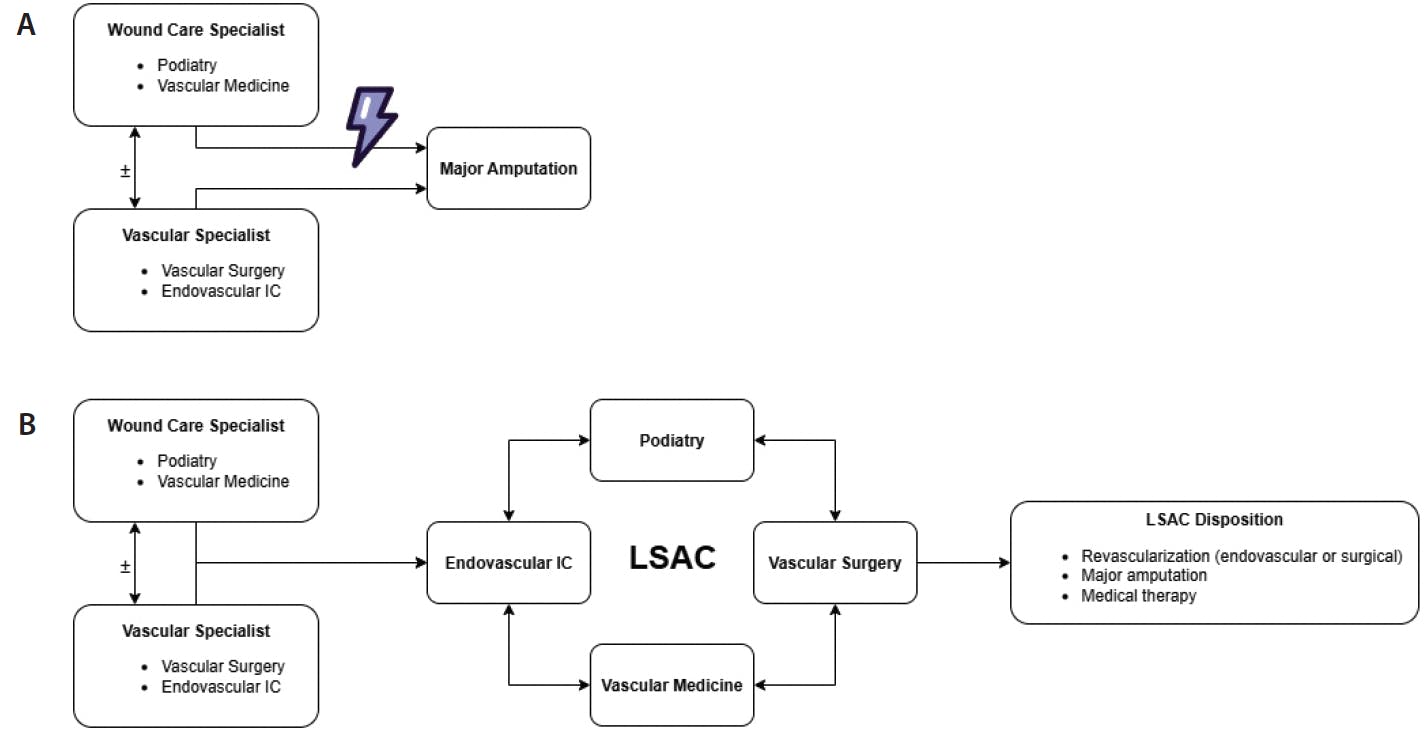
Figure 1. Current model for CLTI, with each specialty practicing in a relative “silo,” without a structured, multidisciplinary team approach to address a limb at risk of major amputation (A). To disrupt this pattern, LSAC can be interjected prior to major amputation. A team-based approach where patients at risk of major amputation undergo LSAC multidisciplinary team discussion first to discern best route of therapy on an individualized approach (B). IC, interventional cardiologist. Adapted from Shishehbor MH, Hammad TA, Rhone TJ, et al. Impact of interdisciplinary system-wide limb salvage advisory council on lower extremity major amputation. Circ Cardiovasc Interv. 2022;15:e011306. doi: 10.1161/CIRCINTERVENTIONS.121.011306
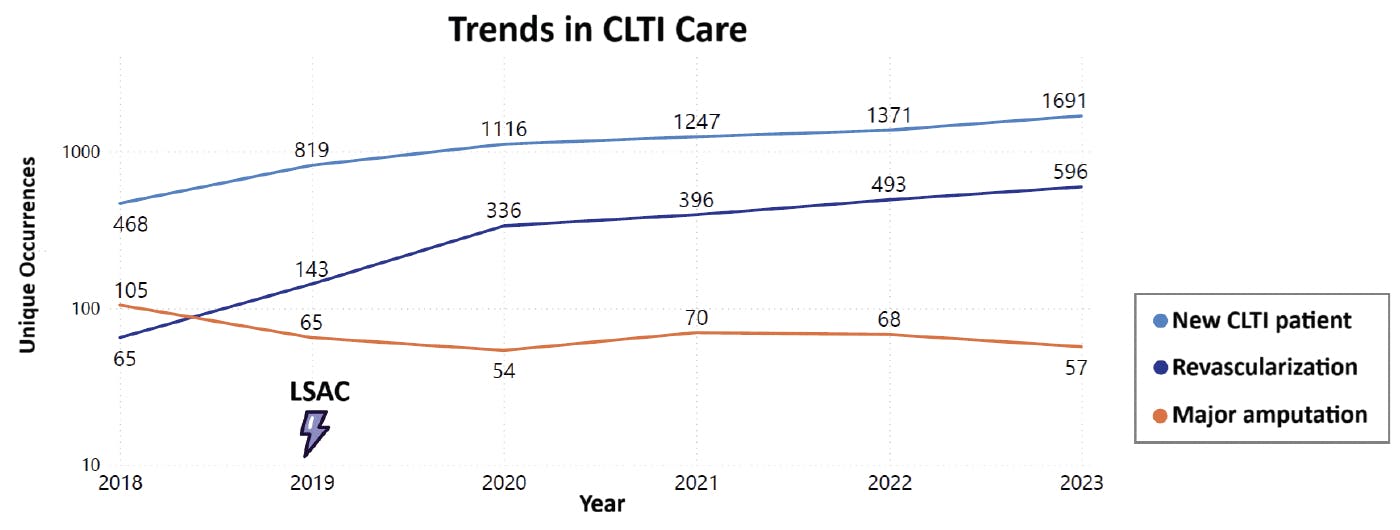
Figure 2. Program growth for CLTI unique patients, along with revascularization and major amputation trends over time. LSAC initiation was in 2019, as noted.
CAROTID DISEASE
For decades, coverage for carotid artery stenting (CAS) has been limited to selective patients, specifically those with symptomatic disease but deemed to be at high risk for surgery or those undergoing clinical trial enrollment or postmarket registry.14 In the last 2 years, the decision from Centers for Medicare & Medicaid Services (CMS) to expand the national coverage determination for percutaneous transluminal angioplasty of the carotid artery concurrent with stenting has altered the landscape of carotid revascularization.15 Alongside guideline-directed medical therapy, providers now have the ability to offer a full spectrum of revascularization choices to patients: carotid endarterectomy, CAS, or transcarotid artery revascularization.
Providing a patient-centric experience to allow the best strategy for revascularization in an individualized approach is vital for success of a carotid care team. Team models typically include vascular surgeons, interventional cardiologists, neurologists, neuroradiologists, and general practitioners to help collaboratively assess and risk stratify patients. Carotid care teams operate within structured pathways and/or protocols to facilitate timely consultation and shared decision-making with patients and family. Considerations for mode of therapy should take into account patient comorbidities, anatomic factors, local physician expertise, and local facility adjunctive services. Due to the lapse of coverage for CAS in the past 2 decades resulting in diminished procedural experience in interventionalists across all specialities, multisocietal recommendations have been made for training curriculum guidelines.14 Collaboration between subspecialties is integral to the success of training future generations of interventionalists in optimal carotid care. The framework of multidisciplinary carotid care teams promoting best practices will reduce stroke incidence, improve clinical outcomes, and advocate for evidence-based, patient-centered care.
CONCLUSION
Multidisciplinary teams have been shown to be effective in other subspecialties, including tumor boards, transplant teams, and structural heart. Similarly, the ability to infuse a multispecialty team approach into aspects of endovascular care in PE, limb salvage, RDN, and carotid management will optimize patient outcomes.
1. Shi Y, Li H, Yuan B, Wang X. Effects of multidisciplinary teamwork in non-hospital settings on healthcare and patients with chronic conditions: a systematic review and meta-analysis. BMC Prim Care. 2025;26:110. doi: 10.1186/s12875-025-02814-0
2. Epstein NE. Multidisciplinary in-hospital teams improve patient outcomes: a review. Surg Neurol Int. 2014;5(suppl 7):S295-S303. doi: 10.4103/2152-7806.139612
3. Monteleone PP, Rosenfield K, Rosovsky RP. Multidisciplinary pulmonary embolism response teams and systems. Cardiovasc Diagn Ther. 2016;6:662-667. doi: 10.21037/cdt.2016.11.05
4. Ozbek IC, Durmaz A, Ozen Y, et al. Effectiveness of carotid council in the treatment of carotid artery disease: early-term outcomes of the multidisciplinary approach. Vascular. 2024;32:573-578. doi: 10.1177/17085381231153222
5. Dudzinski DM, Piazza G. Multidisciplinary pulmonary embolism response teams. Circulation. 2016;133:98-103. doi: 10.1161/CIRCULATIONAHA.115.015086
6. Potthoff SA, Rump LC, Vonend O. The “resistant hypertension team”: focus on a multidisciplinary approach to hypertension. EuroIntervention. 2013;(9 suppl R):R48-R53. doi: 10.4244/EIJV9SRA9
7. Baillie C, Rahman S, Youssief A, et al. Multidisciplinary approach to the management of diabetic foot complications: impact on hospital admissions, limb salvage and amputation rates. Endocrinol Metab Int J. 2017;5:00119. doi: 10.15406/emij.2017.05.00119
8. Wright C, Goldenberg I, Schleede S, et al. Effect of a multidisciplinary pulmonary embolism response team on patient mortality. Am J Cardiol. 2021;161:102-107. doi: 10.1016/j.amjcard.2021.08.066
9. Barnes G, Giri J, Courtney DM, et al. Nuts and bolts of running a pulmonary embolism response team: results from an organizational survey of the National PERT™ Consortium members. Hosp Pract (1995). 2017;45:76-80. doi: 10.1080/21548331.2017.1309954
10. El Sabbagh A, Yucel E, Zlotnick D, et al. Percutaneous mechanical aspiration in infective endocarditis: applications, technical considerations, and future directions. J Soc Cardiovasc Angiogr Interv. 2024;3:101269. doi: 10.1016/j.jscai.2023.101269
11. Zhang RS, Yuriditsky E, Zhang P, et al. Comparing management strategies in patients with clot-in-transit. Circ Cardiovasc Interv. 2024;17:e014109. doi: 10.1161/CIRCINTERVENTIONS.124.014109
12. Lobo JM, Kang H, Brennan MB, et al. Regional and racial disparities in major amputation rates among medicare beneficiaries with diabetes: a retrospective study in the southeastern USA. BMJ Public Health. 2023;1:e000206. doi: 10.1136/bmjph-2023-000206
13. Grines CL, Klein AJ, Bauser-Heaton H, et al. Racial and ethnic disparities in coronary, vascular, structural, and congenital heart disease. Catheter Cardiovasc Interv. 2021;98:277-294. doi: 10.1002/ccd.29745
14. Li J, Feldman DN, Klein AJ, et al. Carotid artery stenting. J Soc Cardiovasc Angiogr Interv. 2024;3:102435. doi: 10.1016/j.jscai.2024.102435
15. Centers for Medicare & Medicaid Services. Percutaneous transluminal angioplasty (PTA) of the carotid artery concurrent with stenting. Accessed August 6, 2025. https://www.cms.gov/medicare-coverage-database/view/ncacal-decision-memo.aspx?proposed=N&ncaid=311
Advertisement
Advertisement