Advertisement
Advertisement
September/October 2024
T-TEER Versus TTVR: Considerations for Transcatheter Tricuspid Valve Therapy Choice
The clinical, anatomic, and echocardiographic criteria for selecting between tricuspid edge-to-edge repair and transcatheter tricuspid valve replacement for tricuspid regurgitation.
With the development of new transcatheter therapeutic options, tricuspid regurgitation (TR) has come to the forefront as an unmet need. It is recognized that moderate or higher TR adversely affects survival, morbidity, and quality of life. While the standard of care is medical therapy, medical therapy alone has a minimal long-term impact on TR. In one study, 95% of patients in the medical therapy arm had severe TR at 1 year compared to 13% in the transcatheter repair therapy arm.1 Surgery for isolated TR is rare, and the operative mortality for isolated severe TR can be as high as 10%. An increased interest in transcatheter interventions for TR culminated in recent FDA approval of tricuspid transcatheter edge-to-edge repair (T-TEER) and transcatheter tricuspid valve replacement (TTVR) following the results of the TRILUMINATE and TRISCEND studies, respectively.1,2
This article focuses on clinical, anatomic, and echocardiographic criteria for selection of transcatheter tricuspid valve therapies. To date, there have been no direct comparisons of these two therapies, but we hope to describe factors to consider when choosing the optimal therapy for patients.
CLINICAL EVALUATION
Patients with TR often present initially with fatigue that may then progress to dyspnea and extracardiac manifestations, predominantly involving the kidneys and liver. The chronic passive congestion can also lead to malabsorption and malnutrition presenting as ascites, coupled with lower extremity edema. Patients eventually develop overt right-sided heart failure, including anasarca. In the later stages of the disease, patients may develop cardiac cirrhosis and low-output renal failure part of a hepatorenal syndrome.
To potentially assist in choice of therapy, cardiac catheterization can provide additional information on the hemodynamic effects of TR, as well as ascertain the severity of left-sided heart disease and guide hemodynamic optimization. The presence of severe pulmonary hypertension and untreated left-sided valve disease were exclusions for TR device trials. In addition, the use of right ventricle–to–pulmonary artery (RV-PA) coupling ratio derived from echocardiogram and cardiac catheterization data may predict the risk of afterload mismatch and influence the choice of transcatheter therapy.3,4
Given the complexity of the disease, care of TR patients is best served within a multidisciplinary heart team. Newer risk scores have been developed to evaluate the risk of surgical intervention, including the multiparametric TRI-SCORE.5 However, the key to ensuring that therapy selection is tailored to individual patient is judgment by the heart team in a comprehensive valve center.
ANATOMIC EVALUATION
Although the tricuspid valve has generally been thought to have three leaflets, detailed echocardiographic evaluations have resulted in a new understanding that the anatomy can be varied and includes variants with two leaflets or multiple leaflets.6 An understanding of leaflet anatomy is crucial for T-TEER procedural planning and in order to restore leaflet coaptation. Leaflet anatomy is best assessed using transesophageal echocardiography (TEE) using the transgastric imaging plane to visualize the anterior papillary muscle and leaflet morphology. In addition to leaflet anatomy, other important anatomic assessments include evaluation of TR severity, mechanism of TR, location of the jet, assessment of coaptation gaps, and evaluation of device lead position and impact on TR.
IMAGING ASSESSMENT
Transthoracic echocardiography (TTE) is critical for the initial screening, which evaluates TR severity, RV function, PA pressures, and RV-PA coupling. In addition, given the frequency of concomitant left-sided valve disease, TTE is important for evaluating left ventricular function and the presence of significant mitral or aortic valve disease (Figure 1A).
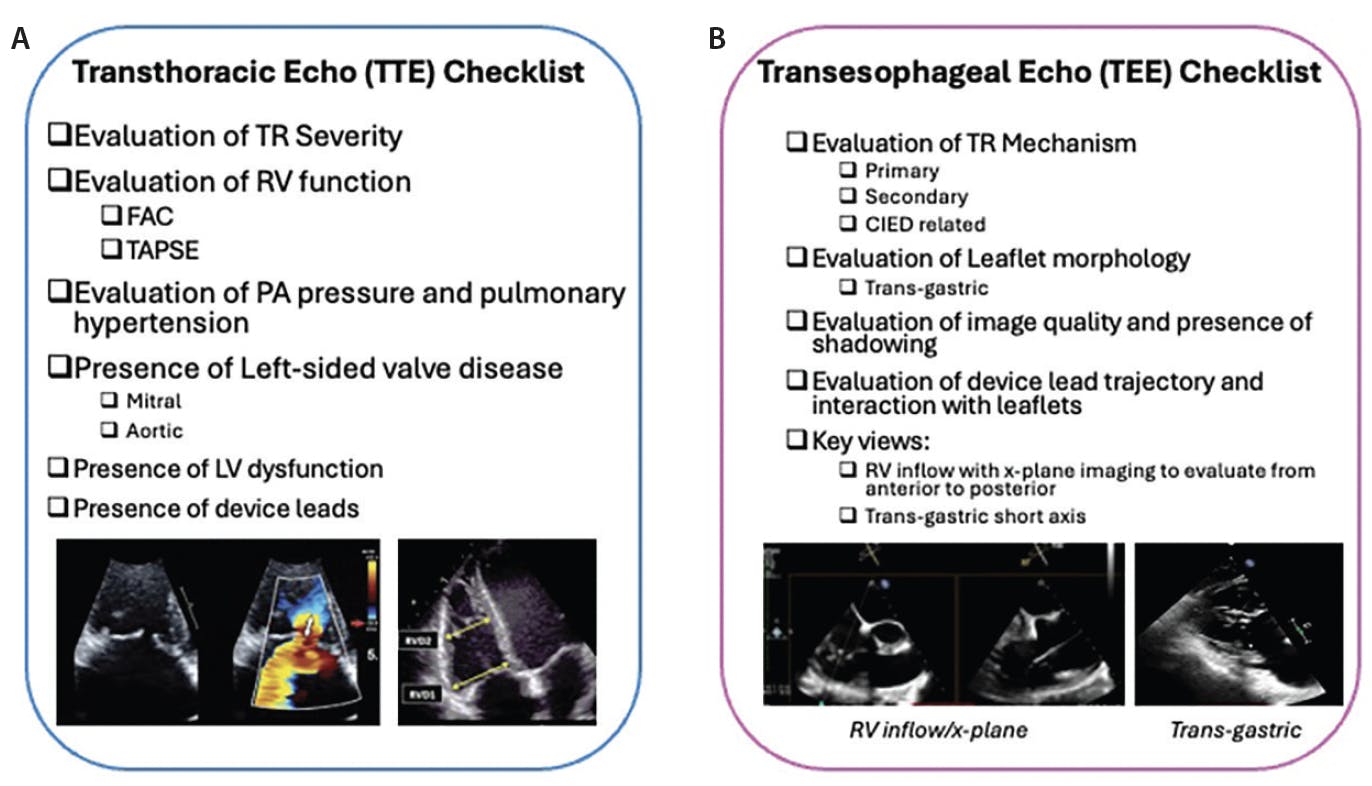
Figure 1. TTE (A) and TEE (B) imaging checklist for T-TEER. CIED, cardiac implantable electronic device; FAC, fractional area change; LV, left ventricular; TAPSE, tricuspid annular plane systolic excursion.
TEE follows standard TTE imaging and is most useful for determining the mechanism of TR (Figure 1B). Tricuspid valve regurgitation is now divided into four types: (1) primary TR, (2) secondary atrial TR, (3) secondary ventricular TR, and (4) cardiac implantable electronic device–related TR.
The mechanism of TR is more clearly elucidated using TEE imaging to evaluate leaflet morphology, number of coaptation planes, gaps in coaptation, leaflet length and number of leaflets, papillary muscle location, leaflet tethering, and leaflet anatomy. The path of device leads and its interaction with the tricuspid valve leaflets and subvalvular apparatus can also be evaluated using TEE.
One challenge of tricuspid valve interventions is related to valve imaging. TEE is the mainstay of procedural guidance, and therefore difficult or poor TEE imaging can make interventions more difficult and, in some cases, impossible. The development of three-dimensional (3D) intracardiac echocardiography (ICE) has provided a useful adjunct for tricuspid valve imaging and in some cases has rendered the impossible possible. Three-dimensional ICE provides imaging from inside the right atrium and reduces shadowing from imaging through cardiac structures—namely, the interatrial septum and mechanical left-sided valves. The availability of multiplanar imaging can also assist with challenging anatomy and leaflet grasping but is often associated with a decrease in imaging resolution. The ability to switch from 3D ICE to TEE imaging has helped increase procedural efficiency and facilitate transcatheter therapy, particularly T-TEER.
Cardiac CT is crucial for patient evaluation for TTVR and provides essential information on inferior vena cava offset from the tricuspid annulus, RV size and length, tricuspid annulus measurements, and procedural planning. In addition, it is a useful adjunct for imaging patients with device leads to evaluate lead trajectory and interaction with the subvalvular apparatus.
T-TEER
T-TEER is a transcatheter tricuspid valve repair technique that reduces TR by restoring leaflet coaptation through leaflet approximation, which indirectly reduces the annulus by anchoring lateral (anterior or posterior) leaflets to a more stable septal leaflet using TEE guidance under general anesthesia. T-TEER is the most commonly performed transcatheter repair of the tricuspid valve. It can be accomplished with TriClip (Abbott) or Pascal (Edwards Lifesciences), two steerable systems that use a transfemoral transvenous approach to restore tricuspid valve coaptation with either a clip or clasp device.
TriClip is the only currently approved device in the United States for T-TEER. It is deployed via a steerable device adapted for the tricuspid valve using TEE/ICE guidance. The clips are available in four sizes with a combination of clip lengths and widths (XTW, XT, NTW, NT) that are chosen depending on patient anatomy, leaflet lengths, and desired target location. Pascal, which is available in Europe, has a steerable guide catheter and sheath that can be adapted to either the mitral or tricuspid valve due to the independent mobility of the steerable guide catheter and clasp delivery system.
Clinical Considerations
T-TEER has been established as very safe in randomized controlled trials and registries. In the randomized TRILUMINATE trial, T-TEER demonstrated 0% device-related in-hospital mortality, 87% moderate or less TR reduction, and 49.7% trace or mild residual TR.1 Treatment with T-TEER was also associated with significant improvements in quality of life that drove the composite endpoint, resulting in a positive outcome for the TRILUMINATE pivotal trial.
Postmarket approval registries for TriClip (TRILUMINATE and bRIGHT) and PASCAL (CLASP TR and PASTE) demonstrate that reduction to moderate or less TR is associated with symptom benefit.1,2,7-9 In addition, imaging data has confirmed evidence of right ventricular remodeling after therapy with T-TEER, as well as improvements in right ventricular function.10
T-TEER has been successfully used for all TR types. The most favorable anatomy is a central jet or a jet localized at the anteroseptal coaptation. The number of leaflets and multiple coaptation planes may increase the procedural complexity of T-TEER. Wide coaptation gaps > 10 mm, severe tethering of the septal leaflet, bileaflet thickening, and severe bileaflet tethering are not ideal anatomies for T-TEER. Severe tethering and right atrial size were associated with decreased success for T-TEER in the real-world TriClip bRIGHT registry. Leaflet-to-annulus index may also be a consideration for durability of repair.11 Density of chords and subvalvar structures also must be considered as the devices can get entangled and lead to chordal injury and worsening TR.
The presence of cardiac implantable electronic device leads should be carefully evaluated in patients considered for T-TEER. Specifically, the position of the lead must be identified, as well as its role in the TR. In many cases, leads localized in the posteroseptal commissure may have no role in the TR, and these valves may be treated with T-TEER without intervention required on the lead. In cases where the device lead is felt to be causative, consultation with electrophysiology will be crucial to determine the best course of action, including lead extraction.
TTVR
TTVR involves replacing the tricuspid valve by inserting a bioprosthetic valve via a transcatheter transvenous approach. TTVR can either be orthotropic or heterotopic, with the latter often used as a palliative procedure in patients who cannot undergo T-TEER or orthotopic TTVR to allay venous congestion in the organs. Orthotopic TTVR effectively eliminates TR and is not limited by the presence of a large coaptation gap. TTVR devices use a variety of anchoring mechanisms to the leaflets, annulus, or subvalvar structures, but the majority require small anchors positioned under the valve leaflets. The procedure is performed under general anesthesia with TEE guidance. There are numerous devices in research studies, but the only FDA-approved device is Evoque (Edwards Lifesciences). The Evoque device has several sizes (42, 48, and 52 mm), and sizing is predominantly done using CT analysis.
Clinical Considerations
TTVR with the Evoque device has been found to be effective in reducing TR, with 97.6% of treated patients having mild TR at follow-up in the TRISCEND trial.2 Patients treated with TTVR did have increased severe bleeding events (16.9%) and a higher requirement for new permanent pacemaker (13.3%). In addition, all patients to date have required long-term anticoagulation. For those with preexisting pacemaker leads, leads were generally jailed behind the valve prosthesis, but no lead dysfunction has been reported to date.
One concern of complete valve replacement is the hemodynamic effect on the RV after restoration of valve competency. This afterload mismatch may result in right ventricular impairment acutely, and all patients are carefully managed with “pre-hab” prior to TTVR intervention to ensure optimal volume status. In the TRISCEND trial, evaluation of echo parameters including right ventricular fractional area change and tricuspid annular plane systolic excursion decreased, suggesting impairment of RV systolic function. However, this was balanced with improvement in left ventricular stroke volume and cardiac output.2
CHOICE OF THERAPY FOR TR: REPAIR VERSUS REPLACEMENT
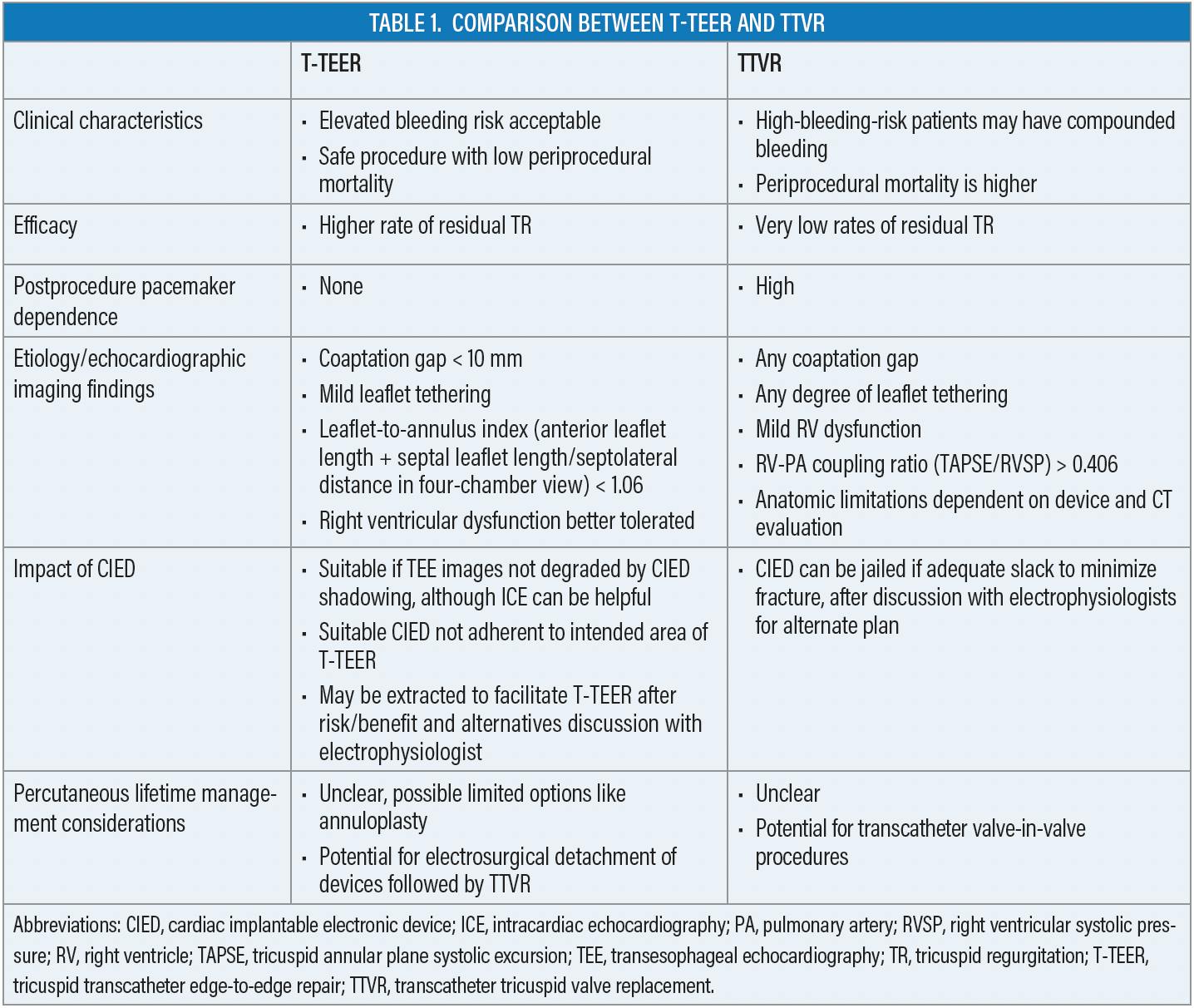
In the absence of head-to-head studies of repair versus replacement, choosing between therapeutic options depends on incorporating clinical features and anatomic characteristics in order to choose the therapy that is best suited to each individual patient (Table 1). Clinical features such as patient frailty, presence of significant RV dysfunction, and contraindications to long-term anticoagulation may favor repair over replacement. Anatomic factors such as large coaptation gaps and multiple leaflets may favor a TTVR approach. Finally, lifetime management of TR must consider the effects of valve degeneration, new pacemaker, and requirement for subsequent interventions. Imaging challenges affect both techniques equally with the currently approved devices, but new technology relying less on leaflet anchoring may obviate the need for optimal TEE images.
CONCLUSION
TR remains an important burden that, with the development of transcatheter therapies, finally has treatment options. The complex clinical status and anatomy of patients with severe TR necessitate a tailored approach to durable treatment options within the context of a robust multidisciplinary team to ensure the best outcomes for these patients. Emerging real-world use and further data will help refine patient selection, procedural techniques, and workflow to optimize the choice of therapy.
1. Sorajja P, Whisenant B, Hamid N, et al; TRILUMINATE Pivotal Investigators. Transcatheter repair for patients with tricuspid regurgitation. N Engl J Med. 2023;388:1833-1842. doi: 10.1056/NEJMoa2300525
2. Kodali S, Hahn RT, Makkar R, et al. Transfemoral tricuspid valve replacement and one-year outcomes: the TRISCEND study. Eur Heart J. 2023;44:4862-4873. doi: 10.1093/eurheartj/ehad667
3. Sugiura A, Tanaka T, Kavsur R, et al. Refining accuracy of RV-PA coupling in patients undergoing transcatheter tricuspid valve treatment. Clin Res Cardiol. 2024;113:177-186. doi: 10.1007/s00392-023-02339-5
4. Brener MI, Lurz P, Hausleiter J, et al. Right ventricular-pulmonary arterial coupling and afterload reserve in patients undergoing transcatheter tricuspid valve repair. J Am Coll Cardiol. 2022;79:448-461. doi: 10.1016/j.jacc.2021.11.031
5. Dreyfus J, Audureau E, Bohbot Y, et al. TRI-SCORE: a new risk score for in-hospital mortality prediction after isolated tricuspid valve surgery. Eur Heart J. 2022;43:654-662. doi: 10.1093/eurheartj/ehab679
6. Hahn RT, Weckbach LT, Noack T, et al. Proposal for a standard echocardiographic tricuspid valve nomenclature. JACC Cardiovasc Imaging. 2021;14:1299-1305. doi: 10.1016/j.jcmg.2021.01.012
7. Lurz P, Rommel KP, Schmitz T, et al. Real-world 1-year results of tricuspid edge-to-edge repair from the bRIGHT study. J Am Coll Cardiol. 2024;84:607-616. doi: 10.1016/j.jacc.2024.05.006
8. Kodali SK, Hahn RT, Davidson CJ, et al. 1-year outcomes of transcatheter tricuspid valve repair. J Am Coll Cardiol. 2023;81:1766-1776. doi: 10.1016/j.jacc.2023.02.049
9. Wild MG, Löw K, Rosch S, et al; PASTE Investigators. Multicenter experience with the transcatheter leaflet repair system for symptomatic tricuspid regurgitation. JACC Cardiovasc Interv. 2022;15:1352-1363. doi: 10.1016/j.jcin.2022.05.041
10. Tanaka T, Sugiura A, Kavsur R, et al. Changes in right ventricular function and clinical outcomes following tricuspid transcatheter edge-to-edge repair. Eur J Heart Fail. 2024;26:1015-1024. doi: 10.1002/ejhf.3183
11. Tanaka T, Sugiura A, Kavsur R, et al. Leaflet-to-annulus index and residual tricuspid regurgitation following tricuspid transcatheter edge-to-edge repair. EuroIntervention. 2022;18:e169-e178. doi: 10.4244/EIJ-D-21-00862
Advertisement
Advertisement