Advertisement
Advertisement
September/October 2024
Contemporary Considerations in Transcatheter Pulmonary Valve Replacement
Clinical evidence, current and forthcoming technology, and patient-centered decision-making for treating the pulmonary valve.
By Ada C. Stefanescu Schmidt, MD, MSc, and Shabana Shahanavaz, MD, MBBS
Congenital anomalies of the pulmonary valve (PV) and right ventricular outflow tract (RVOT) leading to stenosis or regurgitation of the PV are among the most common congenital heart defects. Right ventricle (RV)–to–pulmonary artery (PA) conduit dysfunction from patients treated via Ross procedure for aortic valve disease or conotruncal abnormalities is also increasingly prevalent. Transcatheter techniques to treat the PV have rapidly evolved and become options in the lifetime management of children and adults with a variety of anatomies, with increasingly good mid- and long-term data.
ANATOMIC CHALLENGES
The heterogeneity in RVOT anatomy carries unique challenges in transcatheter treatment strategy. These anatomic differences include diameter; degree of calcification; underlying tissue characteristics (native or patched RVOT, traditional or decellularized homograft, synthetic conduits, bioprosthetic valves with varying rigidity,1 prior stainless steel or covered stents); and surrounding structures, particularly proximity of the coronary arteries and associated risk of coronary compression and ischemia. The ideal hemodynamic result includes mild or no regurgitation and a low final gradient (defined as < 10 mm Hg or < 20 mm Hg depending on studies),2 with a higher gradient associated with shorter valve longevity and higher risk of endocarditis.3,4
TRANSCATHETER OPTIONS FOR PVs
Early Technology and Clinical Outcomes
The first transcatheter PV (TPV) in 2000—also the first transcatheter valve to be implanted in a human—was a bovine jugular valve sewn in a platinum-iridium stent. This eventually evolved into the Melody valve (Medtronic), which has paved the way for transcatheter heart valve (THV) technology. The balloon-expandable valve is available in diameters of 18 to 22 mm and can be expanded up to a 24-mm internal diameter (Figure 1A).
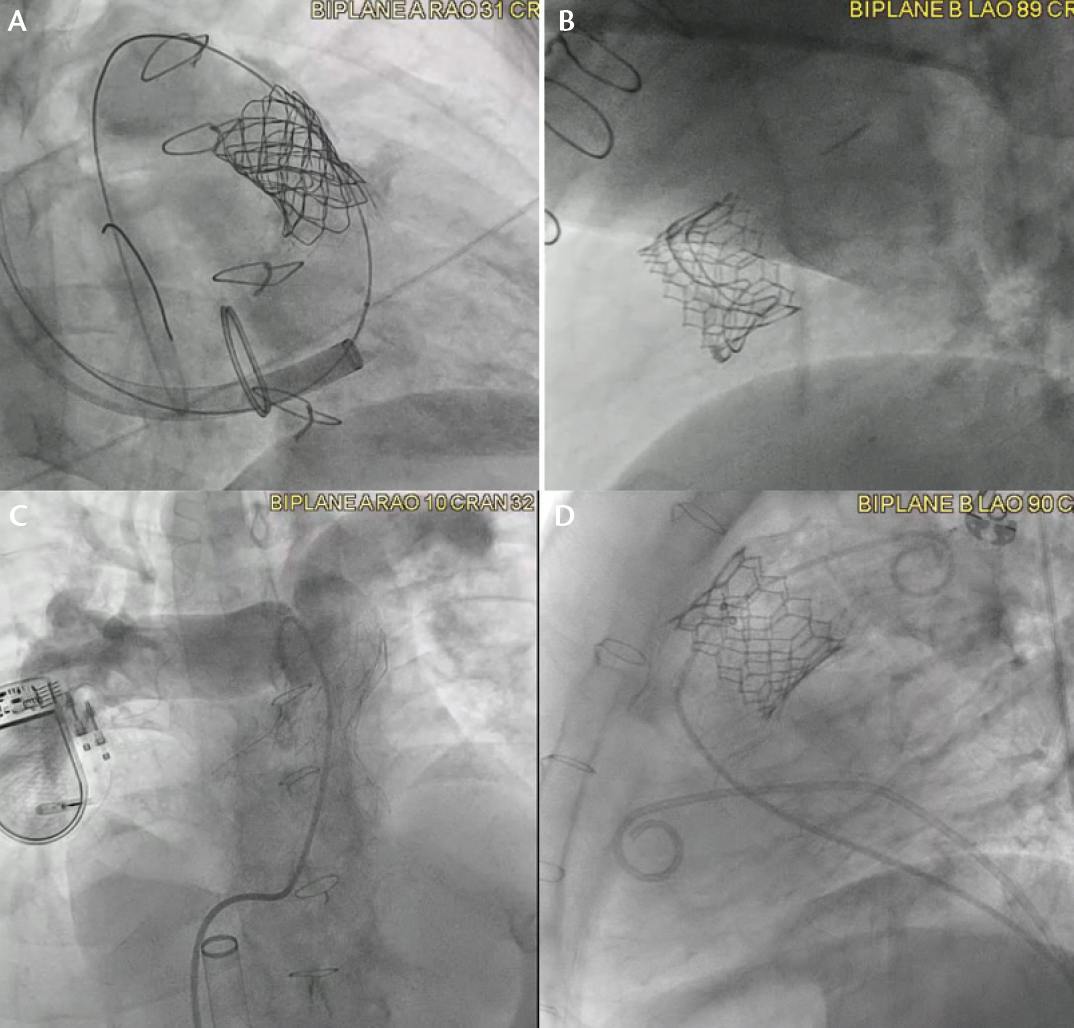
Figure 1. TPV implants: Melody valve within a calcified conduit after prestenting with a covered and bare-metal stent (A). Sapien valve implanted inside a Magna Ease bioprosthetic valve (Edwards Lifesciences), which was intentionally fractured with high-pressure balloon inflation prior to Sapien deployment (B). Harmony valve (C). Sapien valve implanted in an Alterra prestent (D).
The Sapien family of balloon-expandable valves (Edwards Lifesciences) was developed for use in the aortic valve and is approved for patients with dysfunctional RV-to-PA conduits or bioprosthetic valves (Figure 1B). Sapien features bovine pericardial leaflets in a cobalt-chromium frame and is available in internal diameters of 20 to 29 mm.
In a national registry including over 4,500 procedures from 2016 to 2021 (of which 25% were done in native RVOT), balloon-expandable valves have been implanted safely with > 94% acute success and 2.4% incidence of major adverse events.2 A large trial is now underway to assess the performance of the newest-generation Sapien 3 Ultra Resilia in bioprosthetic valves, conduits, and THV-in-THV procedures (COMPASSION trial). The Sapien 3 Ultra Resilia has an anticalcification treatment on the leaflets and a longer skirt to prevent paravalvular leak.
The Melody valve has the longest follow-up data among the TPVs. Ten-year outcomes data from the Melody investigational device exemption (IDE) trial (n = 149) showed a 90% estimated freedom from mortality and 60% freedom from reintervention.5,6 Long-term data are not yet available for the Sapien TPV. A large, retrospective, multicenter registry in the United States and Europe included 774 patients treated with Sapien XT or S3, with 97.4% procedural success, only two procedural deaths, and 10% serious procedural adverse events.7,8 Incidence of infective endocarditis in this cohort was 1.7% per patient-year, with no infective endocarditis–related deaths.
Continued Innovation
The past 3 years have seen a major advancement in the field: the introduction of self-expanding platforms designed to treat large RVOT. This has dramatically increased the number of patients who are anatomic candidates for transcatheter treatment. The Harmony valve (Medtronic) and Alterra adaptive prestent (Edwards Lifesciences), both with hourglass-shaped nitinol frames, are approved for use in the United States (Figure 1C and 1D). VenusP-valve (Venus Medtech) and Pulsta Valve (TaeWoong Medical) are nitinol-framed, self-expanding, porcine pericardial valves and are currently available for use outside of the United States,9-12 with trials of the VenusP-valve starting in the United States. Early and midterm results for both Harmony and Alterra prestent/Sapien 3 have been promising,13-16 with high procedural success and a low risk of valve migration requiring surgery or early dysfunction.
Innovative techniques used in other transcatheter interventions include high-pressure balloon dilation for valve modification or fracture to allow larger-size valve-in-valve implantation with better hemodynamics. In addition, Shockwave Medical intravascular lithotripsy is approved for treatment of heavily calcified coronary and peripheral artery vessels (aorta, iliacs, lower extremity) and has been described in calcified RV-to-PA conduits17 as a safe and effective method to reach larger diameters prior to valve implantation.
CHALLENGES AND FUTURE DIRECTIONS
Open questions remain regarding the THV longevity. Although the leaflets are now made by technology similar to surgical valves, the implanted milieu can have a higher immediate postprocedural gradient if stenosis cannot be completely relieved or there are other valves or stents in situ and may decrease longevity via increased risk of valve degeneration from turbulent flow and/or risk of endocarditis.18 Thickening of the leaflets and neointimal proliferation in the stent frame have been described within self-expanding valve frames. Additionally, hypoattenuating leaflet thrombosis and hypoattenuation affecting motion are being increasingly recognized after transcatheter and surgical PV replacement. There is wide practice variability on antiplatelet and/or anticoagulation therapy in the short and long term after TPV replacement (TPVR), in part due to patient substrate: pediatric versus adult, thrombotic risk factors, postprocedural gradients, bleeding risk, atrial arrhythmias, and other factors increasing thrombotic risk. In the largest overall United States multicenter series with midterm follow-up, the incidence of endocarditis was 1.7% per patient-year, with 2% early and 5.8% midterm need for reintervention.8 A recent large European multicenter study reported 8% reintervention, 3.8% endocarditis, and 0.7% valve thrombosis at 6 years.19
DECISION-MAKING CONSIDERATIONS
Patient-centered decision-making relies on good-quality data to help inform the discussion. There are no contemporary randomized trials of surgery versus TPVR, partly because equipoise is difficult to reach when patients are faced with the prospect of multiple surgeries over their lifetime. High-quality observational data from new valve platform IDE and postapproval studies as well as large registries are critically important sources. Examples include the Sapien COMPASSION trial; smaller, detailed trials for Harmony and Alterra; the large, wide-representation American College of Cardiology/National Cardiovascular Data Registry IMPACT registry; and multicenter registries focused on patient subgroups, such as SERVE.
It is important to have careful discussion of all anatomic factors involved, including other lesions that may benefit from treatment now versus a later date; details of surgical options, such as homograft versus bioprosthetic valve; and future valve-in-valve options depending on size of the implant relative to the size of the patient. Although we often discuss with patients which procedure they may prefer and what options would be then possible in the next decade or two when they would need reintervention, most humans (as shown in behavioral economics studies) tend to discount their future happiness at the benefit of immediate gains. This may lead to middle-aged patients preferring to postpone surgery until they are older and are potentially higher-risk candidates. That being said, technology is evolving rapidly, and other competing health risks are unpredictable.
The collaboration between pediatric, adult congenital and structural interventionalists, engineers, industry, national societies, and regulators has lead to remarkable advancements in this field in the last 2 decades. With a growing population of patients in need of PV therapies, the next steps will include ongoing careful studies (including national representative registries and multicenter postapproval studies), device and implant technique innovations, as well as cost reductions and other efforts to improve access to care.
1. Shahanavaz S, Asnes JD, Grohmann J, et al. Intentional fracture of bioprosthetic valve frames in patients undergoing valve-in-valve transcatheter pulmonary valve replacement. Circ Cardiovasc Interv. 2018;11:e006453. doi: 10.1161/CIRCINTERVENTIONS.118.006453
2. Stefanescu Schmidt AC, Armstrong AK, Aboulhosn JA, et al. Transcatheter pulmonary valve replacement with balloon-expandable valves: utilization and procedural outcomes from the IMPACT registry. JACC Cardiovasc Interv. 2024;17:231-244. doi: 10.1016/j.jcin.2023.10.065
3. McElhinney DB, Zhang Y, Levi DS, et al. Reintervention and survival after transcatheter pulmonary valve replacement. J Am Coll Cardiol. 2022;79:18-32. doi: 10.1016/j.jacc.2021.10.031
4. McElhinney DB, Zhang Y, Aboulhosn JA, et al. Multicenter study of endocarditis after transcatheter pulmonary valve replacement. J Am Coll Cardiol. 2021;78:575-589. doi: 10.1016/j.jacc.2021.05.044
5. Cheatham JP, Hellenbrand WE, Zahn EM, et al. Clinical and hemodynamic outcomes up to 7 years after transcatheter pulmonary valve replacement in the US Melody valve investigational device exemption trial. Circulation. 2015;131:1960-1970. doi: 10.1161/CIRCULATIONAHA.114.013588
6. Jones TK, McElhinney DB, Vincent JA, et al. Long-term outcomes after Melody transcatheter pulmonary valve replacement in the US investigational device exemption trial. Circ Cardiovasc Interv. 2022;15:e010852. doi: 10.1161/CIRCINTERVENTIONS.121.010852
7. Kenny D, Rhodes JF, Fleming GA, et al. 3-year outcomes of the Edwards SAPIEN transcatheter heart valve for conduit failure in the pulmonary position from the COMPASSION multicenter clinical trial. JACC Cardiovasc Interv. 2018;11:1920-1929. doi: 10.1016/j.jcin.2018.06.001
8. Shahanavaz S, Zahn EM, Levi DS, et al. Transcatheter pulmonary valve replacement with the Sapien prosthesis. J Am Coll Cardiol. 2020;76(:2847-2858. doi: 10.1016/j.jacc.2020.10.041
9. Sivakumar K, Sagar P, Qureshi S, et al. Outcomes of Venus P-valve for dysfunctional right ventricular outflow tracts from Indian Venus P-valve database. Ann Pediatr Cardiol. 2021;14:281-292. doi: 10.4103/apc.APC_175_20
10. Morgan G, Prachasilchai P, Promphan W, et al. Medium-term results of percutaneous pulmonary valve implantation using the Venus P-valve: international experience. EuroIntervention. 2019;14:1363-1370. doi: 10.4244/EIJ-D-18-00299
11. Garay F, Pan X, Zhang YJ, et al. Early experience with the Venus p-valve for percutaneous pulmonary valve implantation in native outflow tract. Neth Heart J. 2017;25:76-81. doi: 10.1007/s12471-016-0932-5
12. Lin M-T, Chen C-A, Chen S-J, et al. Self-expanding pulmonary valves in 53 patients with native repaired right ventricular outflow tracts. Can J Cardiol. 2023;39:997-1006. doi: 10.1016/j.cjca.2023.03.013
13. Gillespie MJ, McElhinney DB, Jones TK, et al. 1-year outcomes in a pooled cohort of Harmony transcatheter pulmonary valve clinical trial participants. JACC Cardiovasc Interv. 2023;16:1917-1928. doi: 10.1016/j.jcin.2023.03.002
14. Shahanavaz S, Balzer D, Babaliaros V, et al. Alterra adaptive prestent and SAPIEN 3 THV for congenital pulmonic valve dysfunction: an early feasibility study. JACC Cardiovasc Interv. 2020;13:2510-2524. doi: 10.1016/j.jcin.2020.06.039
15. Levi DS, Gillespie MJ, McElhinney DB, et al. O-6 | one-year outcomes in an expanded cohort of Harmony transcatheter pulmonary valve recipients. J Soc Cardiovasc Angiogr Interv. 2022;1: 100326. https://doi.org/10.1016/j.jscai.2022.100326
16. Goldstein BH, McElhinney DB, Gillespie MJ, et al. Early outcomes from a multicenter transcatheter self-expanding pulmonary valve replacement registry. J Am Coll Cardiol. 2024;83:1310-1321. doi: 10.1016/j.jacc.2024.02.010
17. Sabbak N, Denby K, Kumar A, et al. Intravascular lithotripsy for severe RVOT calcification to optimize transcatheter pulmonary valve replacement. JACC Case Rep. 2023;19:101926. doi: 10.1016/j.jaccas.2023.101926
18. Gröning M, Smerup MH, Munk K, et al. Pulmonary valve replacement in tetralogy of fallot: procedural volume and durability of bioprosthetic pulmonary valves. JACC Cardiovasc Interv. 2024;17:217-227. doi: 10.1016/j.jcin.2023.10.070
19. Hascoët S, Bentham JR, Giugno L, et al. Outcomes of transcatheter pulmonary SAPIEN 3 valve implantation: an international registry. Eur Heart J. 2024;45:198-210. doi: 10.1093/eurheartj/ehad663
Advertisement
Advertisement