Advertisement
Advertisement
May/June 2024 Supplement
Sponsored by Medtronic
Understanding the Impact of TAVR in Women With Small Aortic Annulus
Insights into the SMART trial.
By Mauro Gitto, MD; Birgit Vogel, MD; Roxana Mehran, MD; Howard C. Herrmann, MD; and Didier Tchétché, MD
The SMall Annuli Randomized To Evolut or SAPIEN (SMART) trial compared the latest iterations of self-expanding and balloon-expandable transcatheter heart valves (THVs) in patients with a small aortic annulus undergoing transcatheter aortic valve replacement (TAVR). A small aortic annulus is highly prevalent among women undergoing TAVR, who constituted 87% of the randomized patients. This editorial aims to summarize the key findings of the SMART trial and their relevance for women with aortic stenosis (AS).
BACKGROUND, RATIONALE AND DESIGN OF THE SMART TRIAL
AS is a prevalent valve disorder in the aging population of Western countries. Among elderly AS patients, women, who generally have longer life expectancies, constitute a significant proportion.1 In comparison to men, women undergoing TAVR display distinct clinical features and unique anatomic characteristics, which encompass a higher prevalence of fibrosis over calcification as the primary mechanism of leaflet degeneration, as well as smaller annular and left ventricular outflow tract dimensions, despite similar aortic root anatomy.2,3 A small aortic annulus, commonly defined as an aortic valve area ≤ 430 mm2, is notably more prevalent in women compared to men with AS. In the TAVI-SMALL registry, a retrospective study involving 859 patients with small annulus undergoing TAVR with self-expanding valves, 90% of participants were women.4
The presence of a small aortic annulus has been linked to increased postprocedural aortic gradients and prosthesis-patient mismatch (PPM) after both TAVR and surgical aortic valve replacement (SAVR).5,6 Notably, female sex, along with small valve size and balloon-expandable and intra-annular THV designs, have been identified as independent predictors for PPM.7,8 As TAVR is increasingly performed in younger and less comorbid patients, there is a growing recognition of the need to evaluate PPM as a surrogate endpoint for long-term adverse events.4,7 A meta-analysis involving 81,969 TAVR patients from 23 studies indicated that severe PPM, defined by an indexed effective orifice area < 0.65 cm2/m2, had an incidence of 10.9%, and was associated with increased 5-year mortality (hazard ratio [HR], 1.25; 95% CI, 1.16-1.36).9 Additionally, increased aortic mean gradients after TAVR are the main determinant of hemodynamic structural valve deterioration (SVD), a surrogate for TAVR durability, impacting mortality and heart failure hospitalizations, as observed in the pooled CoreValve US Pivotal and SURTAVI analyses.10
Most available data on TAVR in small aortic annuli are derived from retrospective cohorts or secondary trial analyses, highlighting an unmet need for randomized trials focused on this patient population. The recently published VIVA trial, which randomized 151 patients (93% women) with severe AS and a small annulus to either TAVR or SAVR, showed no differences in terms of severe PPM and moderate-severe aortic regurgitation at 60 days.11 However, the rate of severe PPM was numerically higher with SAVR as compared to TAVR (10.3% vs. 5.6%) and, with only 52% of the estimated sample size being finally enrolled, the study was underpowered for its primary endpoint.
The SMART Trial (NCT04722250) is an international, prospective, multicenter, randomized controlled, postmarket trial designed to assess the noninferiority in terms of clinical outcomes and hemodynamic superiority of the Evolut supra-annular self-expanding THV (Medtronic) as compared to the Sapien intra-annular balloon-expandable system (Edwards Lifesciences) (Figure 1).12 Patients with severe symptomatic AS and a small aortic annulus have been enrolled and randomized to receive TAVR with either the Evolut R/PRO/PRO+/FX self-expanding or the Edwards Sapien 3/3 Ultra balloon expandable valve (Figure 2).
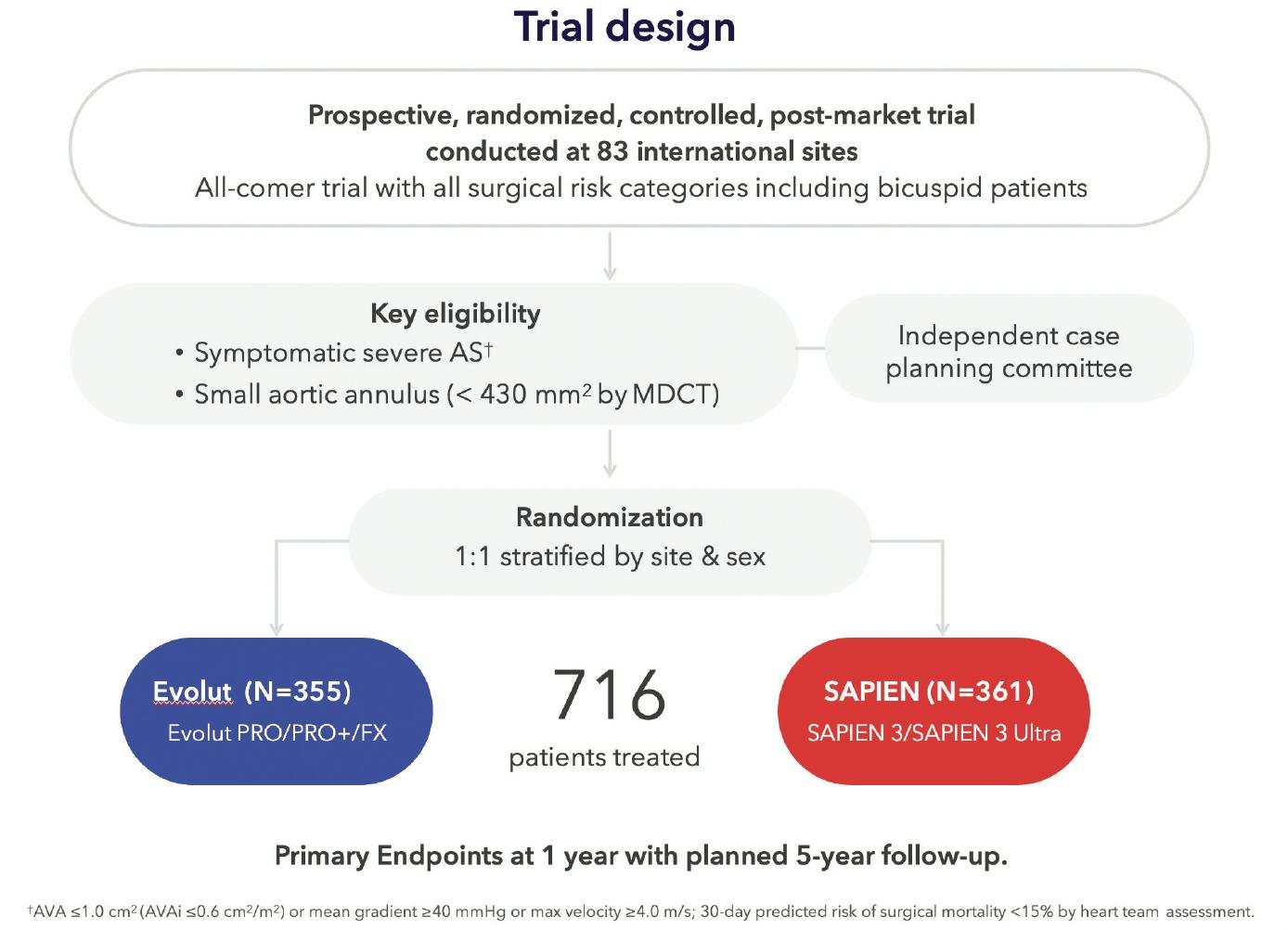
Figure 1. SMART Trial study design.
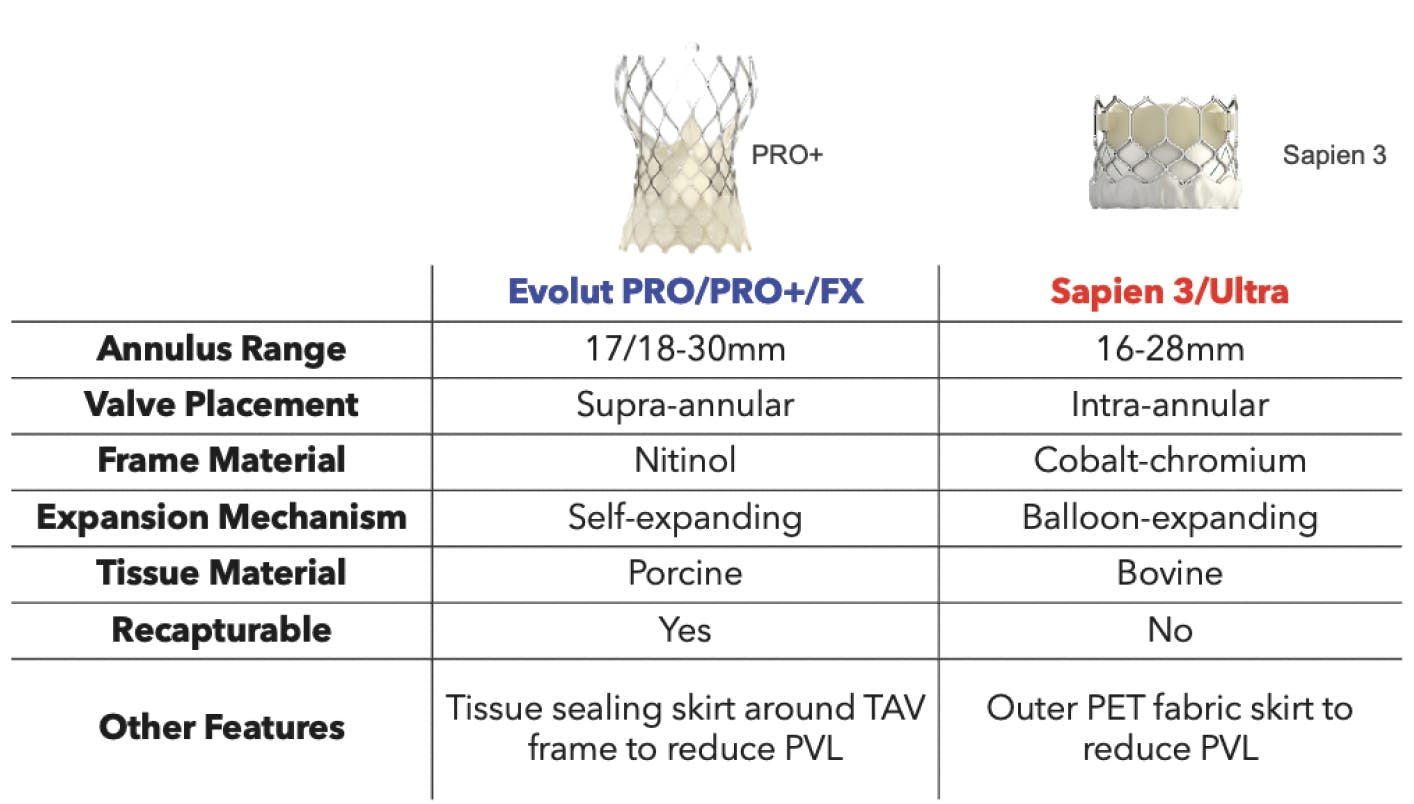
Figure 2. Summary of key differences between the Evolut platform and Sapien platform valves.
The two powered coprimary endpoints at 12-month follow-up were (1) the composite of mortality, disabling stroke, or rehospitalization for heart failure (powered for noninferiority), and (2) Bioprosthetic valve dysfunction (BVD; powered for superiority). BVD was defined as a composite of: hemodynamic structural valve dysfunction (HSVD), defined as an aortic valve mean gradient ≥ 20 mm Hg; non–structural valve dysfunction (NSVD), defined as severe PPM or ≥ moderate aortic regurgitation; clinical valve thrombosis; endocarditis; and aortic valve reintervention.
Key secondary endpoints included BVD in female patients at 12 months, HSVD in all patients at 12 months, hemodynamic mean gradient (continuous variable) at 12 months, effective orifice area as continuous variable at 12 months, and moderate or severe PPM at 30 days. VARC-3 defined device success at 30 days and the change in Kansas City Cardiomyopathy Questionnaire (KCCQ) ordinal outcome were additional exploratory endpoints.
IMPLICATIONS OF THE SMART TRIAL FOR TREATMENT OF WOMEN
Women present striking differences in clinical outcomes after TAVR as compared to men. Trials conducted in low-surgical-risk AS patients highlighted a potential for better outcomes after TAVR versus SAVR in women.13-15 In the Transcatheter Valve Therapy registry of the Society of Thoracic Surgeons/American College of Cardiology, encompassing 23,652 patients undergoing TAVR with first-generation THVs, women demonstrated a lower risk of 1-year mortality compared to men (HR, 0.73; 95% CI, 0.63-0.85; P < .001), but faced a higher risk of bleeding and access-related complications.16 These differences in outcomes have partially been attributed to the peculiar clinical characteristics of women undergoing TAVR, including a lower prevalence of atherosclerotic vascular disease, diabetes, and dyslipidemia, along with a higher burden of hypertension, vascular tortuosity, and advanced chronic kidney disease.17 However, the differences in AS pathophysiology between men and women might also impact TAVR outcomes.2
Small aortic annulus is common among patients undergoing TAVR, with an estimated prevalence up to 40%.2,18 Women constitute up to 90% of the small annulus population.4,19-22 Despite this, few studies have addressed the outcomes of TAVR in small annuli within female populations. In the TAVR-SMALL 2 registry, severe PPM was more frequent in women than in men with small annuli after propensity score matching.23 In a post hoc analysis of the PARTNER 3 trial, severe PPM emerged as a predictor of the composite of mortality, stroke, and repeat hospitalizations at 1 year in women (HR, 3.67; 95% CI, 1.45-9.32) but not in men (HR, 0.27; 95% CI, 0.04-1.96).24 Two secondary analyses of the WIN-TAVI (Women’s INternational Transcatheter Aortic Valve Implantation) registry, which included 1,019 female patients undergoing TAVR, suggested that both small aortic annulus and PPM had no effect on cardiovascular outcomes at 1-year follow-up.8,25 However, these secondary analyses from an observational study might have been underpowered to detect significant differences in hard clinical endpoints at short-term follow-up.
On this background, the SMART trial was the first randomized trial, powered for hard clinical endpoints, to evaluate the performance of TAVR with the most contemporary balloon-expandable and self-expanding valve THV devices in women and men with a small aortic annulus.
PERSPECTIVES ON TRIAL RESULTS
A total of 737 patients were randomized, of whom 366 were assigned to receive Evolut and 371 to Sapien THVs. The final implanted population consisted of 350 patients in the Evolut group and 365 in the Sapien group.26 Importantly, 86.7% of the implanted patients were women.26
The first coprimary endpoint, the composite of mortality, disabling stroke, or heart failure hospitalization through 12 months occurred in 9.4% of patients in the Evolut group and in 10.6% of patients in the Sapien group (difference, –1.2%; 90% CI, –4.9 to 2.5; P < .001 for noninferiority). The 12-month incidence of the second coprimary endpoint, BVD, was 9.4% in the Evolut group and 41.6% in the Sapien group (difference, –32.2%; 95% CI, –38.7 to –25.6; P < .001 for superiority). This was driven by a higher rate of both NSVD (5.9% vs 18.2%; difference, −12.3 percentage points; 95% CI, −17.6 to −7.0) and HSVD (3.2% vs 32.2%, difference, –29.1%; 95% CI, –34.6% to –23.5%; P < .001 for superiority) at 12 months in the Sapien group.
The superior performance of the Evolut valve with respect to the BVD endpoint was also consistent when results were assessed in a prespecified analysis of women only, with a 12-month BVD incidence of 8.4% in the Evolut group and 41.8% in the Sapien group (difference, –33.4%; 95% CI, 40.4% to –26.4%; P < .001; Figure 3).
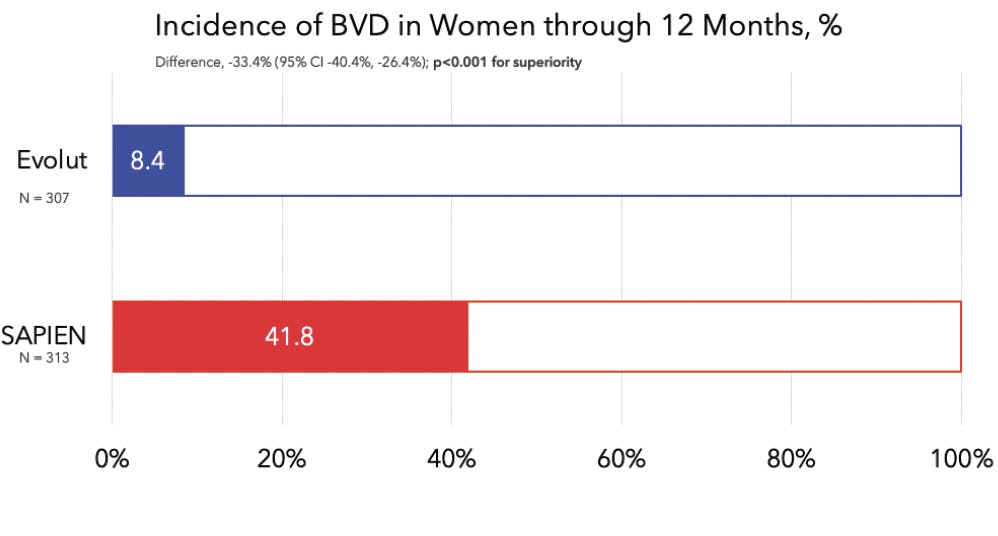
Figure 3. Incidence of BVD in women through 12 months.
CLINICAL IMPLICATIONS AND FUTURE STEPS
The results of the SMART trial are of outmost importance to guide the management of patients with AS and small aortic annulus. Notably, there was a substantial imbalance in BVD incidence, which was fourfold higher and occurred in almost half of patients in the Sapien group compared to the Evolut cohort. Although the current 1-year follow-up was too short to unravel differences between the two THV platforms in terms of clinical outcomes, the SMART data should prompt physicians to screen for small aortic annulus and favor the use of a self-expanding THV in such cases.
Beyond its direct clinical implications, the SMART trial was the largest TAVR trial to focus on a female-specific condition by enrolling mostly women at nearly 90%. In 2021, we published the Lancet Women and Cardiovascular Disease commission, which highlighted the underrepresentation of women in contemporary clinical research and advocated for improved enrollment and retention of women in cardiovascular trials.27 In the TAVR setting, this was partially addressed by the WIN-TAVI, a multinational, prospective, observational registry that included > 1,000 women undergoing TAVR from 2013 to 2015.14,25 Although initial signals suggesting a greater efficacy of self-expanding THVs compared to balloon-expandable THVs in women emerged from WIN-TAVI, the study’s observational design and highly heterogeneous population introduced biases.28 The SMART trial emphasized a substantial treatment gap between the two device types and underscored the importance of conducting female-specific randomized trials to address unmet clinical needs.
EXECUTIVE SUMMARY
In patients with severe AS and a small aortic annulus—a condition that is highly prevalent in women—TAVR with the self-expanding Evolut PRO/PRO+ THV is noninferior to the balloon-expandable Sapien 3/3 Ultra System for the clinical outcome composite through at 1 year and superior with respect to BVD through 1 year. Although the long-term outcomes are yet to be assessed, the potential impact of BVD on both TAVR durability and mortality should caution against the use of balloon-expandable THVs in TAVR candidates with a small aortic annulus.
1. Tsao CW, Aday AW, Almarzooq ZI, et al. Heart disease and stroke statistics-2023 update: a report from the American Heart Association. Circulation. 2023;147:E93-E621. doi: 10.1161/CIR.0000000000001123
2. Shan Y, Pellikka PA. Aortic stenosis in women. Heart. 2020;106:970-976. doi: 10.1136/heartjnl-2019-315407
3. Buellesfeld L, Stortecky S, Kalesan B, et al. Aortic root dimensions among patients with severe aortic stenosis undergoing transcatheter aortic valve replacement. JACC Cardiovasc Interv. 2013;6:72-83. doi: 10.1016/j.jcin.2012.09.007
4. Regazzoli D, Chiarito M, Cannata F, et al. Transcatheter self-expandable valve implantation for aortic stenosis in small aortic annuli: the TAVI-SMALL registry. JACC Cardiovasc Interv. 2020;13:196-206. doi: 10.1016/j.jcin.2019.08.041
5. Ghoneim A, Bouhout I, Demers P, et al. Management of small aortic annulus in the era of sutureless valves: a comparative study among different biological options. J Thorac Cardiovasc Surg. 2016;152:1019-1028. doi: 10.1016/j.jtcvs.2016.06.058
6. Abdelghani M, Mankerious N, Allali A, et al. Bioprosthetic valve performance after transcatheter aortic valve replacement with self-expanding versus balloon-expandable valves in large versus small aortic valve annuli: insights from the CHOICE trial and the CHOICE-Extend registry. JACC Cardiovasc Interv. 2018;11:2507-2518. doi: 10.1016/j.jcin.2018.07.050
7. Herrmann HC, Daneshvar SA, Fonarow GC, et al. Prosthesis-patient mismatch in patients undergoing transcatheter aortic valve replacement: from the STS/ACC TVT registry. J Am Coll Cardiol. 2018;72:2701-2711. doi: 10.1016/j.jacc.2018.09.001
8. Panoulas VF, Chandrasekhar J, Busi G, et al. Prevalence, predictors, and outcomes of patient prosthesis mismatch in women undergoing TAVI for severe aortic stenosis: insights from the WIN-TAVI registry. Catheter Cardiovasc Interv. 2021;97:516-526. doi: 10.1002/ccd.29227
9. Sá MP, Jacquemyn X, Van den Eynde J, et al. Impact of prosthesis-patient mismatch after transcatheter aortic valve replacement: meta-analysis of Kaplan-Meier-derived individual patient data. JACC Cardiovasc Imaging. 2023;16:298-310. doi: 10.1016/j.jcmg.2022.07.013
10. O’Hair D, Yakubov SJ, Grubb KJ, et al. Structural valve deterioration after self-expanding transcatheter or surgical aortic valve implantation in patients at intermediate or high risk. JAMA Cardiol. 2023;8:111-119. doi: 10.1001/jamacardio.2022.4627
11. Rodés-Cabau J, Ribeiro H, Mohammadi S, et al. Transcatheter or surgical aortic valve replacement in patients with severe aortic stenosis and small aortic annulus: a randomized clinical trial. Circulation. 2024 Feb 27;149:644-655. doi: 10.1161/CIRCULATIONAHA.123.067326
12. Herrmann HC, Abdel-Wahab M, Attizzani GF, et al. Rationale and design of the SMall Annuli Randomized To Evolut or SAPIEN Trial (SMART Trial). Am Heart J. 2022;243:92-102. doi: 10.1016/j.ahj.2021.09.011
13. Mack MJ, Leon MB, Thourani VH, et al. Transcatheter aortic-valve replacement with a balloon-expandable valve in low-risk patients. N Engl J Med. 2019;380:1695-1705. doi: 10.1056/NEJMoa1814052
14. Panoulas VF, Francis DP, Ruparelia N, et al. Female-specific survival advantage from transcatheter aortic valve implantation over surgical aortic valve replacement: meta-analysis of the gender subgroups of randomised controlled trials including 3758 patients. Int J Cardiol. 2018;250:66-72. doi: 10.1016/j.ijcard.2017.05.047
15. Blankenberg S, Seiffert M, Vonthein R, et al. Transcatheter or surgical treatment of aortic-valve stenosis. N Engl J Med. Published online April 8, 2024. doi: 10.1056/NEJMoa2400685.
16. Chandrasekhar J, Dangas G, Yu J, et al. Sex-based differences in outcomes with transcatheter aortic valve therapy: TVT Registry from 2011 to 2014. J Am Coll Cardiol. 2016;68:2733-2744. doi: 10.1016/j.jacc.2016.10.041
17. Vlastra W, Chandrasekhar J, García Del Blanco B, et al. Sex differences in transfemoral transcatheter aortic valve replacement. J Am Coll Cardiol. 2019;74:2758-2767. doi: 10.1016/j.jacc.2019.09.015
18. Freitas-Ferraz AB, Tirado-Conte G, Dagenais F, et al. Aortic stenosis and small aortic annulus. Circulation. 2019;139:2685-2702. doi: 10.1161/CIRCULATIONAHA.118.038408
19. Makkar RR, Kapadia S, Chakravarty T, et al. Outcomes of repeat transcatheter aortic valve replacement with balloon-expandable valves: a registry study. Lancet. 2023;402:1529-1540. doi: 10.1016/S0140-6736(23)01636-7
20. Hase H, Yoshijima N, Yanagisawa R, et al. Transcatheter aortic valve replacement with Evolut R versus Sapien 3 in Japanese patients with a small aortic annulus: The OCEAN-TAVI registry. Catheter Cardiovasc Interv. 2021;97:E875-E886. doi: 10.1002/ccd.29259
21. Scotti A, Sturla M, Costa G, et al. Evolut PRO and SAPIEN ULTRA performance in small aortic annuli: The OPERA-TAVI registry. JACC Cardiovasc Interv. 2024;17:681-692. doi: 10.1016/j.jcin.2024.01.006
22. Kalogeras K, Jabbour RJ, Pracon R, et al. Midterm Outcomes in Patients With Aortic Stenosis Treated With Contemporary Balloon-Expandable and Self-Expanding Valves: Does Valve Size Have an Impact on Outcome?. J Am Heart Assoc. 2023;12:e028038. doi: 10.1161/JAHA.122.028038
23. Leone PP, Gohar A, Pagnesi M, et al. Clinical outcomes in women and men with small aortic annuli undergoing transcatheter aortic valve implantation: a multicenter, retrospective, propensity score-matched comparison. Int J Cardiol. 2023;379:16-23. doi: 10.1016/j.ijcard.2023.02.044
24. Pibarot P, Salaun E, Dahou A, et al. Echocardiographic results of transcatheter versus surgical aortic valve replacement in low-risk patients: the PARTNER 3 trial. Circulation. 2020;141:1527-1537. doi: 10.1161/CIRCULATIONAHA.119.044574
25. Pivato CA, Cao D, Spirito A, et al. Impact of small valve size on 1-year outcomes after transcatheter aortic valve implantation in women (from the WIN-TAVI Registry). Am J Cardiol. 2022;172:73-80. doi: 10.1016/j.amjcard.2022.02.025
26. Herrmann HC, Mehran R, Blackman DJ, et al. Self-expanding or balloon-expandable tavr in patients with a small aortic annulus. N Engl J Med. 2024 Apr 7. doi: 10.1056/NEJMoa2312573. Online ahead of print.
27. Mehran R, Vogel B, Ortega R, et al. The Lancet Commission on women and cardiovascular disease : time for a shift in women’s health. Lancet. 2019;393:967-968. doi: 10.1016/S0140-6736(19)30315-0
28. Giannini C, Petronio AS, Mehilli J, et al. Edwards SAPIEN versus Medtronic aortic bioprosthesis in women undergoing transcatheter aortic valve implantation (from the Win-TAVI Registry). Am J Cardiol. 2020;125:441-448. doi: 10.1016/j.amjcard.2019.10.056
Advertisement
Advertisement