Advertisement
Advertisement

In the field of interventional cardiology on the whole, we are fortunate to have seen a recent wave of strong technologic development, with robust clinical evidence to support many coronary, valvular, structural, and other applications. Physician-scientists are represented throughout our leadership, and the demand for current data is a norm. Fortunately, we recognize that just as our techniques and technologies evolve, so too must our ability to evaluate them. Endpoints evolve, as do our capabilities to image, measure, and collect our outcomes.
We also recognize that we may learn more from our failures than our successes, and trials that may not have a favorable result for the studied therapy nonetheless advance the field in the longer term by educating us on how much we did not previously understand. We should present our “failed” trials with as much pride as those deemed successful, for these teach us how not to fail in the future.
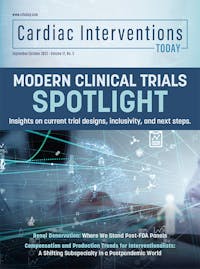
In this edition of Cardiac Interventions Today, we gathered a group of interventional cardiology trial experts to ponder the next phase of clinical study. From data needs to broad changes in approach, Mirvat Alasnag, MD; Salvatore Brugaletta, MD; Jay Giri, MD; Rasha Al-Lamee, MBBS; Rishi Puri, MD; and Gagan D. Singh, MD, provide their foremost priorities and innovation needs for future trials in women’s health, acute coronary syndrome, mitral/tricuspid intervention, renal denervation, percutaneous coronary intervention (PCI), and transcatheter aortic valve replacement.
This forward-looking focus continues with F. Aaysha Cader, MDI; Marion Mafham, MBChB; Megan Coylewright, MD; and Celina M. Yong, MD, presenting steps to take to achieve a more inclusive, equitable clinical trial landscape.
Our coverage then shifts to a selection of three contemporary clinical trials in our space. First, Romy R.M.J.J. Hegeman, MD; Martin J. Swaans, MD; and Patrick Klein, MD, share study design details of the ALIVE trial, which is evaluating left ventricular reconstruction with Revivent TC system (BioVentrix) for ischemic heart failure. They also outline where the study and technique fit among the existing literature and technology.
Next, Ziad A. Ali, MD; Doosup Shin, MD; and Richard A. Shlofmitz, MD, look at the ILUMIEN IV: OPTIMAL PCI trial of optical coherence tomography– versus angiography-guided PCI, reviewing study design, recently published results and their interpretations, and how we should apply the findings moving forward.
Finally, Christiana O. Oshotse, BA, and Robert W. Yeh, MD, highlight the background, study design, and impacts on patients and practice for TARGET IV North American, a trial comparing the Firehawk rapamycin-eluting cobalt chromium stent (MicroPort) with commercially approved second-generation drug-eluting stents for PCI, and review other previous and ongoing evaluations of the stent system.
Elsewhere in this issue, we surveyed the state of renal denervation after the FDA Circulatory System Devices Panels. Drs. Ajay J. Kirtane, Eric A. Secemsky, and Taisei Kobayashi have a discussion about questions remaining after the panels, including defining “clinically meaningful” blood pressure (BP) reduction, the function of office-based versus ambulatory BP monitoring, patient selection and preference, and more.
We round out this issue with two regular series. First, in the Today’s Practice column, Joel Sauer, MBA, walks us through MedAxiom’s 2023 Cardiovascular Provider Compensation & Production Survey and reveals the current compensation and production trends seen in cardiovascular specialties.
Then, to close this edition, the Cardiac Interventions Today editors share an interview that should be an essential read for all interventional physicians regardless of their practice focus. Cardiologist and vascular medicine specialist Geoffrey D. Barnes, MD, shares his expertise regarding pulmonary embolism response, anticoagulation stewardship, implementation science, and collaborative patient care.
In closing, although evolution in our trial designs and greater understanding of disease processes and endpoints is vital, it is also essential that progress be made in ensuring diverse populations are represented in modern patient populations as well as in trial investigators.
We hope this issue of Cardiac Interventions Today helps you stay current with the latest clinical trial experiences, and we look forward to continued evolution in the field.
Ori Ben-Yehuda, MD
Guest Chief Medical Editor
Advertisement
Advertisement