Advertisement
Advertisement
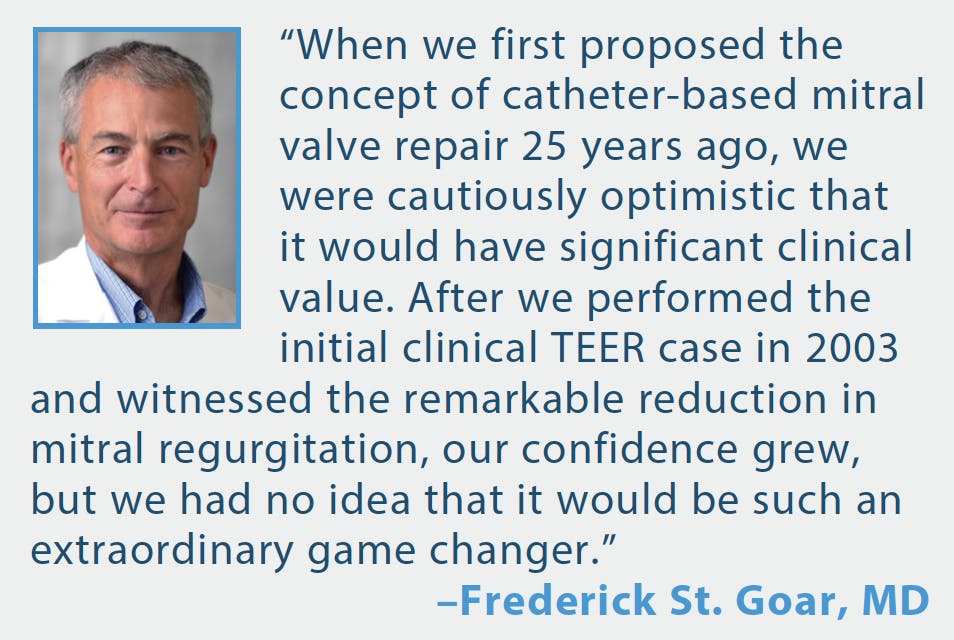
Transcatheter edge-to-edge repair (TEER) treatment of mitral regurgitation (MR) was first conceived in the late 1990s based on a novel edge-to-edge surgical repair technique pioneered by Professor Ottavio Alfieri. In 1998, interventional cardiologist Fred St. Goar, after learning of Prof. Alfieri’s unique surgical approach, proposed the concept of catheter-delivered mitral valve (MV) repair to the Silicon Valley med-tech incubator, The Foundry. After some basic proof-of-concept work and intellectual property diligence, they founded a startup, Evalve, Inc., in the fall of 1999. Although initial TEER device concepts were focused on installing sutures into opposing valve leaflets1 or stapling the leaflets together using a catheter,2 Evalve’s early prototyping and testing efforts led to the insight that an implantable Clip (without the need to puncture through leaflets) would be a safer and more effective approach. Working with innovative physician collaborators, Evalve’s engineering team built and tested a variety of early device concepts, finally arriving at the first Clip-based TEER technology, known today as the MitraClip™ system (Abbott). Evalve continued the early development of the MitraClip platform through its first-in-human implantation in 2003 and subsequently achieved CE Mark approval in Europe in 2008.3,4 Evalve was acquired by Abbott Laboratories in 2009.5 Abbott continued to develop and mature the MitraClip TEER technology and therapy, supporting the approval of the MitraClip system by the United States FDA in 2013.6
A REVOLUTION IN TRANSCATHETER MV REPAIR
With a 20-year history, the MitraClip device has defined TEER therapy for treating regurgitant MVs and was the first and only transcatheter valve repair option available for its first 10 years. The MitraClip therapy has been studied extensively with the largest body of clinical data across any transcatheter MV repair therapy, spanning more than 20 trials evaluating more than 80,000 patients with over 3,200 articles published.7 In real-world use, MitraClip therapy has now been used to treat more than 200,000 patients across the world in more than 75 countries with an excellent safety profile and favorable outcomes in terms of reduction in MR, improved heart failure prognosis, and improved patient quality of life.8 As will be described in this supplement, steadily improving outcomes have been made possible through the addition of key design features in each MitraClip device generation, along with a continual partnership with highly skilled imagers and implanters who use MitraClip devices to improve the lives of patients in the clinical setting (Figure 1).
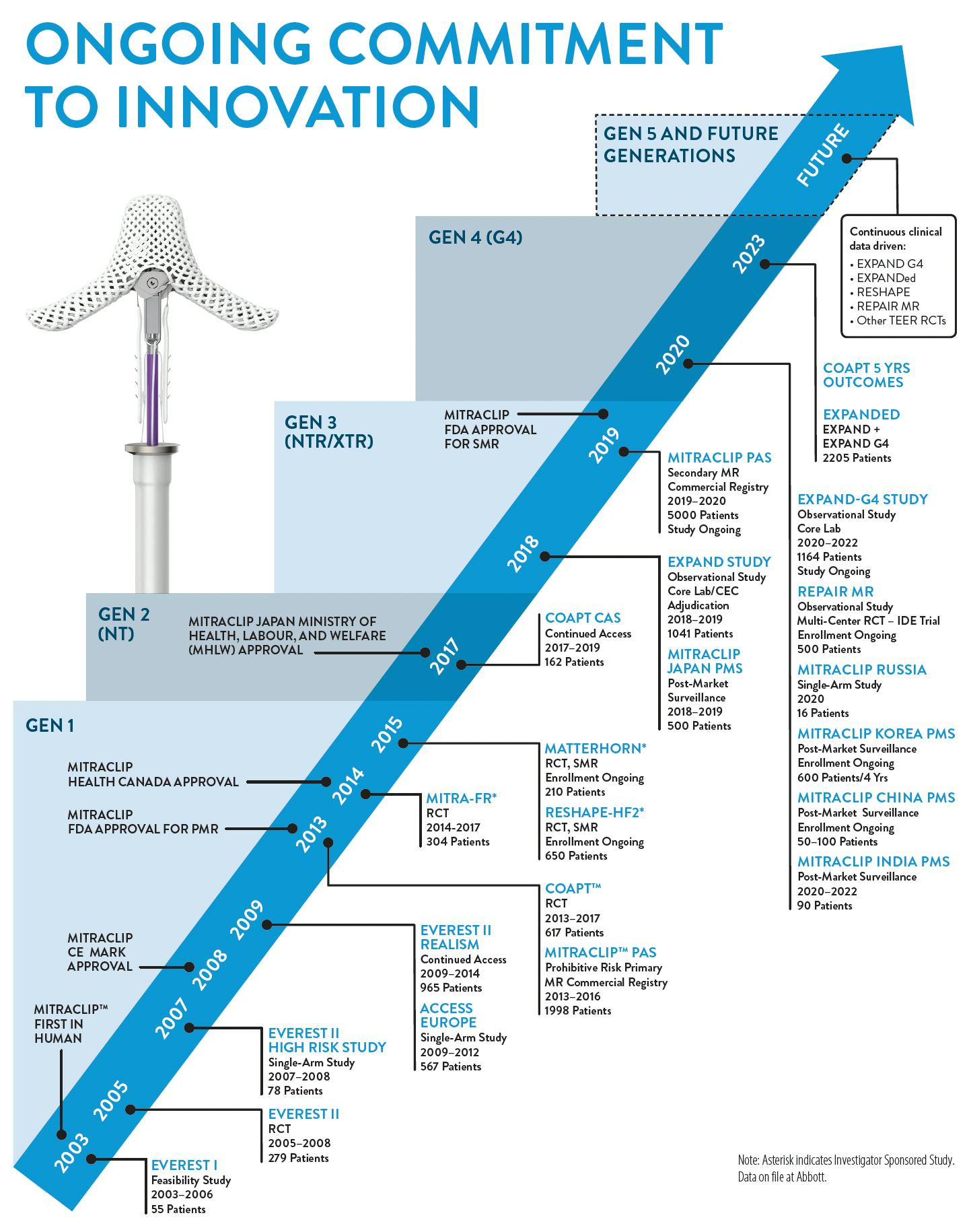
Figure 1. The evolution of MitraClip™ technologies and associated clinical studies.
1. St. Goar FG, I-Lin Fann J, Deem ME, et al, inventors; Evalve, Inc., assignee. Methods and apparatus for cardiac valve repair. US patent 6629534B1. October 7, 2003.
2. Oz M, Lemole G, Lotvin A, et al, inventors; Columbia University of New York, assignee. Method and apparatus for circulatory valve repair. US patent 20010005787A1. June 28, 2001.
3. Condado JA, Acquatella H, Rodriguez L, et al. Percutaneous edge-to-edge mitral valve repair: 2-year follow-up in the first human case. Catheter Cardiovasc Interv. 2006;67:323-325. doi: 10.1002/ccd.20603
4. Evalve, Inc. announces CE Mark approval of the world’s first percutaneous valve repair system. News release. BioSpace. March 25, 2008. Accessed August 21, 2023. https://www.biospace.com/article/releases/evalve-inc-announces-ce-mark-approval-of-the-world-s-first-percutaneous-valve-repair-system-/
5. Cardiovascular News. Abbott to acquire Evalve, a leader in mitral valve repair technology. News release. September 14, 2009. Accessed August 21, 2023. https://cardiovascularnews.com/abbott-to-acquire-evalve-a-leader-in-mitral-valve-repair-technology/
6. American College of Cardiology. FDA approves device for treatment of degenerative mitral regurgitation. News release. October 25, 2013. Accessed August 21, 2023. https://www.acc.org/latest-in-cardiology/articles/2013/10/25/11/10/fda-approves-device-for-treatment-of-degenerative-mitral-regurgitation
7. De Backer O, Wong I, Taramasso M, et al. Transcatheter mitral valve repair: an overview of current and future devices. Open Heart. 2021;8:e001564. doi: 10.1136/openhrt-2020-001564
8. Freixa X, Estévez-Loureiro R, Carrasco-Chinchilla F, et al. Percutaneous mitral valve repair: outcome improvement with operator experience and a second-generation device. J Clin Med. 2021;10:734. doi: 10.3390/jcm1004073
Advertisement
Advertisement