Advertisement
Advertisement
September/October 2023 Supplement
Sponsored by Abbott
Conclusion: Closing the Gap, Opening Options
A bright future for the MitraClip™ therapy.
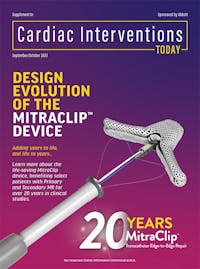
The MitraClip™ technology (Abbott) has a 20-year history of enabling minimally invasive transcatheter edge-to-edge repair (TEER) treatment of patients with mitral regurgitation (MR). Although the MitraClip device restores leaflet coaptation in a way that seemingly mimics the surgical Alfieri stitch, the Clip’s unique mechanism of action accomplishes more than a simple suture. With its locking mechanism, grippers, and Clip arms, the MitraClip device reduces the mitral valve (MV) annulus anterior-posterior (AP) dimension and interrupts its progressive enlargement. The unique annulus stabilization effect of the MitraClip device provides long-term MR reduction, promoting improved heart failure prognosis for years after device implantation. Finally, the dedicated delivery system design, made specifically for optimal MV access, enables procedure efficiency and predictability.

All four generations of MitraClip device designs have been robustly engineered and optimized with feedback from clinicians. The progressive enhancements to the device design—from introducing four Clip sizes, to adding independent leaflet capture, and enhanced steering precision and control—were based on user input on how new features could steadily improve patient clinical outcomes, broaden the range of treatable patient anatomies, reduce procedure times, and allow physicians to tailor the therapy to each patient for more optimal results. The 20 years of continual efforts and partnership with the physician community—including heart teams, interventional cardiologists, cardiac surgeons, and hospital administration staff—have established a level of care for patients that is unprecedented and paves the way for future device generations that could enable even better patient outcomes. In parallel, the MitraClip therapy has generated the largest body of clinical data in the TEER space with over 20 years of clinical studies evaluating the treatment of more than 80,000 patients. These studies spanning across each MitraClip device generation have demonstrated Abbott’s ongoing commitment to innovation and to achieving improved outcomes for patients with MR. The data generated have further characterized the impact of MitraClip implantation on the MV annulus and left ventricle, providing insights on how the MitraClip device, with its stable locked Clip arms, safely supports the structures of the heart in a way that slows the progression of heart failure.
Moving forward, the MitraClip therapy is being studied in new, expanded patient populations. The REPAIR MR (Percutaneous MitraClip Device or Surgical Mitral Valve Repair in Patients with PrImaRy Mitral Regurgitation who are Candidates for Surgery) trial (NCT04198870 clinicaltrials.gov) will evaluate the safety and effectiveness of TEER with the MitraClip device in patients with primary MR who are at moderate surgical risk and are candidates for surgical MV repair. The trial will generate contemporary clinical evidence comparing the MitraClip device and surgical MV repair. Beyond the treatment of additional patient populations, the MitraClip system is a platform technology that can be leveraged to develop products for treating other valvular diseases such as tricuspid regurgitation. Elements of the technology can be used to develop future delivery systems for transcatheter MV and tricuspid valve replacement, chordal repair, and annuloplasty therapies. If the last 20 years and the more than 200,000 patients treated worldwide are any reflection of what’s to come, the next 20 years look bright for the MitraClip therapy and the field of cardiovascular therapeutics.
The testimonials do not provide any indication, guide, warranty, or guarantee as to the response a patient may have to the treatment or effectiveness of the product or therapy in discussion. Opinions about the treatment discussed can and do vary, are specific to the individual, and might not be representative of others.
Physician Disclosures
Dr. St. Goar: Consultant for, and receives honoraria and/or equity from Abbott, Heartflow, Solopace, Moray, Avive, Biospectal, and uLink.
Dr. Kar: Consultant and Research Grants from Abbott, Boston Scientific, Medtronic, V wave, PiCardia, Laminar; National Co-Principal Investigator of the REPAIR MR trial and the EXPAND Registry; consultant to Peija Medical; scientific advisory board Laminar.
Dr. von Bardeleben: Non-paid trial activities for Abbott, Edwards Lifesciences, Medtronic, and the University of Göttingen (IIT); advisory board or speaker’s bureau member for Abbott Cardiovascular, Edwards Lifesciences, Medtronic, and NeoChord.
Dr. Asgar: Receives grant/research support from Abbott; receives consultant fees/honoraria from Abbott, Medtronic, Gore & Associates, and Anteris.
Dr. Sorajja: Receives grants/research support from Abbott (institutional), Boston Scientific (institutional), Edwards Lifesciences (institutional), and Medtronic (institutional); receives consultant fees/honoraria from 4C Medical, Abbott Structural, Anteris, Boston Scientific, Edwards Lifesciences, Evolution Medical, HighLifeMedical, Medtronic, Phillips, Siemens, Shifamed, WL Gore, and VDyne.
Dr. Nickenig: Receives honoraria for lectures or advisory boards from Abbott, Amarin, AstraZeneca, Bayer, Berlin Chemie, Biosensus, Biotronic, BMS, Boehringer Ingelheim, Cardiovalve, Daiichi Sankyo, Edwards, Medtronic, Novartis, Pfizer, and Sanofi Aventis; stock options from Beren, Cardiovalve; participation in clinical trials for Abbott, AstraZeneca, Bayer, Berlin Chemie, Biosensus, Biotronic, BMS, Boehringer Ingelheim, Cardiovalve, Daiichi Sankyo, Edwards, Medtronic, Novartis, Pfizer, and Sanofi Aventis; research funding from DFG, BMBF, EU, Abbott, Bayer, BMS, Boehringer Ingelheim, Edwards, Medtronic, Novartis, and Pfizer.
Dr. Maisano: Receives grant and/or research institutional support from Abbott, Medtronic, Edwards Lifesciences, Biotronik, Boston Scientific Corporation, NVT, Terumo, Venus; consulting fees, honoraria (personal and institutional) from Abbott, Medtronic, Edwards Lifesciences, Xeltis, Cardiovalve, Occlufit, Simulands, Mtex, Venus, Squadra; royalty income/IP rights for Edwards Lifesciences; shareholder (including share options) of Magenta, Transseptalsolutions, and 4Tech.
Dr. Alfieri: None.
Dr. Asch: Directs an academic core lab with institutional (MedStar Health Research Institute) contracts or grants with Abbott, Boston Scientific, Edwards, Medtronic, Neovasc, Corcym, GDS, InnovHeart, ANCORA Heart, and Polares.
Rx Only
Important Safety Information
MITRACLIP™ CLIP DELIVERY SYSTEM
Indications for Use
The MitraClip™ G4 System is indicated for the percutaneous reduction of significant symptomatic mitral regurgitation (MR ≥ 3+) due to primary abnormality of the mitral apparatus [degenerative MR] in patients who have been determined to be at prohibitive risk for mitral valve surgery by a heart team, which includes a cardiac surgeon experienced in mitral valve surgery and a cardiologist experienced in mitral valve disease, and in whom existing comorbidities would not preclude the expected benefit from reduction of the mitral regurgitation.
The MitraClip™ G4 System, when used with maximally tolerated guideline-directed medical therapy (GDMT), is indicated for the treatment of symptomatic, moderate-to-severe or severe secondary (or functional) mitral regurgitation (MR; MR ≥ Grade III per American Society of Echocardiography criteria) in patients with a left ventricular ejection fraction (LVEF) ≥ 20% and ≤ 50%, and a left ventricular end systolic dimension (LVESD) ≤ 70 mm whose symptoms and MR severity persist despite maximally tolerated GDMT as determined by a multidisciplinary heart team experienced in the evaluation and treatment of heart failure and mitral valve disease.
Contraindications
The MitraClip G4 System is contraindicated in patients with the following conditions: Patients who cannot tolerate, including allergy or hypersensitivity to, procedural anticoagulation or post procedural anti-platelet regime; Patients with known hypersensitivity to clip components (nickel / titanium, cobalt, chromium, polyester), or with contrast sensitivity; Active endocarditis of the mitral valve; Rheumatic mitral valve disease; Evidence of intracardiac, inferior vena cava (IVC) or femoral venous thrombus.
Potential Complications and Adverse Events
The following ANTICIPATED EVENTS have been identified as possible complications of the MitraClip G4 procedure: Allergic reactions or hypersensitivity to latex, contrast agent, anaesthesia, device materials (nickel / titanium, cobalt, chromium, polyester), and drug reactions to anticoagulation, or antiplatelet drugs, Vascular access complications which may require transfusion or vessel repair including: wound dehiscence, catheter site reactions, Bleeding (including ecchymosis, oozing, hematoma, hemorrhage, retroperitoneal hemorrhage), Arteriovenous fistula, pseudoaneurysm, aneurysm, dissection, perforation / rupture, vascular occlusion, Emboli (air thrombotic material, implant, device component); Peripheral Nerve Injury; Lymphatic complications; Pericardial complications which may require additional intervention, including: Pericardial effuse on, Cardiac tamponade, Pericarditis; Cardiac complications which may require additional interventions or emergency cardiac surgery, including: Cardiac perforation, Atrial septal defect; Mitral valve complications, which may complicate or prevent later surgical repair, including: Chordal entanglement / rupture, Single Leaflet Device Attachment (SLDA), Thrombosis, Dislodgement of previously implanted devices, Tissue damage, Mitral valve stenosis, Persistent or residual mitral regurgitation, Endocarditis; Cardiac arrhythmias (including conduction disorders, atrial arrhythmias, ventricular arrhythmias); Cardiac ischemic conditions (including myocardial infarction, myocardial ischemia, and unstable / stable angina); Venous thromboembolism (including deep vein thrombosis, pulmonary embolism, post procedure pulmonary embolism); Stroke / Cerebrovascular accident (CVA) and Transient Ischemic Attack (TIA); System organ failure: Cardio-respiratory arrest, Worsening heart failure, Pulmonary congestion, Respiratory dysfunction / failure / atelectasis, Renal insufficiency or failure, Shock (including cardiogenic and anaphylactic); Blood cell disorders (including coagulopathy, hemolysis, and Heparin Induced Thrombocytopenia (HIT)); Hypotension / hypertension; Infection including: Urinary Tract Infection (UTI), Pneumonia, Septicemia; Nausea / vomiting; Chest pain; Dyspnea; Edema; Fever or hyperthermia; Pain; Death; Fluoroscopy, Transesophageal echocardiogram (TEE) and Transthoracic echocardiogram (TTE) -related complications: Skin injury or tissue changes due to exposure to ionizing radiation, Esophageal irritation; Esophageal perforation, Gastrointestinal bleeding.
CAUTION: Product(s) intended for use by or under the direction of a physician. Prior to use, reference to the Instructions for Use, inside the product carton (when available) or at eifu.abbottvascular.com or at medical.abbott/manuals for more detailed information on Indications, Contraindications, Warnings, Precautions and Adverse Events.
Illustrations are artist’s representations only and should not be considered as engineering drawings or photographs. Photos on file at Abbott.
Abbott 3200 Lakeside Dr., Santa Clara, CA 95054 USA, Tel: 1.800.227.9902 ™ Indicates a trademark of the Abbott Group of Companies www.structuralheart.abbott ©2023 Abbott. All rights reserved. MAT-2309096 v2.0 | Item approved for U.S. use only.
Advertisement
Advertisement