Advertisement
Advertisement
July/August 2022
20 Years of TAVR: An Interview With Alain Cribier, MD, FACC, FESC
Prof. Cribier shares the inspiring and challenging story of TAVR’s origin and legacy, from the beginnings of an idea to the first-in-human procedure and from fighting for acceptance to influence on other valvular diseases, and all the highlights and triumphs of his career along the way.
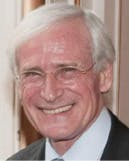
This year marks the 20th anniversary of the first transcatheter aortic valve replacement (TAVR), performed by you and your team at Charles Nicolle University Hospital in Rouen, France—a culmination of years of work and one of many milestones in your career. Rewinding to the beginning, how would you describe your career goals and interests after you completed your medical education?
My career as a cardiologist and innovator was determined very early. My orientation toward cardiology stemmed from my first hospital internship in Paris as a medical student in the 1960s. I spent most of my time in prestigious departments of cardiology and cardiac surgery that were at the forefront of therapeutic innovations of the time. I joined the Charles Nicolle University Hospital in 1972 as a resident in the Department of Cardiology, which was headed by Professor Brice Letac, a bright young Professor of Medicine and my first outstanding mentor. Prof. Letac was a cardiac catheterization and coronary arteriography pioneer in France and was the one who organized my fellowship in Los Angeles at Cedars-Sinai Medical from 1976 to 1977. I was fortunate to have Drs. Jeremy Swan and William Ganz as the directors of my research program on collateral circulation. These great innovators were very inspiring to me. They opened my mind to clinical research and innovative technologies, and I will always be deeply grateful to them. I learned to recognize unmet clinical needs and believed I could be the one to solve problems (which I must say was a bit presumptuous).
Back in Rouen, I worked to become Professor of Medicine in 1983, while putting into practice the principles I learned in the United States—for instance, pioneering thrombolytic treatment of acute myocardial infarction in France or developing new devices for coronary angioplasty and stenting.
The turning point of my career was the development of balloon aortic valvuloplasty (BAV) for treatment of degenerative aortic stenosis (AS), which constituted an undeniable first revolution in the management of the disease. In the early 1980s, approximately half of patients with symptomatic AS were turned down for surgical aortic valve replacement (SAVR), most often due to age (at that time, 70 years), and left with catastrophic short-term prognoses. Faced with this obvious unmet clinical need, I sought to enlarge the aortic orifice with a balloon catheter because this was already performed for congenital pulmonary valve stenosis in the department; but, I was aware that valvular calcification would be a significant limiting factor for hemodynamic improvement.
Against the advice of close partners, I decided to perform the first BAV in September 1985 on a highly symptomatic, critically ill, 72-year-old woman who was turned down for SAVR three times due to her age. In spite of a modest decrease of transvalvular gradient, the procedure led to the spectacular, prolonged disappearance of all symptoms and allowed her to resume a normal life. BAV was then performed in a first series of AS patients, and in 1986, our group published the first series of BAV for inoperable patients in The Lancet.1 Thereafter, the technique was rapidly embraced by the entire worldwide cardiology community. I was quickly contacted by industry to develop specific balloon catheters for BAV. This is how the Cribier-Letac BAV catheter (Mansfield) was manufactured and largely distributed in the world. Criticisms were constant; however, the success of BAV pushed cardiac surgeons to demonstrate their ability to operate on older patients, which is among the significant collateral effects of BAV.
After several years of expansion and tens of thousands of patients treated, the lack of a long-lasting benefit for BAV became evident and produced deep disappointment in the medical community. This didn’t discourage me; rather, it pushed me to find a solution against early post-BAV restenosis and led to the concept of TAVR.
You always learn from your failures, and the history of BAV was very instructive for me when the time came to develop the percutaneous valve. I am very happy to see that nowadays BAV has retained some specific indications and is routinely integrated in so many TAVR procedures for pre- or postdilatation. Obviously, the technique was not developed in vain.
The story of TAVR’s development is one of perseverance and dedication—involving 2 decades of validation, prototypes, evaluation, and animal models. What was your impetus to start exploring the idea of TAVR, and what were the challenges and highlights of this time before the first implantation?
I started exploring the idea of TAVR in the late 1980s, while seeing many BAV patients come back with valvular restenosis. In 1987, during one of our first international seminars on BAV, I announced that the next step might be “the placement of an aortic valve prosthesis using regular catheterization techniques under local anesthesia.” I’d observed that the valvuloplasty balloons could always be fully inflated, pushing aside the valvular calcifications. Thus, a balloon-expandable stent with a high radial force that could resist the valvular compression and contain a valvular structure—if accurately positioned within the native disease valve—might allow recovery of normal valve function. The original idea was to keep the calcified valve in place and use it as a platform to anchor the stent. The concept was easy to state, but its realization seemed particularly difficult from the outset. The idea was unanimously rejected by everyone, especially cardiac surgeons. In their mind, it couldn’t work for many reasons: the impossibility of crossing the valve and deploying a device within the calcifications, unavoidable blockage of the coronary ostia, injury to the mitral valve and His bundle, risk of aortic rupture and device embolization, poor and nonlasting hemodynamic results, stroke, aortic regurgitation, endocarditis, and death! It was also believed that cardiac surgery was covering the needs and that any new technology would be useless.
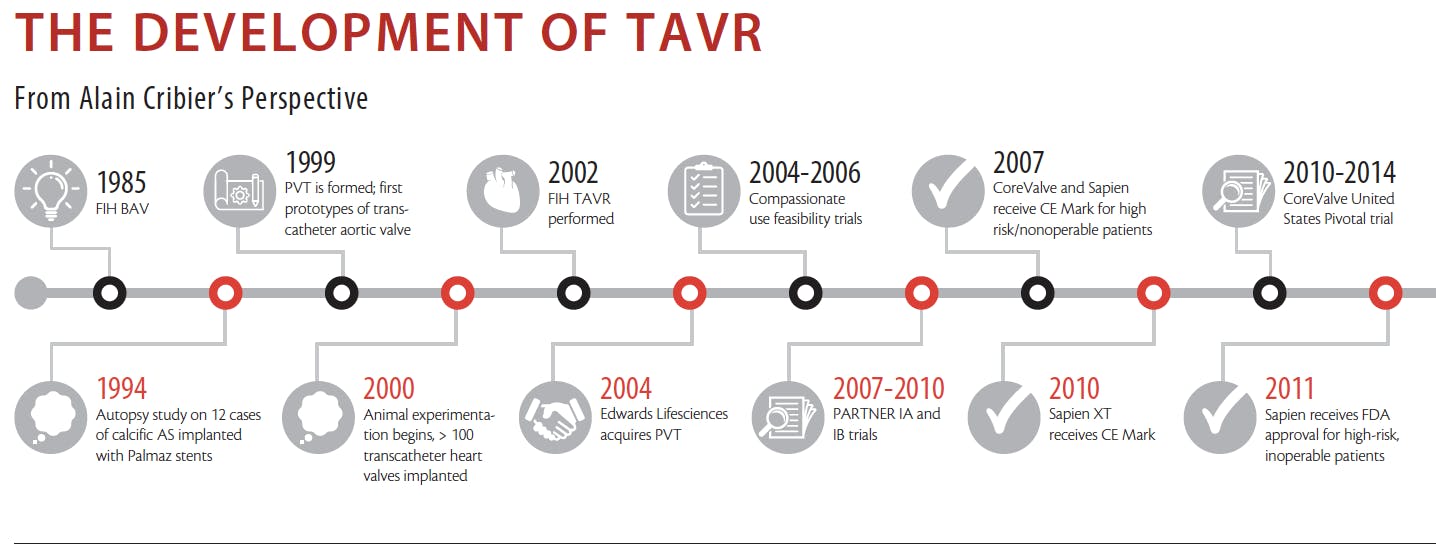
From 1993 to 1994, in spite of this fierce opposition, I performed a landmark autopsy study on a series of fresh specimen of AS with two colleagues, Prof. Hélène Eltchaninoff and Dr. René Koning, to assess the possibility of aortic valve stenting in AS. The study showed that a balloon-expandable stent (we used 23-mm peripheral Palmaz stents, Cordis) could (1) be fully expanded no matter the amount of calcium on the valve, and (2) with appropriate dimensions (15 to 17 mm in height) would not injure the adjoining structures. Furthermore, the high traction force required to remove it after implantation was an argument against the risk of embolization. Interestingly, in 2002, just before the first TAVR, renowned United States pathologist Renu Virmani, MD, further confirmed these results (to her great astonishment, as she says). In 1994, drawings of both the device and the transfemoral procedure were produced for filing a European patent.
For 5 years, the project was rejected by experts from many biomedical companies. It was considered the stupidest project presented. I must confess that I was rather discouraged, until our luck changed when we met with two engineers from Johnson & Johnson (J&J), Stan Rabinovich and Stan Rowe, who surprisingly supported the project. They spoke to Martin Leon, MD, then Medical Director at J&J, who also embraced the project. After a failed attempt to develop the aortic valve with J&J, we launched a start-up in 1999 called Percutaneous Valve Technologies, Inc. (PVT), with the goal of taking on the challenge ourselves. We found a small engineering company in Israel (Aran R&D) that agreed to invest and develop the stented valve prototype with the help of Assaf Bash, a remarkable engineer who was experienced in stent development and who, with his team, solved numerous issues associated with the “philosophy” of the stented valve. Within a few months, I had in my hand a prototype corresponding to my wishes: a laser-cut, stainless steel stent that was 23 mm in diameter and comprised a tricuspid polymeric (later, equine pericardial) valve. The device and all additional accessories were submitted to complete laboratory testing in Israel. In 2000, Prof. Eltchaninoff and I began an extensive in vivo study using a sheep model at Institut Montsouris in Paris. The study led to the development and refinement of the overall technical aspects of valve implantation on acute and chronic evaluation, but it didn’t answer the question of the procedure’s feasibility and safety in humans due the different anatomy and healthy valves of the sheep.
On April 16, 2002, you successfully performed the first-in-human (FIH) TAVR in a 57-year-old patient with severe symptomatic AS and a failed BAV. What were the emotions and thoughts going through your head after the intervention was completed?
The FIH implantation will stay forever in my memories. In Rouen, a patient from Lille, France, presented for emergent BAV. He was young, at 57 years of age, and presented with severe, bicuspid, type 1 AS. He was critically ill, dying, and in cardiogenic shock, with most of the current contraindications for TAVR today, including an ejection fraction of 12%, floating thrombus in the left ventricle, subacute leg ischemia related to a double aortoiliac graft dysfunction, and other comorbidities. He had been turned down for SAVR by three surgical teams. Due to a lack of patent femoral arteries, BAV was immediately attempted using the transseptal approach, a procedure that was soon stopped because of hemodynamic intolerance. Recurrence of shock occurred 24 hours later. TAVR was considered the only possible life-saving procedure for this young patient.
I received the green light from my PVT partners in the United States, despite the considerable risk of failure in this clinical setting. It was a dreadful situation for a first case, made even more difficult by the need for the challenging unplanned transseptal approach. The technique, performed under local anesthesia and without transesophageal echocardiography, was improvised step by step, and the atmosphere in the cath lab was extremely loud. Every step was carried out successfully—advancing the valve over a guidewire that entered the right femoral vein and exited the left femoral artery, crossing the septum, making a U-turn with the device in the left ventricle (around the floating thrombus), crossing the native valve, positioning the device within the calcifications, and inflating the balloon to deliver the device—and led to an immediate, amazing clinical improvement.
It is hard to describe the emotion of the entire team when we observed the color of the patient’s face passing from black to gray and gray to pink within minutes and the patient smiling and thanking everyone. The vision of the valve opening and closing on transthoracic echocardiography was overwhelming for all of us. A few tears flowed among the team. It was a dream come true.
While drinking champagne with the patient in his room a few hours later, I realized that if we could succeed in such a challenging case, we might enter a new era for treating desperate, inoperable cases. I was ready to repeat it in less critically ill patients via the transfemoral route. Of course, I could not anticipate the unbelievable, fast expansion of the procedure and the explosion of indications that we see today.
The report in Circulation of this first human case was received with stupefaction and enthusiasm by the medical community.2 I waited almost a year to be allowed by French authorities to begin a controlled series of patients on a compassionate basis (ie, life expectancy not exceeding a few weeks), and I was required to use the same transseptal approach in all. Unfortunately, the goal of experts was to stop this “outrageous” therapeutic option. We were able to include 36 patients in our first series, with 80% procedural success.3 The results attracted the attention of the most skeptical. Against all expectations, although many patients died of comorbidities after a few months, several patients did live for several years with no device failure and a return to normal life. Some extraordinary clinical cases played an indisputable role in the acceptance of TAVR, such as our seventh patient, an 83-year-old woman who received TAVR in the worst clinical setting but was strong enough to travel to the Transcatheter Cardiovascular Therapeutics meeting in Washington, DC, 1 year later to speak of her experience. She survived for 6.5 years with normal cardiac function and died of breast cancer. A similar striking, long-lasting improvement was observed in the first patient to receive TAVR via the much simpler transfemoral antegrade route, which we had in mind from the beginning. In this case, the transseptal approach could not be performed due to concomitant mitral stenosis. This particular patient gave us a good idea of what might be the future of TAVR.
In this optimistic context, expansion of the protocol started in the United States and Europe, and by 2005, a total of 100 patients had been treated worldwide. In 2004, PVT was acquired by Edwards Lifesciences, an event that incredibly boosted the course of TAVR history. You know the extraordinary steps of TAVR’s development thereafter!
Before the first TAVR was the introduction of your balloon-expandable transcatheter heart valve. What features were you aiming for in terms of valve configuration for that first prototype, and how has transcatheter heart valve technology evolved since?
I previously talked of the “philosophy” of the aortic valve. What were our requests to the Aran engineers? A prosthesis made of a highly resistant frame, containing a uni-, bi-, or trileaflet valvular structure; able to be homogeneously compressed over a high-pressure balloon, making possible its introduction into an introducer (femoral artery) of 7 to 9 mm in diameter; and able to be enlarged by balloon inflation to an external diameter of 23 mm, without any damage to the frame and valvular structure! The hemodynamics were crucial. The valve had to offer a high effective orifice area and a low gradient, a proper coaptation of the leaflets with no leakage, and optimal tissue deflection matching. Safety was another goal, and this involved minimizing interference with surrounding structures and having a low crimped profile, predictable deployment, and anchorage. Durability was also a concern, with the search for resistant leaflet tissue, uniform stress distribution on leaflets, and good resistance to calcification. These were highly challenging requests, but they made it!
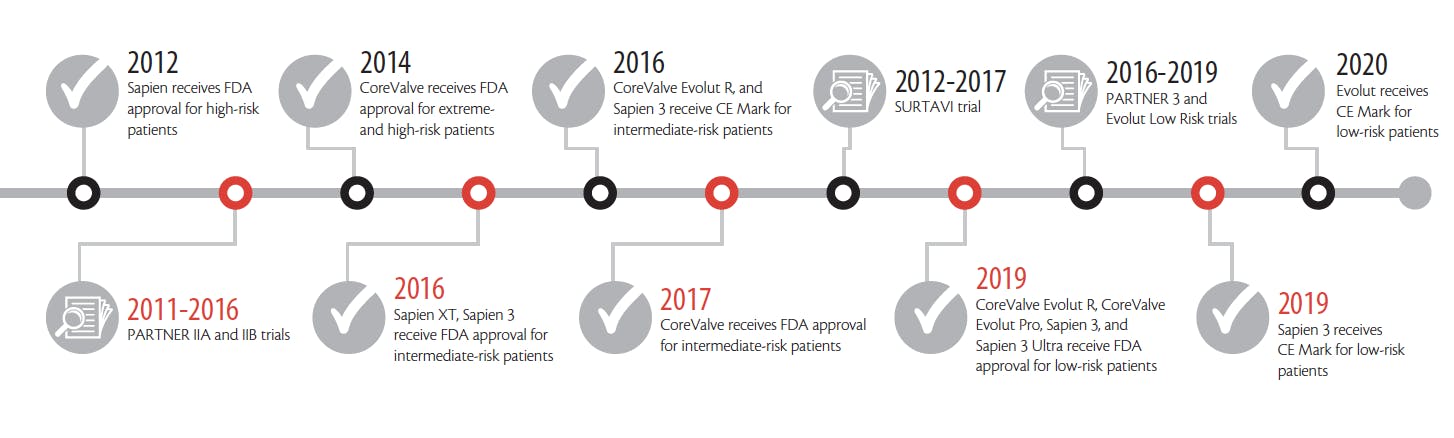
The first generation of TAVR valves (first the PVT valve, then the Cribier-Edwards transseptal valve [Edwards Lifesciences]) were excellent devices but had a few limitations, such as the caliber of the crimped valve that required a 24-F introducer and a single valve size of 23 mm. Soon after the acquisition of PVT, Edwards made several iterations to the device, providing two sizes (23 and 26 mm) and renaming it the Edwards Sapien valve. However, the 24-F sheath required for the retrograde approach limited TAVR to 50% of potential candidates. This issue was solved by the development of the alternative antegrade transapical approach: a minimally invasive surgical approach that avoided sternotomy and extracorporeal circulation, allowed for treatment of almost all TAVR candidates, and led surgeons to change their mind about TAVR. When I attended the first transapical case in Leipzig, Germany, with Friedrich Mohr, MD, and Michael Mack, MD, they said it was like “the devil entering the operating room.”
The self-expanding CoreValve (Medtronic) was launched in 2004, in 20 and then 18 F, and featured the nonuse of a balloon catheter. In the course of TAVR’s development, the fair competition between these two devices has contributed to the procedure’s expansion throughout the world.
The expansion of TAVR greatly resulted in more advanced technology; a consistent decrease in crimped size, from 24 to 14 F; and a multiplication of valve sizes to ensure optimal coverage of the aortic annulus. This is the case with the latest-generation TAVR valves, Sapien 3 from Edwards Lifesciences, CoreValve Evolut from Medtronic, and other new valves available on the market. These improvements led to improved results and a decrease in severe complications. Also, they facilitated the transfemoral approach—which is currently applied in > 90% of the cases using a “minimalist” strategy that our team has pioneered since 2012—turning TAVR into a “stent-like” procedure performed under local anesthesia that allows the patient to be discharged home within 2 to 3 days.
This first performance in 2002 was just the beginning of your fight for TAVR to become an established treatment—what were the main hurdles you encountered, and how did you overcome them?
I confirm that I had many hurdles on my way. To limit the topic to two, the main one was the fierce opposition from some cardiac surgeons who could not accept another technology from me after BAV! At the time, they were the experts of biomedical companies because the artificial valve was their domain of competence. I had a hard time at meetings when reporting our first results; I just was not trusted to the point that I was often insulted. The relief came from the launch of the transapical approach. As I could anticipate after the FIH case in Leipzig, cardiac surgeons realized that a balloon-expandable valve could be fully circularly opened in any calcified valve, with major complications, at least after a learning curve.
Another hurdle was the health authorities in France and other countries; we had to first prove the interest of this disruptive technology for inoperable dying patients and then move step by step to less severely ill patients. This pathway is very unusual in medicine and is totally different from the one followed for developing any new technology, such as coronary angioplasty, where the first cases were performed on single proximal lesions before being expanded to more complex cases. The fact that TAVR survived this pathway is remarkable and confirms the immense value of the technique, which is supported by all evidence-based trials, no matter the surgical risk.
After 20 years of progress of this breakthrough disruptive technology, what are today’s challenges and needs for further innovation in TAVR? What do you think the future of TAVR looks like?
The number of TAVR devices developed over the last 15 years is absolutely amazing. Physicians and companies have overflowed with imagination to create competitive valves given the obvious importance of the market. However, most remain investigational or disappear after a brief clinical use. Today, a few additional devices can be used, but their superiority or noninferiority over the two “major devices” cannot be scientifically demonstrated. Other recent devices from Asia or South America are promising but under investigation, and their cost-efficacy is a possible argument for use in low-resource countries.
Even without a crystal ball, it’s easy to predict continuous expansion of TAVR in the future, in the range of 4% to 10% per year. The expansion curve of TAVR over the last 10 years is “exponential,” with a continuous increase in the number of centers worldwide and now > 1.5 million patients treated in about 80 countries.
One of today’s challenges is the high cost of TAVR valves, which is a hindrance to the expansion of the procedure in developing countries. However, as has been observed with all new devices, the cost should progressively decrease after increased demand and competition between manufacturers. The continuous technologic advances, growing experience of the teams, and expansion of indications to valve-in-valve cases and moderate or asymptomatic AS will be among the many factors that contribute to an explosion of indications, without forgetting the growing interest of cardiac surgeons to learn transfemoral TAVR, as well as the possible changes in health regulation to allow for the opening of some centers without cardiac surgery on board.
The future of TAVR will also depend on the long-term valve durability, which is still an unanswered question despite the lack of alarm so far. Anecdotally, the longest follow-up in Rouen is 14 years, with no valve deterioration. Many companies today are working on nonbiologic valve structures that might be a solution for decreasing the risk of structural deterioration with time. But obviously, the future of TAVR is bright!
How have you seen the success of TAVR’s development and clinical validation in aortic valve stenosis contribute to the transcatheter treatment of other valvular diseases?
I have been following with interest the development of transcatheter therapies for other valvular diseases, with the satisfaction of having been inspired by the development of TAVR! Twenty years later, the road is still bearing fruit. Soon after the launch of TAVR, several companies made mitral regurgitation (MR) the next big target, with the idea that the overall number of patients with MR exceeds that of AS. In spite of explaining the difference between organic and functional valve disease and pointing out the disparity of clinical needs, millions of dollars have been spent to develop nonsurgical techniques for treatment of MR. Almost 20 years later, very few—among an incredible number of technologies that turned out to be disappointing, too complex, or simply inapplicable—did survive. These include mitral valve repair with the MitraClip (Abbott), for instance, but its acceptance and expansion are not comparable to TAVR. Percutaneous mitral valve replacement was experimented 15 years ago, with difficulties emerging due to the different anatomy of the mitral valve, large annulus size, lack of calcification, proximity of the left ventricular outflow tract, specific complications such as thrombosis, and the limited market. The future of this technology remains, for me, uncertain; however, some promising new devices have been launched with short series of patients reported to date. The tricuspid valve has also been a source of inspiration for several companies, and the clinical impact of some recent devices for treating tricuspid regurgitation is promising.
That being said, the interest stirred by these different technologies, the amount of work done, and the money spent are beyond imagination. The development of TAVR catalyzed the onset of various technologies for other structural, nonvalvular heart diseases. TAVR continues to inspire a new generation of cardiologists and will have a durable impact on the pattern of medical practice.
In Rouen, France, you created a multidisciplinary Medical Training Center (MTC). After the inauguration of the MTC by the French President of the Republic 6 years ago, you served as Medical Director before leaving to remain an adviser for the cardiology training programs, including TAVR. What does that role entail, and what is your favorite part of working at the MTC?
Training and proctoring have always been an enormous, exciting part of my activities since the onset of BAV, the development of the mitral commissurotomy, and eventually the launch of TAVR. From 2003 to 2008, we received > 1,500 cardiologists, cardiac surgeons, and nurses from France and foreign countries to undergo training on TAVR. We offered a few days of programs, including live cases, work on an electronic simulator, and workshop and didactic sessions. With the increased demand, TAVR training with the balloon-expandable valve was moved to the Edwards European facilities in Switzerland. There, I was involved with didactic sessions, and live cases transmitted from Rouen were performed by Prof. Eltchaninoff and our team. Since 2017, we have been reinitiating training programs on TAVR in Rouen two or three times a year by taking advantage of the great facilities offered by the new Rouen MTC. Our goal was to offer additional training to physicians who wished to learn tips and tricks associated with the transfemoral minimalist approach, and there are a lot of them. COVID-19 forced us to temporarily use virtual training for the last 2 years.
I love to work in our outstanding MTC, a huge building on the hospital campus. The MTC fits with my conviction to have simulation programs in medicine, keeping the adage: “Never the first time on a patient.” In Rouen, simulation is now part of the medical and paramedical studies in all disciplines. We have also opened a large technical platform with a cardiac catheterization lab and several operating rooms—those facilities that I missed so much during my personal research programs in the past—to allow start-ups to do in vivo testing.
Outside of TAVR, what have been your proudest professional or personal achievements?
I am satisfied that I’ve been able to combine my professional mission as an innovator, for the sake of so many patients, with the hard work inherent to the function of Professor of Medicine—heading an outstanding and very active Department of Cardiology while being in charge of the teaching and research programs at the university. I am happy to have instilled in the entire team of physicians and nonphysicians a special spirit of placing respect for the patient at the top of our priorities. I am proud to have generated strong, friendly relationships with so many colleagues around the world, especially in India, where I’ve been committed since the late 1990s by founding the Indo-French Foundation of Interventional Cardiology. It is primarily for India that I developed, with the French company Medicorp, a cost-effective percutaneous metallic commissurotomy for treatment of mitral stenosis, which has been very successfully used in many low-resource countries. Interestingly, I developed it during the 5-year break in my TAVR program due to the lack of funding!
Besides my professional achievements, I am proud of having dedicated my time to my superb family that always supported my activities and encouraged me despite an unbearable schedule. Playing the piano has also been a wonderful way to decompress, and I now have a lot more time to devote to it.
What advice would you share with physicians who may face skepticism or criticism of their research, as you did in the beginning stages of TAVR’s development?
Anyone who wishes to innovate in medicine must be ready to face a number of obstacles that inevitably include skepticism and criticism. Nobody can trust that you are able to bring something new, assuming that your project would already exist if it was valid. My advice: Never give up! Don’t be discouraged and move forward tenaciously. If you have the conviction that your project is good, if it corresponds to a clinical need, and if you have been able to find an argument to support it, there is no obstacle that will prevent you from succeeding. The history of TAVR should be very inspiring in this respect.
1. Cribier A, Savin T, Saoudi N, et al. Percutaneous transluminal valvuloplasty of acquired aortic stenosis in elderly patients: an alternative to valve replacement? Lancet. 1986;1:63-67. doi: 10.1016/s0140-6736(86)90716-6
2. Cribier A, Eltchaninoff H, Bash A, et al. Percutaneous transcatheter implantation of an aortic valve prosthesis for calcific aortic stenosis: first human case description. Circulation. 2002;106:3006-3008. doi: 10.1161/01.cir.0000047200.36165.b8
3. Cribier A, Eltchaninoff H, Tron C, et al. Treatment of calcific aortic stenosis with the percutaneous heart valve: mid-term follow-up from the initial feasibility studies: the French experience. J Am Coll Cardiol. 2006;47:1214-1223. doi: 10.1016/j.jacc.2006.01.049
Advertisement
Advertisement
Interested in reading more interviews?
To read more interviews with thought leaders in the interventional cardiology field, check out our Profiles & Perspectives hub.
Read More