Advertisement
Advertisement
January/February 2022
Atrial Septal Defects and Patent Foramen Ovale: Current Data Update
Primary clinical manifestations associated with PFO and ASD and their therapeutic implications.
By Marilena Di Salvo, MD; Marco Monte, MD; and Marco Barbanti, MD
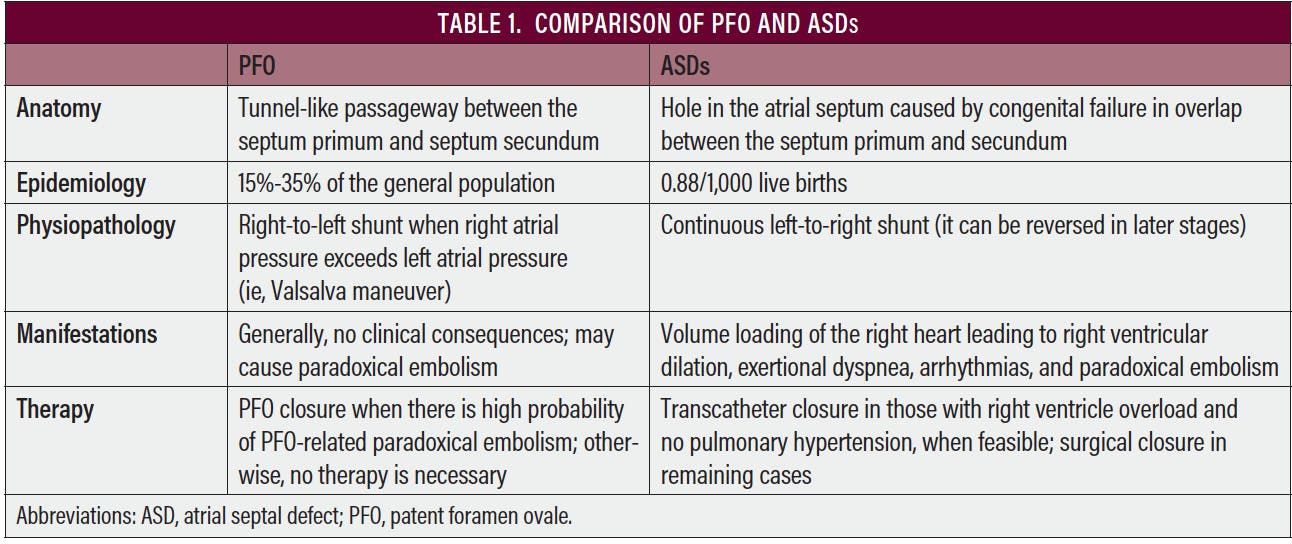
Patent foramen ovale (PFO) and atrial septal defects (ASDs) represent the most common and second most common congenital heart abnormalities, with a prevalence of 25% to 30% in the general population and 1.65 per 1,000 live births, respectively.1 The prevalence of PFO is 15% to 35% via autopsy and 15% to 25% in echocardiographic studies, with a tendency to decrease with aging.2 The most common ASDs are isolated secundum ASD, which accounts for 7% of all congenital heart defects; they are generally sporadic, although sometimes are associated with a few genetic mutations and genetic syndromes (ie, Down syndrome, Noonan syndrome).3 This article reviews the clinical manifestations of PFO and ASDs and their therapeutic implications (Table 1).
EMBRYOLOGY
During fetal growth, the primitive atria are separated by the septum primum, which develops from the atrial roof and presents a small inferior opening called the ostium primum. As the septum primum grows, the ostium primum starts to shrink, but before its complete closure, the ostium secundum forms in the ostium primum toward the roof of the atria, allowing the physiologic fetal right-to-left shunt to be maintained.1 An infolding of the right atrial roof (previously the septum secundum) forms the roof of the ostium secundum. A tunnel-like passage formed by the septum secundum and ostium secundum, the so-called foramen ovale, allows the passage of blood.4 At birth, the increase in left atrial pressure due to respiration forces the septum primum against the septum secundum, functionally closing the foramen ovale; these two membranes will eventually close with time. If adhesion is incomplete, a PFO will remain.1
PFO
Physiopathology
A PFO is a tunnel-like passageway between the septum primum and septum secundum that allows a physiologic right-to-left shunt during fetal life and closes at birth in 70% to 75% of cases when left atrial pressure increases above right atrial pressure.3 However, anatomic closure does not occur in the 25% to 30% of cases, allowing a right-to-left shunt when right atrial pressure exceeds left atrial pressure (ie, Valsalva maneuver). As a result, thrombi, air, or vasoactive peptides may cross through the PFO from the pulmonary to systemic circulation, a phenomenon known as paradoxical embolism, which is associated with different clinical manifestations.5 In most cases, PFO remains undetected or appears as an incidental finding during cardiac investigations in otherwise asymptomatic patients.
Clinical Manifestations
Cryptogenic stroke (CS) is defined as a cerebral ischemic event that is not caused by atherosclerotic disease, atrial fibrillation (AF), small artery disease, or intracerebral pathologies despite extensive vascular, serologic, and cardiac evaluation. CS represents 40% of stroke diagnoses.6 The suspected mechanism of PFO-related CS is the translocation of venous thrombi to the arterial circulation at the moment when the PFO is opened (leading to embolic stroke) during rapid rise and fall in right atrial pressure (for instance, during the Valsalva maneuver).5 Deep vein thrombosis and thrombophilia may facilitate paradoxical embolization. Systemic embolization to the myocardium, gut, limbs, and coronary arteries has also been described.5
There is a bidirectional association between PFO and migraine. PFO-related migraine is most likely caused by systemic embolization of vasoactive neurotransmitters without filtration in the pulmonary circulation.7
Decompression sickness (DCS) typically occurs in divers and high-altitude pilots when gas bubbles enter systemic circulation bypassing the pulmonary circulation, thus provoking vessel occlusion. Fatigue, dizziness, confusion, motor incoordination, and paralysis are the main symptoms.8
Platypnea-orthodeoxia syndrome (POS) is characterized by positional dyspnea and arterial desaturation worsening when sitting or standing and improving while in the supine position. Concomitant changes in thoracic anatomy (ie, chest surgery, aortic dilation) facilitate a blood shunt from the inferior vena cava to the systemic circulation.9
Diagnosis and Indications for PFO Closure
The diagnosis of PFO is made using a combination of techniques and is required only to make a treatment decision.10 At present, the precise diagnosis of PFO is based on the use of different diagnostic modalities, as no technique is considered a gold standard.10 Contrast-enhanced transcranial Doppler is a sensitive method to detect right-to-left shunt during the Valsalva maneuver, although the exact location of the shunt is unknown. Contrast-enhanced transesophageal echocardiography (TEE) provides direct visualization of the PFO-related shunt and other structures (ie, the interatrial septum).10,11
Given the high prevalence of PFO in the general population, transcatheter PFO closure should be reserved for patients with a high probability of a PFO-related embolic event, whereas medical therapy should be considered if the probability is low.10 The Risk of Paradoxical Embolism (RoPE) score classifies the relationship between CS and PFO, but it still needs external validation and does not include some variables that have been associated with higher recurrence rate (ie, atrial septal aneurysms [ASAs], PFO dimension, coagulation disorders) and a higher risk of CS (ASA, PFO dimension, embryonic residues, shunt severity).10,12
Other potential causes of an ischemic event should be excluded before proceeding to intervention. Carotid ultrasound should exclude significant plaque disease, while thrombophilia testing may be considered based on clinical suspicion.10 Brain imaging (MRI, CT) is pivotal to correctly identify treatable patients, confirm the presence of ischemic lesions, and exclude nonembolic causes of ischemic stroke; cortical and subcortical lesions are associated with cardioembolic emboli, while multiple lesions involving a single vascular territory are suggestive of large artery atherosclerosis.11
Identification of AF is extremely important, as it may cause both systemic embolism and recurrences caused by left atrial appendage thrombus rather than paradoxical embolism. A routine 12-lead electrocardiogram (ECG) and, in selected patients, inpatient cardiac telemetry or 24-hour Holter ECG are generally sufficient to exclude AF-related ischemic events.10 However, in high-risk patients for AF, an insertable cardiac monitor may be reasonable to rule out AF before deciding on PFO closure.10
There are no studies comparing PFO closure to behavioral prevention of DCS. In general, patients with DCS should be considered for intervention when the probability of causal PFO is high, they are not willing to stop the activity responsible for DCS, and when behavioral prevention is not feasible.13
Patients affected by migraine with aura could be considered for PFO closure for compassionate use when they are dissatisfied with medical therapy or when refractory to maximal medical therapy.13
Device Overview and PFO Closure Outcomes
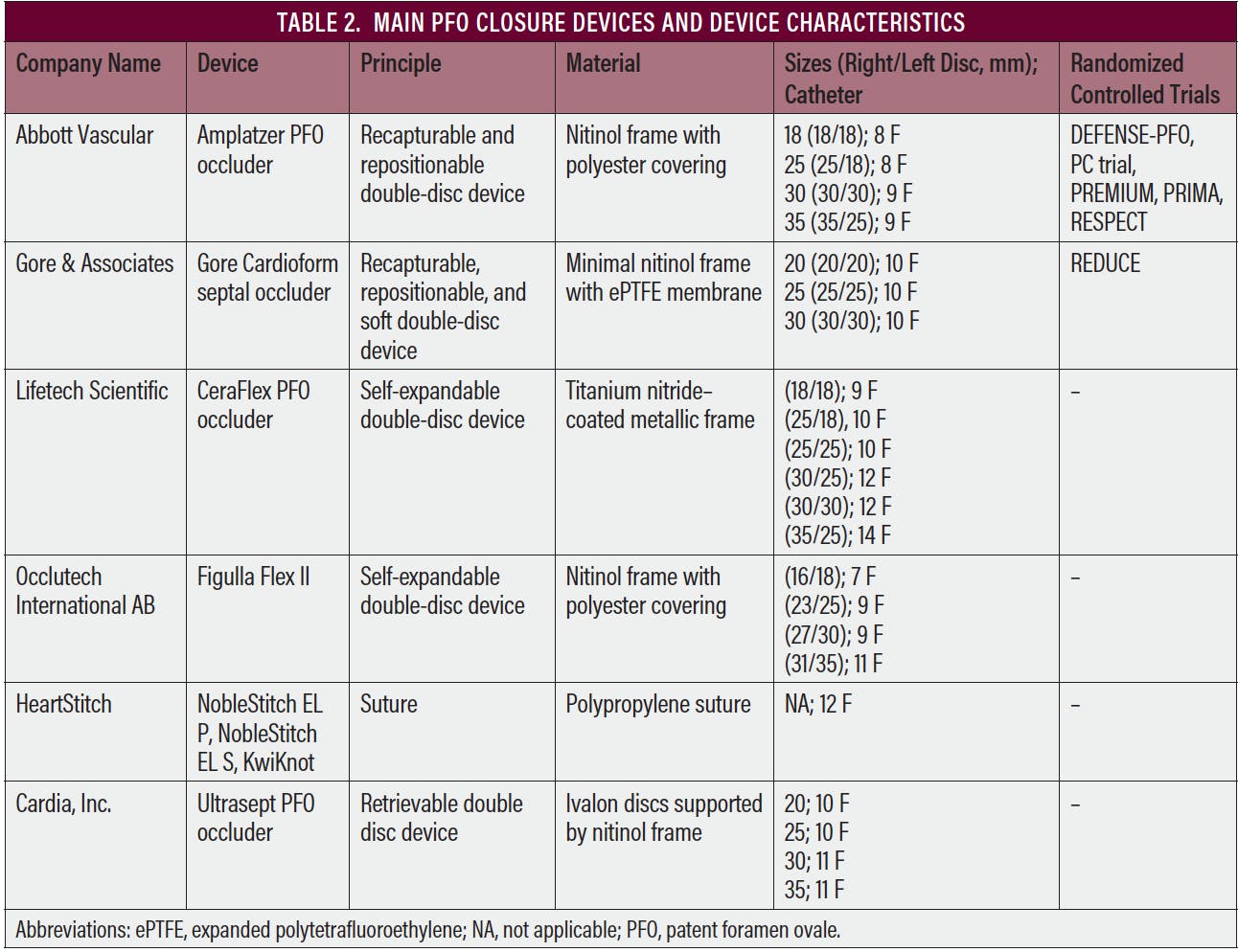
Various devices with different shapes and sizes are currently available for PFO closure (Table 2). Most consist of a double disc connected by a short waist. The Amplatzer PFO occluder (Abbott) and the Gore Cardioform septal occluder (Gore & Associates) are the most adopted devices in PFO trials, and they are the only FDA-approved devices in the United States. In Europe, different devices are used for PFO closure.14 Device size and choice are guided by anatomic features of the PFO (eg, ASA, Chiari network, tunnel-like PFO) and clinical factors such as contraindication to antiplatelet therapy or nickel allergy.15 A PFO-suture device (NobleStitch EL, HeartStitch) can also be used in favorable anatomies.16
Studies and a meta-analysis have highlighted that PFO closure plus antiplatelet therapy confers substantial reduction in stroke recurrence compared with antiplatelet therapy alone, at the cost of a modest increase in the risk of AF and atrial flutter.17-20 The earliest PFO trials (CLOSURE I, PC trial, RESPECT) did not demonstrate superiority of closure compared with medical therapy. These studies were underpowered, as the expected recurrent stroke rate was overestimated, and had a high crossover between groups.5 However, a meta-analysis of these studies showed superiority of PFO closure over medical therapy for secondary prevention of stroke.21 On the contrary, the most recent PFO trials (long-term results of RESPECT, REDUCE, and CLOSE) showed superiority of PFO closure over medical therapy.22
After PFO closure, dual antiplatelet therapy with aspirin (100 mg/daily) plus clopidogrel (75 mg/daily) is recommended for at least 1 to 6 months, followed by single antiplatelet therapy for at least 5 years.10,22 The incidence of new-onset postprocedural AF is low, with an incidence rate of 0.013 person-years.23 A network meta-analysis showed that considering serious AF (risky clinical condition), correctly selected patients gain more advantages in being treated.24
Medical Therapy
For patients in whom medical therapy is chosen, a variety of treatments are available, although no specific trial has assessed the optimal medical treatment for PFO-associated cerebrovascular events.10 Different studies highlight the superiority of oral anticoagulation versus antiplatelet agents, but the benefits should be weighed against bleeding risk, with anticoagulation with vitamin-K antagonists preferred in those with low bleeding risk and good therapeutic compliance. At present, no data are available for medical therapy with direct oral anticoagulants.10
ASDs
Definition, Types, and Physiopathology
ASD is a direct communication between the two atria that allows shunting of blood between the pulmonary and systemic circulation. Depending on its location, four types of ASD can be distinguished25:
- Ostium secundum defects: the most common type of ASD, accounting for 80% of ASDs, which are characterized by a communication between the two atria at the level of the fossa ovalis
- Ostium primum defects: these account for 10% of ASDs, arising from a deficiency of tissue at the level of the atrioventricular valves
- Sinus venosus defects: generally involve the superior portion of the embryologic sinus venosus and are associated with partial anomalous pulmonary venous return
- Coronary sinus defects: holes involving the coronary sinus1
ASDs cause continuous left-to-right shunt, the magnitude of which is determined by the size of the defect and relative atrial pressures. Significant shunts cause right ventricular (RV) volume overload and pulmonary overcirculation, whereas smaller shunts do not result in significant volume overload.26 Long-standing and significant shunts result in right-sided volume enlargement and right-sided heart failure between the fourth and fifth decade of life, atrial arrhythmias, and pulmonary hypertension (PH). Ultimately, Eisenmenger syndrome and right-to-left shunt may develop, which are contraindications to ASD closure.26
Clinical Manifestations and Diagnosis
Smaller ASDs may remain asymptomatic lifelong, while significant shunts may be asymptomatic during childhood and adolescence but become symptomatic during adulthood (usually from the third to fourth decade). Symptoms include palpitations due to arrhythmias, exertional dyspnea due to PH, fatigue, and syncope.26 Rarely, larger defects may cause manifestations during childhood such as failure to thrive, tachypnea, heart failure, and respiratory failure.26 Paradoxical embolism and POS may be clinical manifestations.27 A murmur in the pulmonary area and complete or incomplete right bundle branch block, right axis deviation, and signs of RV enlargement may represent incidental clinical and electrocardiographic findings, respectively.25 An increase in pulmonary vascularity may appear on chest x-ray.28
Imaging is required to confirm the diagnosis of ASD and its hemodynamic consequences. Transthoracic echocardiography is the first-line diagnostic technique because it allows evaluation of RV function and the size of atria and ventricles, estimation of pulmonary artery pressure (PAP), and, in those with optimal acoustic windows, direct visualization of the interatrial septum and the interatrial shunt.27 The use of agitated saline solution may be very helpful in more complex cases, while TEE is generally necessary to directly examine the interatrial septum and evaluate the size and location of the ASD.29 Cardiac MR is rarely required for the evaluation of RV size and function, quantification of pulmonary to systemic flow ratio (ie, Qp/Qs), and pulmonary venous connection, while cardiac catheterization is required to evaluate pulmonary vascular resistance (PVR) in patients with increased PAPs.28
Indications and Outcomes for ASD Closure
Percutaneous ASD closure is indicated in patients with evidence of RV volume overload and no PH or left ventricular disease and should be considered in patients with a high suspicion of ASD-related paradoxical embolism.28 ASD closure is not recommended in the presence of Eisenmenger physiology, PH, or desaturation on exercise.28 Transcatheter ASD closure is the therapy of choice when technically feasible; surgical repair with autologous pericardium or synthetic material has good long-term results and low mortality.28
Sinus venosus type and primus type represent contraindication to percutaneous closure due to insufficient rim to support device implantation.30 Outcome is best when repair is undertaken at age < 25 years. Calculation of PVR is mandatory in those with PH, as patients with PVR > 5 Woods units are unlikely to improve.28
TEE and intracardiac echocardiography, together with fluoroscopy, represent the main intraoperative imaging methods to guide percutaneous ASD closure, allowing the selection of the correct dimension of the device.31 Three-dimensional echocardiography improves the evaluation of ASD location, dimensions, and spatial relationships to surrounding structures.32 After ASD closure, the prevalence of PH and mean PAPs tend to decrease irrespective of age.33
Transcatheter procedures have long-term success in adults,34 where the successful device implantation rate reaches 98.7% and device embolization, atrioventricular block, cardiac perforations and erosions, and thromboembolism represent the main complications.30 Regular follow-up, with evaluation of residual shunt, RV size and function, and PAPs, is required for those undergoing repair at age > 25 years, while patients aged < 25 years do not require regular follow-up.28
CONCLUSION
Transcatheter PFO closure is a safe and feasible procedure that should be reserved for young patients (aged 18-60 years) with a high probability of PFO-related paradoxical embolism after the exclusion of other possible causes of ischemic stroke, as it may represent an incidental finding considering the high prevalence of PFO.10 The most recent PFO trials showed superiority of PFO closure over medical therapy.22 A multimodality imaging approach is generally necessary for appropriate patient selection for closure. The optimal antithrombotic therapy after percutaneous PFO closure remains uncertain. Aspirin plus clopidogrel is generally given for 6 months, followed by single antithrombotic therapy, usually aspirin, for 2 to 5 years.10 Medical treatment could represent an alternative, but data on optimal antithrombotic or anticoagulant regimens are lacking.10
ASDs are among the most common congenital heart abnormality and can manifest through a wide clinical spectrum. Sometimes they are an incidental finding in otherwise asymptomatic patients with preserved RV function or they can cause significant RV heart failure and PH.3 Percutaneous closure represents an effective therapeutic approach with very low morbidity and mortality, and a surgical approach can be considered if a transcatheter approach is not feasible.28
1. Naqvi N, McCarthy KP, Ho SY. Anatomy of the atrial septum and interatrial communications. J Thorac Dis. 2018;10(suppl 24):S2837-S2847. doi: 10.21037/jtd.2018.02.18
2. Hagen PT, Scholz DG, Edwards WD. Incidence and size of patent foramen ovale during the first 10 decades of life: an autopsy study of 965 normal hearts. Mayo Clin Proc. 1984;59:17-20. doi: 10.1016/s0025-6196(12)60336-x
3. Kheiwa A, Hari P, Madabhushi P, Varadarajan P. Patent foramen ovale and atrial septal defect. Echocardiography. 2020;37:2172-2184. doi: 10.1111/echo.14646
4. Jensen B, Spicer DE, Sheppard MN, Anderson RH. Development of the atrial septum in relation to postnatal anatomy and interatrial communications. Heart. 2017;103:456-462. doi: 10.1136/heartjnl-2016-310660
5. Giblett JP, Williams LK, Kyranis S, et al. Patent foramen ovale closure: state of the art. Interv Cardiol. 2020;15:e15. doi: 10.15420/icr.2019.27
6. Collado FMS, Poulin MF, Murphy JJ, et al. Patent foramen ovale closure for stroke prevention and other disorders. J Am Heart Assoc. 2018;7:e007146. doi: 10.1161/JAHA.117.007146
7. Chiang MC, Dumitrascu OM, Chhabra N, Chiang CC. Migraine with visual aura and the risk of stroke–a narrative review. J Stroke Cerebrovasc Dis. 2021;30:106067. doi: 10.1016/j.jstrokecerebrovasdis.2021.106067
8. Cho KK, Khanna S, Lo P, et al. Persistent pathology of the patent foramen ovale: a review of the literature. Med J Aust. 2021;215:89-93. doi: 10.5694/mja2.51141
9. Yepes I, Ji S, Wu F, et al. Platypnea-orthodeoxia syndrome: rare or under-diagnosed syndrome? 3 case reports and a literature review. Cardiovasc Revasc Med. 2021;22:115-119. doi: 10.1016/j.carrev.2020.06.002
10. Pristipino C, Sievert H, D’Ascenzo F, et al. European position paper on the management of patients with patent foramen ovale. General approach and left circulation thromboembolism. Eur Heart J. 2019;40:3182-3195. doi: 10.1093/eurheartj/ehy649
11. Assenza GE, Spinardi L, Mariucci E, et al. Transcatheter closure of PFO and ASD: multimodality imaging for patient selection and perioperative guidance. J Cardiovasc Dev Dis. 2021;8:78. doi: 10.3390/jcdd8070078
12. Thaler A, Kvernland A, Kelly S, et al. Stroke prevention in patients with patent foramen ovale. Curr Cardiol Rep. 2021;23:183. doi: 10.1007/s11886-021-01605-0
13. Pristipino C, Germonpré P, Toni D, et al. European position paper on the management of patients with patent foramen ovale. Part II–decompression sickness, migraine, arterial deoxygenation syndromes and select high-risk clinical conditions. EuroIntervention. 2021;17:E367-E375. doi: 10.4244/EIJ-D-20-00785
14. Dipasquale F, Immè S, Barbanti M. PFO closure: status update and new devices. Cardiovasc Interv Today. 2019;13:49-53. https://citoday.com/articles/2019-july-aug/pfo-closure-status-update-and-new-devices
15. Price MJ. Transcatheter closure of patent foramen ovale: devices and technique. Interv Cardiol Clin. 2017;6:555-567. doi: 10.1016/j.iccl.2017.05.001
16. Chaudhry-Waterman N, Shapiro S, Thompson J. Use of the NobleStitchTM EL for the treatment of patients with residual right-to-left shunt following device closure of PFO. Clin Case Rep. 2021;9:1929-1932 doi: 10.1002/ccr3.3906
17. Mas JL, Derumeaux G, Buillon B, et al. Patent foramen ovale closure or anticoagulation vs. antiplatelets after stroke. N Engl J Med. 2017;377:1011-1021. doi: 10.1056/NEJMoa1705915
18. Søndergaard L, Kasner SE, Rhodes JF, et al. Patent foramen ovale closure or antiplatelet therapy for cryptogenic stroke. N Engl J Med. 2017;377:1033-1042. doi: 10.1056/NEJMoa1707404
19. Mir H, Siemieniuk RAC, Foroutan F, et al. Patent foramen ovale closure, antiplatelet therapy or anticoagulation in patients with patent foramen ovale and cryptogenic stroke: a systematic review and network meta-analysis incorporating complementary external evidence. BMJ Open. 2018;8:e023761. doi: 10.1136/bmjopen-2018-023761
20. Turc G, Calvet D, Guérin P, et al. Closure, anticoagulation, or antiplatelet therapy for cryptogenic stroke with patent foramen ovale: systematic review of randomized trials, sequential meta-analysis, and new insights from the CLOSE study. J Am Heart Assoc. 2018;7:e008356. doi: 10.1161/JAHA.117.008356
21. Kent DM, Dahabreh IJ, Ruthazer R, et al. Device closure of patent foramen ovale after stroke. J Am Coll Cardiol. 2016;67:907-917. doi: 10.1016/j.jacc.2015.12.023
22. Elzanaty AM, Patel N, Sabbagh E, Eltahawy EA. Patent foramen ovale closure in the management of cryptogenic stroke: a review of current literature and guideline statements. Curr Med Res Opin. 2021;37:377-384. doi: 10.1080/03007995.2021.1876648
23. Oliva L, Huszti E, Barker M, et al. New-onset atrial fibrillation following percutaneous closure of patent foramen ovale: a systematic review and meta-analysis. J Interv Card Electrophysiol. 2021;60:165-174. doi: 10.1007/s10840-020-00925-5
24. Varotto L, Bregolin G, Paccanaro M, et al. Network meta-analysis on patent foramen ovale: is a stroke or atrial fibrillation worse? Neurol Sci. 2021;42:101-109. doi: 10.1007/s10072-020-04922-4
25. Bradley EA, Zaidi AN. Atrial septal defect. Cardiol Clin. 2020;38:317-324. doi: 10.1016/j.ccl.2020.04.001
26. Le Gloan L, Legendre A, Iserin L, Ladouceur M. Pathophysiology and natural history of atrial septal defect. J Thorac Dis. 2018;10(suppl 24):S2854-S2863. doi: 10.21037/jtd.2018.02.80
27. Deri A, English K. Educational series in heart disease: echocardiographic assessment of left to right shunts: atrial septal defect, ventricular septal defect, atrioventricular septal defect, patent arterial duct. Echo Res Pract. 2018;5:R1-R16. doi: 10.1530/ERP-17-0062
28. Baumgartner H, De Backer J, Babu-Narayan SV, et al. 2020 ESC guidelines for the management of adult congenital heart disease. Eur Heart J. 2021;42:563-645. doi: 10.1093/eurheartj/ehaa554
29. Faletra FF, Saric M, Saw J, et al. Imaging for patient’s selection and guidance of LAA and ASD percutaneous and surgical closure. JACC Cardiovasc Imaging. 2021;14:3-21. doi: 10.1016/j.jcmg.2019.06.032
30. Yang MC, Wu JR. Recent review of transcatheter closure of atrial septal defect. Kaohsiung J Med Sci. 2018;34:363-369. doi: 10.1016/j.kjms.2018.05.001
31. Fraisse A, Latchman M, Sharma SR, et al. Atrial septal defect closure: indications and contra-indications. J Thorac Dis. 2018;10(suppl 24):S2874-S2881. doi: 10.21037/jtd.2018.08.111
32. Rana BS. Echocardiography guidance of atrial septal defect closure. J Thorac Dis. 2018;10(suppl 24):S2899-S2908. doi: 10.21037/jtd.2018.07.126
33. Akseer S, Horlick E, Vishwanath V, et al. Prevalence and outcomes of pulmonary hypertension after percutaneous closure of atrial septal defect: a systematic review and meta-analysis. Eur Respir Rev. 2020;29:200099. doi: 10.1183/16000617.0099-2020
34. Ghaderian M, Shahsanaei F, Behdad S, Shirvani E. Long-term outcome after transcatheter atrial septal defect closure in adults: a systematic review and meta-analysis. Curr Probl Cardiol. 2021;46:100595. doi: 10.1016/j.cpcardiol.2020.100595
Advertisement
Advertisement