Advertisement
Advertisement
September/October 2021
Cardiovascular Compensation and Production in a Pandemic Year
Interventional insights of a disrupted paradigm.
Any discussion of the year 2020 will likely begin and end with the impact of the global COVID-19 pandemic. Nearly halting all non-emergent medical services (including cardiovascular) beginning in March and extending for months in certain geographies, cardiology production nearly halved. This was the major story stemming from MedAxiom’s 2021 Cardiovascular Provider Compensation & Production Survey report.
NEW PATIENT AND PROCEDURE VOLUMES DECREASED
The best leading indicator of production for cardiology is the total number of new patients entering the practice, through the office or the hospital. Figure 1 shows the dramatic impact the pandemic had on these volumes in 2020. Although the monthly totals appear to rebound, a “surge” in pent-up volumes that some expected never materialized and the 2020 total was lower than in previous years.
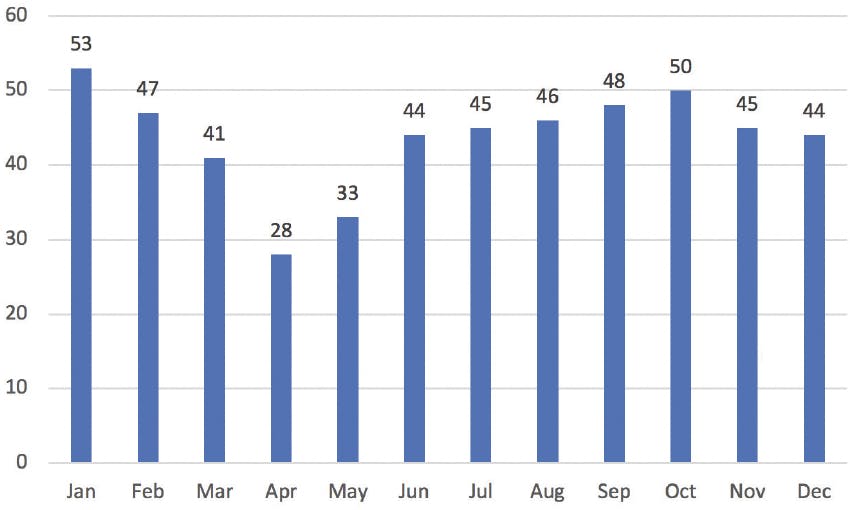
Figure 1. 2020 median total new patients per FTE cardiologist.
Then, as might be expected, this decrease in new patient volumes led to a decline nearly across the board in all other cardiovascular imaging and procedure volumes. Cardiac catheterization volumes decreased by more than half in April, before rebounding as 2020 progressed. However, like the number of new patients, when looking at 2020 in total, catheterization volumes never fully recovered, ending significantly lower from previous years (Figure 2). Percutaneous coronary interventions (PCIs) remained constant with prior years.
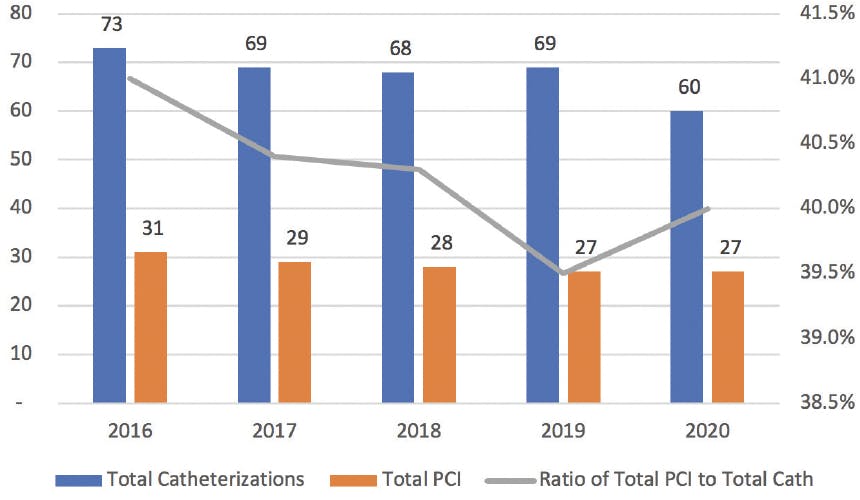
Figure 2. Median catheterization and PCI per 1,000 active patients.
PRODUCTION TRENDS FOR INTERVENTIONALISTS
A decrease in new patients and procedure volumes predictably leads to an overall decline in work relative value units (wRVUs), the gold standard currency for measuring physician production. Overall, cardiology wRVUs fell > 12% in 2020 compared to 2019 and were the lowest overall total published in more than 10 years. Interventional physicians also saw an approximate 10% reduction in wRVUs in 2020 compared to 2019, with the overall median (10,348 per full-time equivalent [FTE]) being the third-lowest total reported in the past 10 years.
Interventional physicians in private practices reported a 17% decrease in wRVUs year-over-year (11,531 wRVUs per FTE), while interventional physicians in integrated practices reported less than a 10% drop (9,907 wRVUs per FTE). As these data note, private interventional physicians, despite the larger drop in 2020 production, are still 16% more productive in terms of wRVUs than their integrated peers.
PRIVATE VERSUS INTEGRATED COMPARISONS
According to the 2020 MedAxiom survey data, > 80% of cardiologists in the United States are now integrated with a hospital or health system, either through employment or under a professional services agreement. The vast majority of these physicians are compensated on a model that heavily utilizes wRVU production as a basis. In private practices, physician owners are paid off the bottom line (revenue minus expenses) where revenue is largely driven by volume. Therefore, a decrease in volume and wRVU production would lead to a decrease in compensation for both ownership cohorts.
This did happen for integrated cardiologists in 2020, who experienced an overall decrease in compensation of 4.9% compared to a 9.3% reduction of wRVUs (Table 1). However, private cardiologists managed a 1.8% increase in total compensation despite a 17% decline in wRVU production. In both ownership cohorts, these data suggest that compensation was bolstered by other means, such as additional hospital/health system support in the case of the integrated physicians and federal stimulus monies for the private physicians. This hypothesis is supported by a separate MedAxiom survey in which > 70% of respondents reported that 2020 physician compensation was augmented by federal COVID relief payments and/or hospital support. Table 1 also shows that integrated interventional physicians reported a more significant drop in total compensation than their private peers, despite a lesser decline in wRVU production.
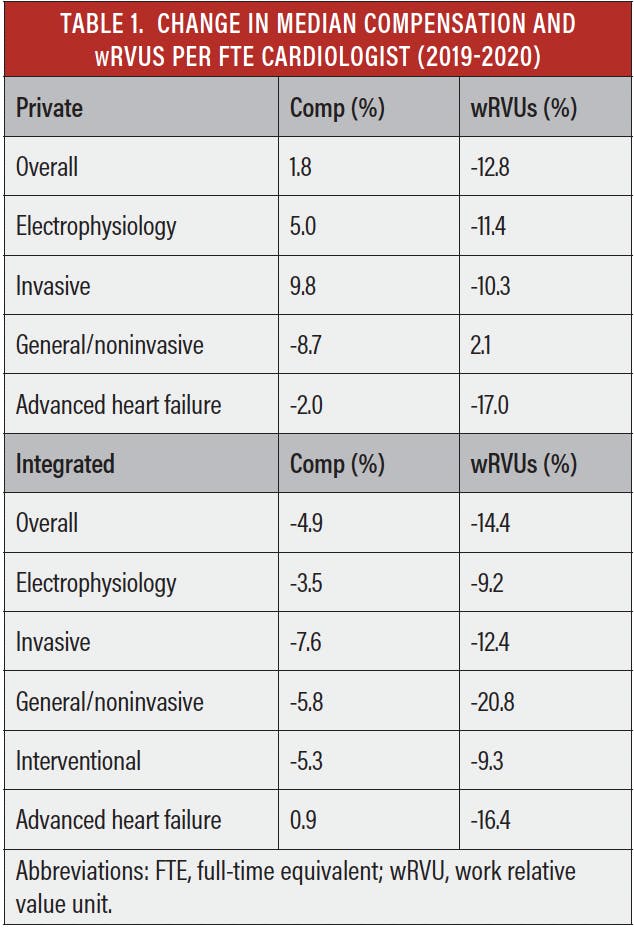
Overall, interventional physicians reported strong total earnings in 2020 relative to prior years, despite the pandemic and regardless of ownership model. At the median, private interventional cardiologists earned total compensation of $669,229 per FTE, while integrated interventional cardiologists came in slightly less at $653,360 per FTE. Of note, this is the first time that private interventional physicians outearned their integrated analogs when considering median total compensation. In private groups, interventional physicians were the top earners for cardiology, while in the integrated environment they fall behind electrophysiology who owns the top spot.
COMPENSATION PER wRVU FOR INTERVENTIONALISTS
An often-cited metric in physician compensation discussions and valuations is compensation per wRVU—total individual compensation from all sources divided by individual wRVU production. The compensation model and distribution methodology play significant roles in the resulting calculations. For instance, two hypothetical identical cardiology groups who have the same total compensation pool, where one group equally divides the monies and the other distributes entirely on wRVU production, will get very different “compensation per wRVU” results. MedAxiom’s survey aggregates these individual results and reports medians. These data should not be taken as a surrogate for contracted wRVU rates, but for what they actually are.
Keeping this in mind, when considering compensation per wRVU, integrated interventional cardiologists reported a median rate of $67.19 compared to $49.14 for their private peers. As noted earlier, private interventional physicians reported 16% more wRVU production per FTE at the median, while median compensation was just 2% higher. This is largely, and disproportionality, driving the differences in compensation per wRVU.
INVASIVE PROCEDURE TRENDS
As for key invasive volumes, 93% of the cardiovascular programs that submitted 2020 data offered diagnostic catheterization and 85% offered PCI services. Only 62% also had structural heart programs, as measured by transaortic valve replacement (TAVR) volumes.
Interventional cardiologists performed the vast majority of overall catheterizations in 2020, reporting median annual catheterization volumes of 213 per interventional FTE as compared to 68 per invasive FTE. Interestingly, the proportion of invasive/noninterventional physicians in cardiology programs has been declining over the past decade. In 2012, these physicians represented 20% of the cardiologists in the workforce, whereas in 2020 their representation had decreased to 13%. Over that same period, the interventional subspecialty cohort has remained relatively steady, fluctuating between 35% and 39% of the cardiology workforce.
The median number of PCIs performed per FTE interventional cardiologist in 2020 was 97. The top 10% of interventional cardiologists performed > 200 PCIs per annum (Table 2). As for structural heart, the median number of TAVRs performed per FTE cardiologist was 31 in 2020, with the top 10% approaching 100 per year. Just 23% of all interventional cardiologists in the 2021 survey reported performing TAVR procedures, while more than half (51%) reported performing a coronary total occlusion PCI.

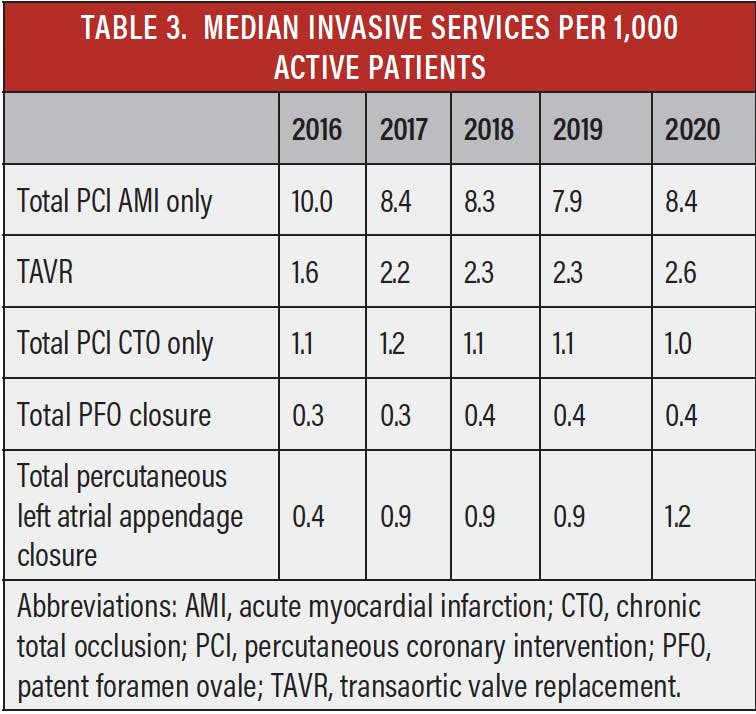
Table 3 shows the prevalence of certain interventional procedures per 1,000 active cardiology patients (defined as a unique face-to-face evaluation and management encounter during the prior 18-month period). The 2021 survey represents nearly 5 million active cardiology patients. Of note is the continued expansion of TAVR and left atrial appendage closure procedures in 2020, despite the pandemic.
CONCLUSION
The year 2020 was so profoundly impacted by the pandemic that it is still unknown how heavily organizations can rely on survey data to present the true picture of the industry. This is particularly true for valuation experts measuring “fair market value” for physicians. There is talk that 2021 could also end up simply representing the COVID reality and not be helpful for insights looking forward.
What we do know from the data is that despite significant reductions in overall productivity, cardiology compensation remained strong in 2020 compared to historical trends. This indicates that the hiring market remains tight and that cardiologists, particularly procedure-based subspecialties, remain highly valuable.
Download the full report at Medaxiom.com/compsurvey.
Advertisement
Advertisement