Advertisement
Advertisement
January/February 2021
Angiography- and Intravascular Imaging–Based FFR
Alternative methods for coronary physiologic assessments in the cardiac catheterization laboratory.
By Tatsunori Takahashi, MD; Azeem Latib, MD; and Yuhei Kobayashi, MD
Fractional flow reserve (FFR) has revolutionized interventional cardiology since the concept was first introduced more than 25 years ago.1 However, despite its critical role in the functional assessment of coronary lesions, the clinical adoption of coronary physiologic assessments is still limited by multiple barriers, including procedural cost, time, and the need for maximum hyperemia. Thus, there has been a growing interest in developing new physiologic indices that could streamline the workflow in the cardiac catheterization laboratory.
Over the last 5 years, computational modeling and fluid dynamics have been used to determine FFR based on invasive coronary imaging modalities. These emerging techniques have a distinct advantage in that neither a pressure wire nor hyperemia is required, facilitating physiology-guided coronary revascularization in routine clinical practice. This article summarizes current evidence and clinical implications of invasive coronary imaging-derived FFR, including coronary angiography–based FFR and intravascular imaging–based FFR.
ANGIOGRAPHY-BASED FFR
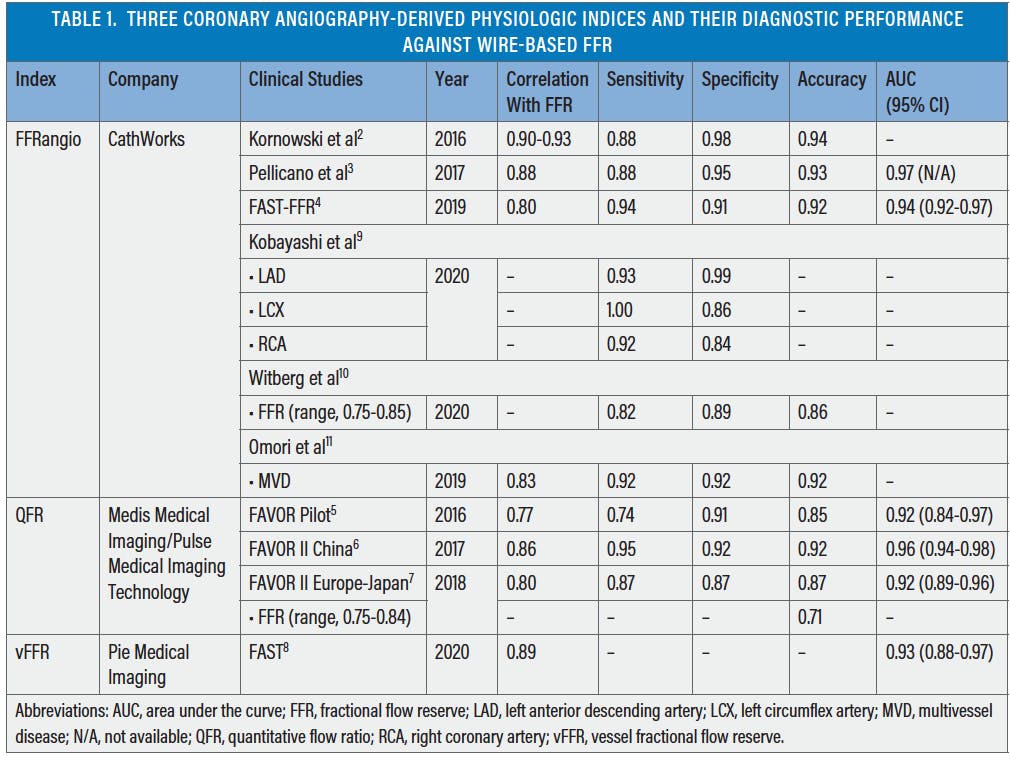
At present, three angiography-based FFR modalities are approved by the FDA and commercially available (Table 1):2-11 FFRangio (CathWorks), quantitative flow ratio (QFR; QFR systems by Medis Medical Imaging and Pulse Medical Imaging Technology), and vessel FFR (vFFR; Caas vFFR, Pie Medical Imaging).
FFRangio System
The FFRangio system, an artificial intelligence-based platform, builds a three-dimensional (3D) reconstruction of the coronary tree, including a target vessel and branches based on two or three angiographic projections. Using patient flow parameters and proven scientific principles, a rapid pressure-flow analysis calculates FFR values at every point in the coronary tree.
A validation study of FFRangio was first reported in 2016, when Kornowski et al analyzed a total of 101 lesions to measure FFRangio and found that the sensitivity, specificity, and diagnostic accuracy were 88%, 98%, and 94%, respectively, compared to invasive FFR (the gold standard).2 The next year, a multicenter study analyzing > 200 lesions demonstrated a high correlation between FFRangio and invasive FFR (Spearman ρ = .90; P < .001) with low interoperator variability.3 The FAST-FFR study is currently the largest trial supporting the use of FFRangio.4 A total of 319 vessels were analyzed in this prospective, multicenter, international study, showing sensitivity and specificity of FFRangio for predicting wire-derived FFR of 94% and 91%, respectively. Although FFRangio lacks multicenter data comparing the total procedural time between FFRangio and wire-derived FFR measurements, a single-center study has shown that FFRangio achieves a faster physiologic assessment than wire-based FFR (4.3 ± 3.4 min per lesion vs 6.9 ± 5.6 min per lesion),11 making its use more attractive in the cardiac catheterization laboratory (Figure 1).
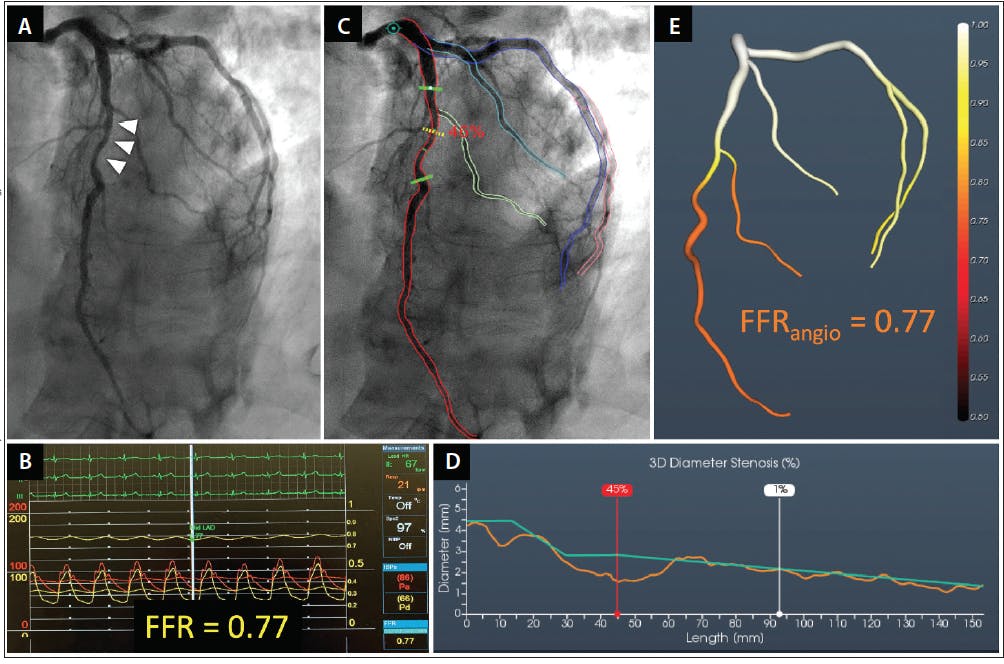
Figure 1. Pre-PCI angiography shows intermediate stenosis in the mid-left anterior descending artery (arrowheads; A). The stenosis is functionally significant with an invasive FFR value of 0.77 (B). Vessel contours and diameter stenosis are automatically overlaid on a fluoroscopy image (C). Three-dimensional diameter stenosis is 45% while FFRangio shows 0.77, the same result as wire-based FFR (D, E).
Case courtesy of Dr. Hana Vaknin-Assa, Head of Interventional Cardiology at Rabin Medical Center, Petah Tikva, Israel.
Quantitative Flow Ratio
The computation of QFR is based on a 3D reconstruction of only the target vessel, using two angiographic projections with a minimum separation of 25°, followed by frame count analysis for estimating contrast flow velocity.
The diagnostic performance of QFR has been validated in multiple studies. The FAVOR pilot study is the first prospective study that showed favorable accuracy of QFR in predicting wire-derived FFR.5 Later, two larger prospective studies (FAVOR II China and FAVOR II Europe-Japan) further reported the feasibility and diagnostic performance of QFR.6,7 Based on a recent meta-analysis that included four prospective studies with a total of 969 lesions, QFR demonstrated high sensitivity (84%), specificity (88%), positive predictive value (PPV; 80%), negative predictive value (NPV; 95%), and area under the receiver operating curve (0.92).12 Furthermore, the FAVOR II Europe-Japan study demonstrated a significantly shorter time of measuring QFR than invasively obtained FFR. The median time to measure QFR versus FFR was 5 and 7 minutes, respectively.7
Two ongoing randomized clinical trials are currently investigating the usefulness of QFR as a clinical decision-making tool. The FAVOR III Europe-Japan study (NCT03729739) will test the hypothesis that a QFR-guided strategy results in noninferior clinical outcomes compared with an FFR-based strategy in 2,000 patients with stable angina pectoris and intermediate coronary stenosis. In FAVOR III China (NCT03656848), clinical outcomes and costs will be compared between QFR- and angiography-guided strategies with a target recruitment of 3,860 patients.
Vessel FFR
vFFR is measured using the CAAS Workstation software, a well-validated platform allowing quantitative coronary angiography (QCA) and 3D reconstruction of coronary arteries.13 This software has recently integrated a technique to compute vFFR based on 3D QCA data. Currently, the FAST study is the only clinical study that assessed the diagnostic accuracy of vFFR compared to wire-based FFR, demonstrating a high correlation between vFFR and FFR (r = 0.89; P < .001) with low interoperator variability (r = 0.95; P < .001).8 The supporting evidence for vFFR is still limited; however, FAST II (NCT03791320), a prospective, observational, multicenter, international study, is in progress to assess the diagnostic performance of vFFR in > 330 participants.
Optimal Clinical Use of Angiography-Based FFR
Angiography-based FFR can potentially offer an easier and faster functional assessment of coronary lesions, with a good correlation to wire-based FFR. Thus, angiography-based FFR may become a robust tool facilitating physiology-guided coronary revascularization, although we are awaiting randomized controlled trial data such as FAVOR III Europe-Japan and FAVOR III China. To optimally use this technology in clinical practice, there are several technical aspects and limitations of measuring angiography-based FFR to understand. First, 3D reconstruction from angiographic projections is an integral part of angiography-based FFR, regardless of the software. Therefore, obtaining optimal angiographic images is of paramount importance to achieving accurate computation of FFR in the various modalities. Specifically, the coronary vessel should be imaged in an optimal field of view from multiple projections, without panning the table and avoiding overlap of side branches as much as possible. Although some degree of postprocessing correction is always required, optimal image acquisition helps minimize the overall measurement time. Second, angiography-based FFR has not been well investigated for the following lesions: severe diffuse disease, left main stenosis, ostial stenosis of the right coronary artery, tortuous vessel, and bifurcation. These lesions were excluded in previous studies and should be assessed with an alternative method. Finally, recent studies have suggested that the diagnostic performance of angiography-based FFR may vary depending on the interrogated vessel or lesions, with FFR values of 0.75 to 0.85 (Table 1).9,10 Angiography-based FFR still remains in an early phase of development and requires further investigation to determine its optimal use in the daily clinical setting.
INTRAVASCULAR IMAGING–BASED FFR
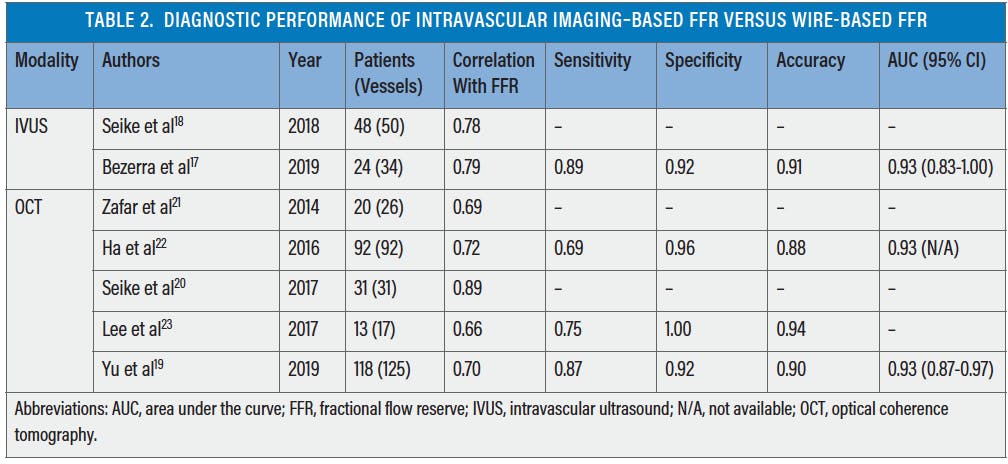
An effort has been made to correlate intravascular ultrasound (IVUS) or optical coherence tomography (OCT) data such as minimal lumen area (MLA) with FFR, but only a weak to moderate diagnostic accuracy was achieved in previous studies.14,15 Furthermore, these imaging-derived cutoff values for detecting positive FFR vary depending on territories interrogated.16 With computational approaches, both IVUS and OCT might become a “one-stop shop,” allowing physicians to assess anatomy and physiology with a greater degree of accuracy (Table 2).17-23
IVUS-Based FFR
Presently, evidence of IVUS-based FFR is supported only by small single-center studies. Bezerra et al applied computational fluid dynamics to 3D IVUS models generated from electrocardiography-gated IVUS images with luminal contour segmentation.17 In the study, IVUS-derived FFR significantly correlated with conventional FFR (r = 0.79; P < .001) and showed high sensitivity (89%), specificity (92%), PPV (80%), NPV (96%), and accuracy (91%) to detect FFR ≤ 0.80. The median simulation time with a supercomputer was 1.2 hours. Of note, image processing was the most time-consuming task, requiring 8 additional hours. In contrast, Blanco et al used one-dimensional (1D) IVUS models to calculate FFR and found that FFR values derived from 1D models highly correlated with those of 3D models.24 Although image processing for 1D models was still a challenging aspect of their methodology and the results should be validated against wire-based FFR, 1D simulations could be an alternative method that can shorten simulation time (the average simulation time of 1D and 3D models was 0.09 and 27.22 hours, respectively). On the other hand, Seike et al developed their original algorithm based on basic fluid dynamics that do not require 3D reconstruction of IVUS or high computational capacity to calculate FFR.18 With this method, IVUS-derived FFR demonstrated a higher correlation with wire-based FFR (r = 0.78; P < .001) than MLA (r = 0.43; P = .002).
OCT-Derived FFR
OCT provides high-resolution images with a great contrast between the lumen and intima, making the measurement of OCT-derived FFR easier and faster compared to IVUS-based FFR. Recently, in the largest study, a total of 125 lesions were analyzed to evaluate the diagnostic accuracy of OCT-based FFR against wire-based FFR.19 With this novel technique, not only the vessel lumen but also the side branches were automatically delineated, while accounting for lumen size changes at bifurcations. A virtual volumetric flow rate was then applied to 3D vessel models to compute OCT-based FFR. The overall diagnostic accuracy of OCT-based FFR to predict FFR ≤ 0.80 was 90%, with high sensitivity (87%) and specificity (92%). Notably, this approach achieved a rapid average analysis time of < 1 minute.
Seike et al investigated the correlation between OCT-derived FFR and pressure wire–based FFR with the same algorithm used to calculate IVUS-derived FFR.18,20 It was found that OCT-derived FFR correlated better with FFR (r = 0.89, P < .001) than MLA or percent area stenosis by QCA (Figure 2). With this method, he reported an analysis time of < 10 minutes.
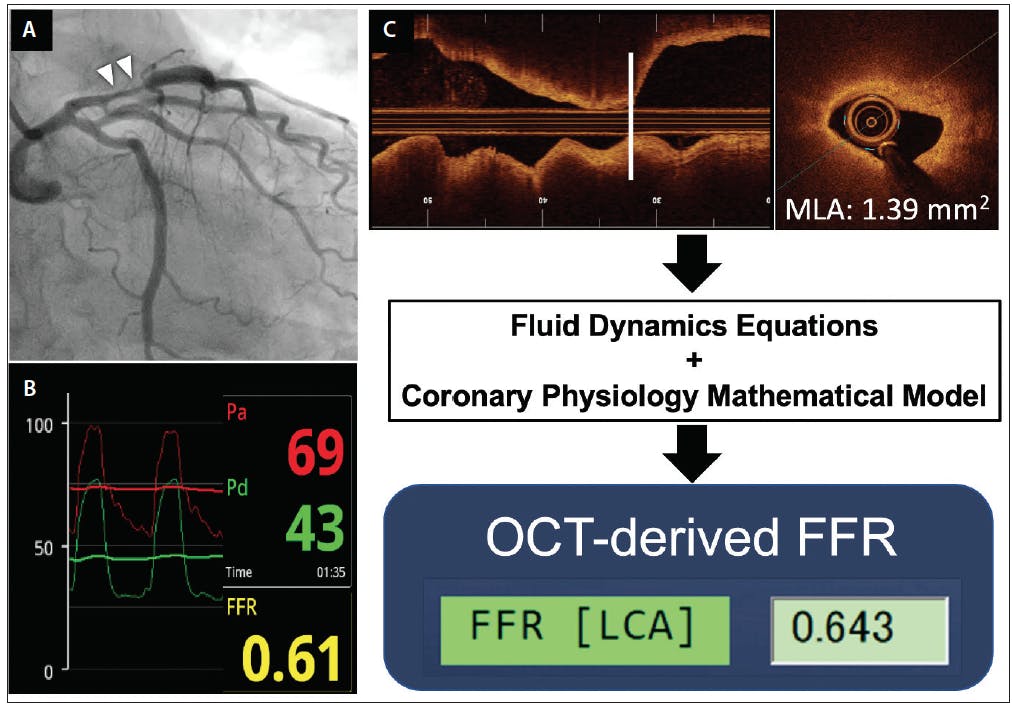
Figure 2. Coronary angiography revealed severe stenosis at the proximal portion of the left anterior descending artery (arrowheads; A). The wire-based FFR value was 0.61 (B). Longitudinal image of OCT and MLA (white line); OCT-derived FFR was calculated based on fluid dynamics equations and coronary physiology mathematical model, and the calculated value was 0.643 (C).
Case courtesy of Dr. Fumiyasu Seike, Cardiovascular Research Foundation, New York, United States.
All the previously mentioned studies assessing the feasibility of OCT-derived FFR are based on OCT images obtained using the OCT systems of Abbott. Abbott is currently sponsoring the FUSION study, the first prospective multicenter study validating an OCT-derived FFR called Virtual Flow Reserve (VFR) against FFR as the reference standard. The study will enroll > 200 patients, and VFR will be computed offline with the original algorithm.
Clinical Implications of Intravascular Imaging–Based FFR
The integration of intravascular imaging and physiology will provide a unique opportunity to interrogate the target vessel before percutaneous coronary intervention (PCI). By knowing the physiologically significant lesion within the target vessel and its lesion characteristics, we can determine the lesion responsible for ischemia and choose an appropriate device for treating the lesion. In addition to pre-PCI assessment, an integrated imaging/physiology assessment can provide additional insights for optimizing PCI results by quantifying residual ischemia. The DEFINE PCI study has shown that approximately 25% of patients have residual ischemia (defined as instantaneous wave-free ratio [iFR] < 0.90) after angiographically successful PCI; post-PCI iFR ≥ 0.95 is associated with better clinical outcomes.25,26 These results suggest the importance of physiologic assessments of the target vessel post-PCI to determine “successful PCI.”
DEFINE-GPS (NCT04451044), a large-scale randomized controlled trial, is currently ongoing to compare clinical outcomes of a functionally optimized strategy targeting post-PCI iFR ≥ 0.95 versus angiography-guided PCI. Theoretically, intravascular imaging–based FFR enables seamless anatomic and physiologic assessments without pressure wire instrumentation after PCI. Thus, intravascular imaging–based FFR could potentially become a suitable tool for post-PCI optimization.
CONCLUSION
Despite the robust evidence supporting the clinical benefits of FFR, its uptake in the cardiac catheterization laboratory has been slow. To address this issue, new physiologic indices based on image processing have emerged with their own unique characteristics. No need for vessel instrumentation is a huge advantage of coronary angiography-based FFR. We believe that if ongoing prospective studies prove its feasibility to guide clinical decision-making, angiography-based FFR will help with wider adoption of coronary functional assessment. Optimistically, angiography-based FFR could potentially replace visually assessed diameter stenoses and wire-based FFR depending on the location of lesions and vessel complexities. In contrast, intravascular imaging–based FFR may not become the first-line index to detect hemodynamically significant stenosis before PCI. Rather, once the technology has been validated, intravascular imaging–based FFR could turn into a valuable tool to simultaneously confirm successful PCI from both anatomic and physiologic standpoints.
1. Pijls NH, van Son JA, Kirkeeide RL, et al. Experimental basis of determining maximum coronary, myocardial, and collateral blood flow by pressure measurements for assessing functional stenosis severity before and after percutaneous transluminal coronary angioplasty. Circulation. 1993;87:1354-1367. doi: 10.1161/01.cir.87.4.1354
2. Kornowski R, Lavi I, Pellicano M, et al. Fractional flow reserve derived from routine coronary angiograms. J Am Coll Cardiol. 2016;68:2235-2237. doi: 10.1016/j.jacc.2016.08.051
3. Pellicano M, Lavi I, De Bruyne B, et al. Validation study of image-based fractional flow reserve during coronary angiography. Circ Cardiovasc Interv. 2017;10:e005259. doi: 10.1161/CIRCINTERVENTIONS.116.005259
4. Fearon WF, Achenbach S, Engstrom T, et al. Accuracy of fractional flow reserve derived from coronary angiography. Circulation. 2019;139:477-484. doi: 10.1161/CIRCULATIONAHA.118.037350
5. Tu S, Westra J, Yang J, et al. Diagnostic accuracy of fast computational approaches to derive fractional flow reserve from diagnostic coronary angiography: the international multicenter FAVOR pilot study. JACC Cardiovasc Interv. 2016;9:2024-2035. doi: 10.1016/j.jcin.2016.07.013
6. Xu B, Tu S, Qiao S, et al. Diagnostic accuracy of angiography-based quantitative flow ratio measurements for online assessment of coronary stenosis. J Am Coll Cardiol. 2017;70:3077-3087. doi: 10.1016/j.jacc.2017.10.035
7. Westra J, Andersen BK, Campo G, et al. Diagnostic performance of in-procedure angiography-derived quantitative flow reserve compared to pressure-derived fractional flow reserve: the FAVOR II Europe-Japan study. J Am Heart Assoc. 2018;7:e009603. doi: 10.1161/JAHA.118.009603
8. Masdjedi K, van Zandvoort LJC, Balbi MM, et al. Validation of a three-dimensional quantitative coronary angiography-based software to calculate fractional flow reserve: the FAST study. EuroIntervention. 2020;16:591-599. doi: 10.4244/EIJ-D-19-00466
9. Kobayashi Y, Collet C, Achenbach S, et al. Diagnostic performance of angiography-based fractional flow reserve in various subgroups: report from the FAST-FFR study. EuroIntervention. Published online May 4, 2020. doi: 10.4244/EIJ-D-19-00933
10. Witberg G, De Bruyne B, Fearon WF, et al. Diagnostic performance of angiogram-derived fractional flow reserve: a pooled analysis of 5 prospective cohort studies. JACC Cardiovasc Interv. 2020;13:488-497. doi: 10.1016/j.jcin.2019.10.045
11. Omori H, Witberg G, Kawase Y, et al. Angiogram based fractional flow reserve in patients with dual/triple vessel coronary artery disease. Int J Cardiol. 2019;283:17-22. doi: 10.1016/j.ijcard.2019.01.072
12. Westra J, Tu S, Campo G, et al. Diagnostic performance of quantitative flow ratio in prospectively enrolled patients: an individual patient-data meta-analysis. Catheter Cardiovasc Interv. 2019;94:693-701. doi: 10.1002/ccd.28283
13. Schuurbiers JC, Lopez NG, Ligthart J, et al. In vivo validation of CAAS QCA-3D coronary reconstruction using fusion of angiography and intravascular ultrasound (ANGUS). Catheter Cardiovasc Interv. 2009;73:620-626. doi: 10.1002/ccd.21872
14. Nascimento BR, de Sousa MR, Koo BK, et al. Diagnostic accuracy of intravascular ultrasound-derived minimal lumen area compared with fractional flow reserve--meta-analysis: pooled accuracy of IVUS luminal area versus FFR. Catheter Cardiovasc Interv. 2014;84:377-385. doi: 10.1002/ccd.25047
15. Ali ZA, Karimi Galougahi K, Maehara A, et al. Intracoronary optical coherence tomography 2018: current status and future directions. JACC Cardiovasc Interv. 2017;10:2473-2487. doi: 10.1016/j.jcin.2017.09.042
16. Kang SJ, Lee JY, Ahn JM, et al. Intravascular ultrasound-derived predictors for fractional flow reserve in intermediate left main disease. JACC Cardiovasc Interv. 2011;4:1168-1174. doi: 10.1016/j.jcin.2011.08.009
17. Bezerra CG, Hideo-Kajita A, Bulant CA, et al. Coronary fractional flow reserve derived from intravascular ultrasound imaging: validation of a new computational method of fusion between anatomy and physiology. Catheter Cardiovasc Interv. 2019;93:266-274. doi: 10.1002/ccd.27822
18. Seike F, Uetani T, Nishimura K, et al. Intravascular ultrasound-derived virtual fractional flow reserve for the assessment of myocardial ischemia. Circ J. 2018;82:815-823. doi: 10.1253/circj.CJ-17-1042
19. Yu W, Huang J, Jia D, et al. Diagnostic accuracy of intracoronary optical coherence tomography-derived fractional flow reserve for assessment of coronary stenosis severity. EuroIntervention. 2019;15:189-197. doi: 10.4244/EIJ-D-19-00182
20. Seike F, Uetani T, Nishimura K, et al. Intracoronary optical coherence tomography-derived virtual fractional flow reserve for the assessment of coronary artery disease. Am J Cardiol. 2017;120:1772-1779. doi: 10.1016/j.amjcard.2017.07.083
21. Zafar H, Sharif F, Leahy MJ. Feasibility of intracoronary frequency domain optical coherence tomography derived fractional flow reserve for the assessment of coronary artery stenosis. Int Heart J. 2014;55:307-311. doi: 10.1536/ihj.13-362
22. Ha J, Kim JS, Lim J, et al. Assessing computational fractional flow reserve from optical coherence tomography in patients with intermediate coronary stenosis in the left anterior descending artery. Circ Cardiovasc Interv. 2016;9:e003613. doi: 10.1161/CIRCINTERVENTIONS.116.003613
23. Lee KE, Lee SH, Shin ES, Shim EB. A vessel length-based method to compute coronary fractional flow reserve from optical coherence tomography images. Biomed Eng Online. 2017;16:83. doi: 10.1186/s12938-017-0365-4
24. Blanco PJ, Bulant CA, Müller LO, et al. Comparison of 1D and 3D models for the estimation of fractional flow reserve. Sci Rep. 2018;8:17275. doi: 10.1038/s41598-018-35344-0
25. Jeremias A, Davies JE, Maehara A, et al. Blinded physiological assessment of residual ischemia after successful angiographic percutaneous coronary intervention: the DEFINE PCI study. JACC Cardiovasc Interv. 2019;12:1991-2001. doi: 10.1016/j.jcin.2019.05.054
26. Cardiac Interventions Today. 1-Year DEFINE PCI data presented for Philips’ iFR-guided interventions. Accessed January 8, 2021. https://citoday.com/news/1-year-define-pci-data-presented-for-philips-ifr-guided-interventions
Advertisement
Advertisement