Advertisement
Advertisement
January/February 2021 Supplement
Funding for this supplement provided by Medtronic
Procedural Optimization to Minimize Interaction With the Left Ventricular Conduction System During Self-Expanding TAVR
The inception of the cusp overlap technique: rationale and development.
Transcatheter aortic valve replacement (TAVR) with the self-expanding, supra-annular CoreValve and Evolut R bioprostheses (Medtronic) has been associated with the need for permanent pacemaker implantation (PPI) in 15.7% to 28.6% of patients within 30 days after the procedure.1-9 The frequent requirement for PPI has been one of the main challenges influencing an operator’s willingness to perform TAVR with this bioprosthesis. We present a novel method that describes a series of procedural steps designed to provide a controlled implantation depth and minimize the interaction of the bioprosthesis with the atrioventricular (AV) conduction system, potentially reducing the subsequent clinical sequelae of conduction disturbances. Traditional deployment of the CoreValve and subsequently Evolut bioprosthesis had relied upon obtaining a three-cusp coplanar view and then adjusting the gantry angle, generally caudal, to eliminate parallax from the capsule marker band. Subsequently, Piazza and colleagues demonstrated that the three-cusp technique with marker adjustment distorted the native anatomy on fluoroscopy.10 Using the three-cusp technique, the operator often deployed the valve without a clear representation of the location of the native annulus relative to the conduction system. The location of the conduction system was obscured by the radiographic foreshortening of the left ventricular outflow tract in noncusp overlap views.
To develop a strategy that minimizes the risk of interaction of the conduction system with the bioprosthesis, a better understanding of the location of the conduction system relative to the aortic annulus basal plane was needed. The noncoronary cusp (NCC), the most inferiorly oriented cusp in the left ventricular outflow tract (LVOT), is isolated from the left coronary cusp (LCC) and the right coronary cusp (RCC) using the cusp overlap technique. Below the non-right commissure, the membranous septum houses the conduction system. More ventricular to the membranous septum, which may be of variable length, these conduction fibers become more superficial in the muscular septum. If the transcatheter heart valve (THV) is deployed below the membranous septum, there is a greater chance of interaction with the conduction system. Jilaihawi et al described the variation in PPI rates depending on the length of the membranous septum and the depth of the THV. Their series suggested that when a THV is deployed below the membranous septum, the risk of PPI was increased.4
CUSP OVERLAP METHOD
Our method demonstrates that by isolating the NCC and overlapping the NCC/RCC commissure along the basal annular plane, the implantation view can be optimized during THV deployment. This view can be easily identified during computed tomography (CT) reconstruction (3Mensio, Pie Medical Imaging) and contribute to preprocedural case planning (Figure 1). The cusp overlap view unforeshortens and elongates the LVOT and accentuates the NCC/RCC commissure in the center of the fluoroscopic view, creating an implant that references the conduction system and separates it from the annular plane. Given the unforeshortening of the LVOT, there is also a greater distance between the NCC insertion and the compact AV node (Figure 2). This fluoroscopic view may lead to a more precise 3-mm implantation depth, thereby minimizing the risk of interaction with the conduction system.
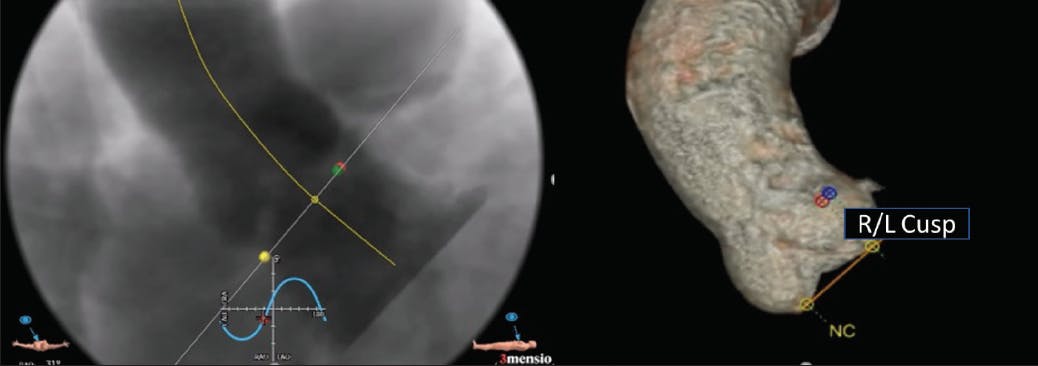
Figure 1. Cusp overlap view. The left panel illustrates the cusp overlap position with the NCC (yellow), RCC (green), and left coronary sinus (red). The right panel shows the volume rendering of the cusp overlap view showing the commissure of the non- and right coronary sinus (courtesy James Harvey, MD).
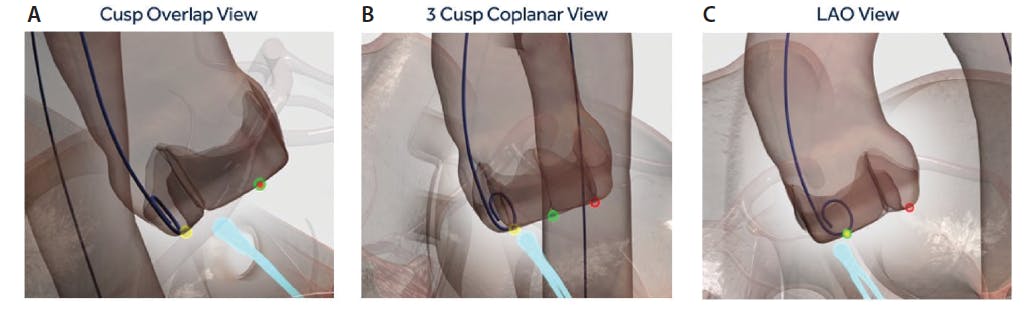
Figure 2. Location of the AV node and basal annular plane. The blue AV node is shown best in the cusp overlap view (A) with an increased distance from the AV node to the basal annular plane. The three-cusp coplanar view generally requires caudal angulation to remove the parallax from the marker band and the AV does appear closer to the basal annular plane due to foreshortening of the LVOT (B). The LAO view shows the AV node with overlaps the RCC and NCC and isolates the LCC (C). The LVOT is also foreshortened in this view.
In addition to the cusp overlap view, several procedural steps have been embedded in this technique to further reduce interaction with the conduction system during TAVR deployment. We now focus on more of a “top-down” deployment of the THV, starting with the catheter marker band positioned at the midportion of the pigtail in the NCC (Figure 3). With retraction of the nitinol capsule, the inflow of the prosthesis advances across the annulus and is positioned at 3 mm below the annulus. This maneuver avoids traumatic advancement of the bioprosthesis into the ventricle with inflow flaring deeper within the left ventricle, resulting in subsequent maneuvers to move it more aortic and interacting with the muscular septum and conduction system. We also use a stiffer, double-curved, Lunderquist wire (Cook Medical) in most cases to maintain a wire position in the non-right commissure and begin the prosthesis deployment along the posterior aspect of the annular plane. The stiffer wire may result in more symmetrical deployment and is especially valuable when deploying larger-sized THVs. Using the cusp overlap view to maintain a reference to the native annular plane, the marker band on the THV delivery catheter does tend to lose parallax when approaching the valve plane. The loss of parallax of the marker band is the result of the delivery catheter following the stiff left ventricular wire that is generally positioned in the NCC/RCC commissure. This approach may lead to more confidence in the initial positioning of the THV in relation to the insertion of the NCC and a better assessment at the point of no-recapture. We also favor sufficient pacing during the deployment to minimize cardiac output and the occurrence of premature ventricular contraction burden, allowing for a stable bioprosthesis deployment. Finally, once we are at 80% deployment, we rotate the gantry to an LAO projection to visualize the LCC and ensure that the inflow is not supra-annular. We aim for an implantation depth of 3 mm, and no deeper than 5 mm, below the NCC to reduce our risk of conduction disturbance. We occasionally aim for shallower deployment in patients at high risk for conduction system abnormality but recommend recapture for bioprosthesis positions < 1 or > 5 mm within the ventricle. Once final positioning is confirmed, we retract the left ventricular wire, centralize the nose cone, and slowly release the delivery catheter from the bioprosthesis by the release of the frame paddles. We are cautious to avoid interaction of the delivery catheter and the bioprosthesis as the delivery catheter is retracted into the aorta.
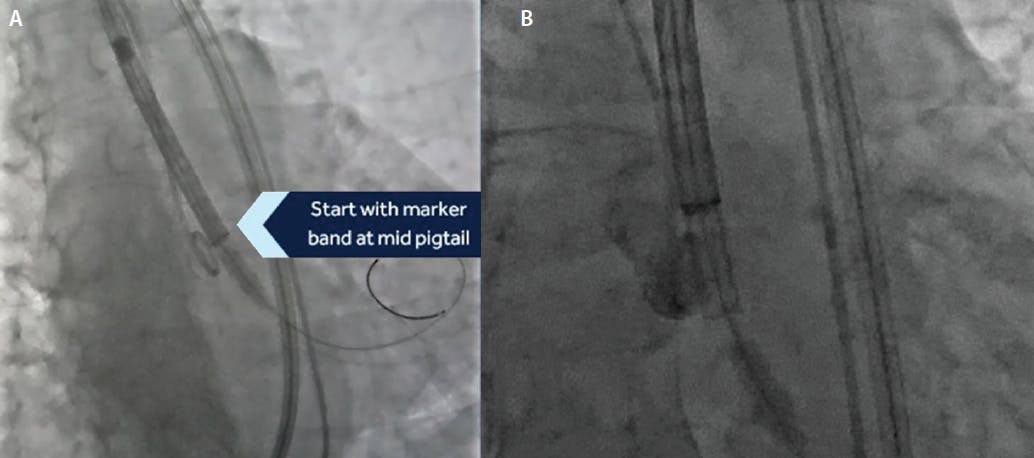
Figure 3. Location of the marker band at initial deployment. The marker band is placed at the mid position of the pigtail catheter that is positioned at the lowest portion of the noncoronary sinus (A). With retraction of the nitinol capsule, the inflow of the Evolut bioprosthesis advances to a 3-mm position below the annulus (B).
THE UPMC PINNACLE EXPERIENCE WITH CUSP OVERLAP
After starting with routine use of the cusp overlap technique in October 2015, we have observed a significant decline in the post-TAVR PPI rates at our institution, especially with the Medtronic CoreValve and Evolut platforms. In the Medtronic Low Risk trial, the rate of PPI 30-days post-TAVR was 17.4%,2 with wide site-specific variability (Figure 4). Our single-center experience utilizing cusp overlap found that only one (1.5%) in 65 patients required permanent pacing. As the highest enrolling center in the Evolut low-risk trial, we attribute this difference to the comprehensive use of the cusp overlap technique at our institution.
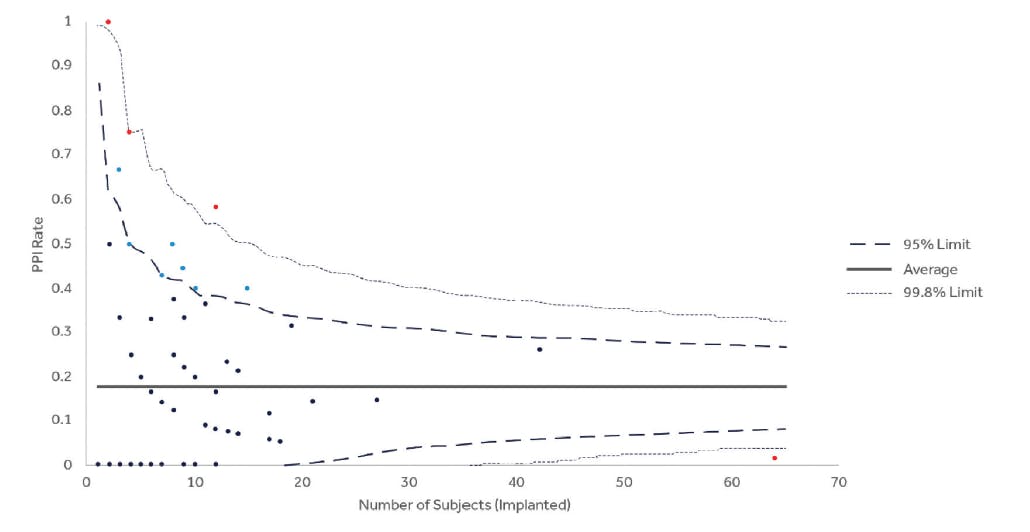
Figure 4. Funnel plot of site-level variability of 30-day post-TAVR PPI rate in the Medtronic Low Risk trial. Each dot represents an enrolling center and UPMC Pinnacle had the highest enrollment with a PPI rate lower than 2 confidence intervals, using the cusp overlap technique for all TAVR deployments.
We have also analyzed our experience in 134 patients without antecedent PPI who underwent placement of the 34-mm Evolut R THV, which has been shown to be a predictor of PPI,11 independent of membranous septum length.4 After preprocedural computed tomography (CT) planning to determine the optimal cusp overlap projection angle, we were able to achieve the projected cusp overlap gantry view on CT reconstruction in 88% of patients, and a near cusp overlap projection in the remaining patients. In this series, we obtained an effective 30-day PPI rate of 5.2%.11 In addition, the new-onset left bundle branch block rate was 10.9%, below contemporary rates previously published.2 When compared to previous studies (Figure 5),4-9 we believe that the cusp overlap view contributed to the lower rate of PPI rates in our series. The Optimize PRO study (NCT04091048) will provide additional insights into the safety and efficacy of this method in a broader array of patients at multiple centers.
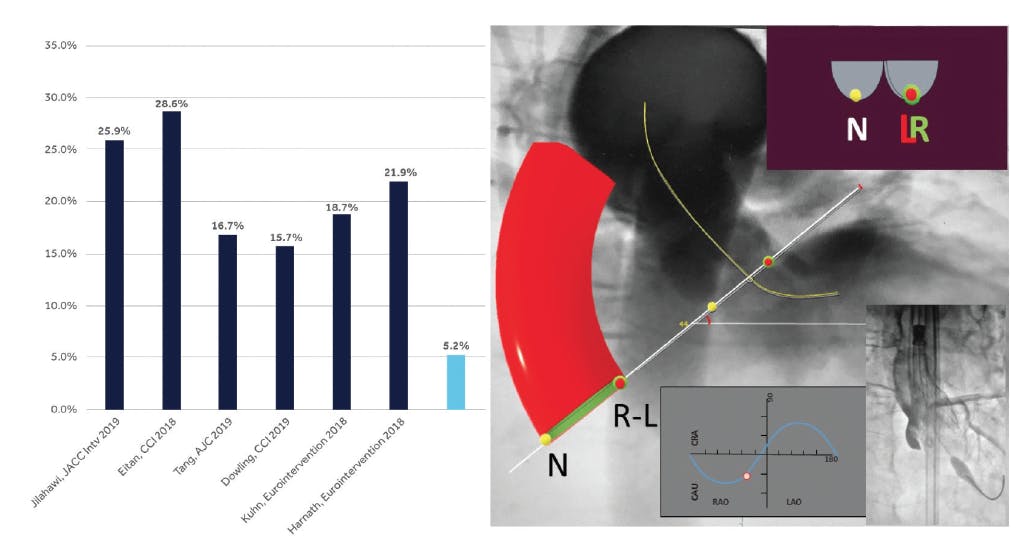
Figure 5. Rate of PPI in the UPMC Pinnacle 34-mm Evolut R series. Using the cusp overlap technique, the lowest reported rate of 30-day PPI with the 34-mm Evolut R was achieved.4-9
PROCTORING EXPERIENCE IN ADOPTION OF CUSP OVERLAP
Prior to the adoption of the cusp overlap technique as the standard for Medtronic self-expanding THV deployment, we were able to teach the cusp overlap technique successfully to several international centers, including those in the United States. A focused didactic experience involving several Latin American centers was initiated in July 2018.12 There were eight formal encounters with Latin American physicians, involving didactics through programmatic lecture, proctored and presented cases, as well as case observation at our institution. We analyzed the results of these experiences extending to October 2019.12 Fourteen implanting physicians from seven countries performed consecutive procedures on 114 patients. Each physician implanted only 22.6 ± 10.9 THVs the previous year, with a lifetime experience of 129 ± 110 THVs. Of the 114 patients, 105 (92%) did not have a prior PPI. In this series, the in-hospital rate of new PPI post-THV was 5.7%. During the 30-day follow-up that included 85 patients, no additional patients required a new permanent pacemaker. These results suggest that the use of the cusp overlap in lower volume operators resulted in reduced rates of PPI and may be useful to potentially shorten the learning curve for this self-expanding bioprosthesis.
OPTIMIZING POSTPROCEDURAL MANAGEMENT
Our institution has focused on optimizing postprocedural management over the past several years, which has included an effort to reduce resource utilization during the hospitalization period. Our institution experienced a reduction in the 2019 TAVR mean length of stay (LOS) to 1.23 days after 386 TAVR procedures, at least partially due to a reduction in the need for new PPI implantation. More specifically, an analysis of 567 TAVR cases performed at our institution between July 2015 and June 2018 included 34 patients who required PPI during their hospital stay. The average cost of PPI was $4,415, but the patients who went on to receive PPI had a significantly longer LOS than those who did not (4.49 vs 1.75 days), resulting in a modified contribution margin differential of $12,654 per case. Although the reasons for this reduction in LOS differential were multifactorial, a primary reason was related to the reduced postprocedural conduction disturbances and the need for a temporary or permanent pacemaker. For example, patients who developed temporary conduction disturbances requiring temporary pacing were not placed on the “fast track” protocol and early ambulation. In those patients who required permanent pacing, usually on postprocedural day 1, an additional 24-hour period of bed rest was needed, leading to slower periprocedural recovery and increased resource utilization to facilitate suitable disposition.
LIMITATIONS AND MITIGATIONS
There are three potential limitations for the cusp overlap method that will be informed by additional single and multicenter studies, including the Optimize PRO study. One concern relates to higher implantation of the self-expanding bioprosthesis with its 13- to 14-mm skirt height that raises concerns for coronary access. Preprocedural CT planning can mitigate this risk by assessing the heights of the coronary arteries and placing the bioprosthesis at a position to allow coronary access after TAVR.
Another potential limitation of the cusp overlap technique is the operator’s anxiety that a shallow TAVR implantation may lead to a higher rate of valve embolism (“pop-outs”), potentially resulting in increased procedural complexity and patient morbidity. In our experience, we have not found this to be the case, and required the use of a second THV in only one (0.5%) of approximately 200 cases. In fact, the cusp overlap technique may facilitate a better understanding of the true THV depth relative to the NCC, and importantly, the target 3-mm implantation depth in relation to the NCC is standard for use for all THV platforms. Because the LVOT is elongated in this particular view, our assessment of the depth assessment is likely more accurate. In a non-cusp overlap view, the LVOT is foreshortened, leading to the false perception that THV is positioned shallower relative to the NCC insertion. Another reason to position the THV at a 3-mm implantation depth is that if postdilation is indicated, there is a buffer for the potential shortening of the THV during postdilatation.
A third limitation is the use of a stiff Lunderquist wire. Our technique supports the use of the double-curved Lunderquist wire in most ventricular anatomies. We believe that the stiffer wire provides several advantages, including biasing the valve toward the posterior aspect of the annular plane, eliminating parallax in the marker band, increasing efficiency, and providing a more predictable deployment. Like all ventricular wires, the possibility of ventricular perforation is always a consideration. We deploy the Lunderquist through a pigtail catheter established toward the apex of the left ventricle. After unsheathing the wire, there is no forward manipulation, thereby reducing the possibility of trauma.
INNOVATION AND IMPACT WITHOUT DEVICE ITERATIONS
Our description of the novel cusp overlap technique includes both optimization of the CT image reconstruction to define an ideal implant angle, and simplification of the procedure to minimize the interaction of the transcatheter bioprosthesis and the conduction system. The simplified cusp overlap technique has the potential to enhance clinical outcomes by focusing on procedural modifications rather than to rely on new technology or expanded infrastructure for clinical improvements. In our institution, the cusp overlap technique has been associated with reproducibly low PPI rates and improved clinical outcomes through what we believe is a rational, evidence-based, and intuitive approach that is supported by sound principles in anatomy and pathophysiology.
1. Reardon MJ, Van Mieghem NM, Popma JJ, et al. Surgical or transcatheter aortic-valve replacement in intermediate-risk patients. N Engl J Med. 2017;376:1321-1331. doi: 10.1056/NEJMoa1700456
2. Popma JJ, Deeb GM, Yakubov SJ, et al. Transcatheter aortic-valve replacement with a self-expanding valve in low-risk patients. N Engl J Med. 2019;380:1706-1715. doi: 10.1056/NEJMoa1816885
3. Adams DH, Popma JJ, Reardon MJ, et al. Transcatheter aortic-valve replacement with a self-expanding prosthesis. N Engl J Med. 2014;370:1790-1798. doi: 10.1056/NEJMoa1400590
4. Jilaihawi H, Zhao Z, Du R, et al. Minimizing permanent pacemaker following repositionable self-expanding transcatheter aortic valve replacement. JACC Cardiovasc Interv. 2019;12:1796-1807. doi: 10.1016/j.jcin.2019.05.056
5. Eitan A, Witt J, Stripling J, et al. Performance of the Evolut-R 34 mm versus Sapien-3 29 mm in transcatheter aortic valve replacement patients with larger annuli: early outcome results of Evolut-R 34 mm as compared with Sapien-3 29 mm in patients with annuli >/=26 mm. Catheter Cardiovasc Interv. 2018;92:1374-1379. doi: 10.1002/ccd.27588
6. Tang GHL, Reardon MJ, Kodali SK, et al. Comparison of clinical and echocardiographic outcomes after transcatheter aortic valve implantation with 31-mm CoreValve versus 34-mm Evolut R bioprostheses from the STS/ACC TVT Registry. Am J Cardiol. 2019;124:1091-1098. doi: 10.1016/j.amjcard.2019.07.010
7. Dowling C, Firoozi S, Doyle N, et al. Initial experience of a large, self-expanding, and fully recapturable transcatheter aortic valve: the UK & Ireland Implanters’ registry. Catheter Cardiovasc Interv. 2019;93:751-757. doi: 10.1002/ccd.27934
8. Kuhn C, Frerker C, Meyer AK, et al. Transcatheter aortic valve implantation with the 34 mm self-expanding CoreValve Evolut R: initial experience in 101 patients from a multicentre registry. EuroIntervention. 2018;14:e301-e305. doi: 10.4244/EIJ-D-17-01153
9. Harnath A, Gomes B, Herwig V, et al. First experience with the 34 mm self-expanding Evolut R in a multicentre registry. EuroIntervention. 2018;14:e298-e300. doi: 10.4244/EIJ-D-18-00137
10. Piazza N, Mylotte D, Theriault Lauzier P. Fluoroscopic “heart chamber” anatomy - the case for imaging modality-independent terminology. EuroIntervention. 2016;12:Y9-Y15. doi: 10.4244/EIJV12SYA3
11. Gada H, Vora A, Siddique S, et al. TCT CONNECT-473 Reduction of rates of permanent pacemaker implantation with 34-mm Evolut R using cusp overlap technique. J Am Coll Cardiol. 2020;76 (17 suppl S):B196.
12. Gada H, Vora A, Millan-Iturbe O, et al. TCT CONNECT-473 Reproducibility of cusp overlap technique to reduce permanent pacemaker implantation with Evolut: the Latin American experience. J Am Coll Cardiol. 2020;76:B202.
Advertisement
Advertisement