Advertisement
Advertisement
January/February 2021 Supplement
Funding for this supplement provided by Medtronic
Evolut Commissural Alignment and the Cusp Overlap Technique
Facilitating post-TAVR coronary reaccess while minimizing the risk of interaction with the conduction system.
By Sophia L. Alexis, MD; Syed Zaid, MD; Sahil Khera, MD; Parasuram Melarcode Krishnamoorthy, MD; George D. Dangas, MD, PhD; Samin K. Sharma, MD; Annapoorna Kini, MD; Aditya Sengupta, MD; and Gilbert H. L. Tang, MD, MSc, MBA
As transcatheter aortic valve replacement (TAVR) is now approved in lower-risk, younger patients, lifetime management of this population is becoming more important.1-5 In surgical aortic valve replacement (SAVR), after excision of the native valve leaflets, commissural alignment of the new prosthesis is guaranteed. This has been demonstrated by Fuchs et al who studied SAVR implantation and found that all commissures were within 30° of native commissures.6 Cardiac surgeons never intentionally rotate the valve off its native axis nor do they compromise the depth of annular sutures.
Because the prevalence of significant coronary artery disease is 40% to 75% in patients with severe aortic stenosis undergoing TAVR, one must consider the need for coronary reaccess when placing a TAVR valve.7,8 In one study of 779 patients undergoing TAVR, 4.7% had acute coronary syndrome within 1 year after TAVR and 10% did during a median follow-up of 25 months. These patients were on average younger than the total population.9,10 Our group has studied optimal commissural alignment with the cusp overlap technique using self-expanding Evolut valves (Medtronic) to decrease likelihood of future coronary access challenges.
COMMISSURAL ALIGNMENT FOR CORONARY REACCESS
Barriers to coronary reaccess after TAVR include the native aortic valve leaflets, the stent frame (whose distal end extends above the sinotubular junction), and the commissures if not properly aligned.11 The likelihood of the frame interfering with coronary reaccess is highest when there is a small angle to the commissure and short inflow to ostium distance.10
Ochiai et al studied coronary positioning with computed tomography (CT) after implantation of 66 Evolut R/Evolut PRO valves from December 2015 to November 2017. Coronary reaccess was considered unfavorable if the ostium ended up below the 13/14-mm skirt (depending on valve size implanted) or if the transcatheter heart valve (THV) commissure landed near the ostium. Results showed that the skirt eclipsed the left coronary artery (LCA) in 12.8% of cases and the right coronary artery (RCA) in 3% of cases. The reason for no immediate hemodynamic collapse was that there was, on average, 4.2 to 4.8 mm of horizontal distance between the coronary ostia and the skirt blocking them. Coronary access was also obscured when the commissural triangle (up to 26 mm at the posts) blocked the LCA in 22.7% of cases and the RCA in 21.2%.8 This led to the inability to selectively engage the coronaries during coronary angiography or percutaneous coronary intervention after TAVR.
Similarly, Abdelghani et al looked at 101 patients from October 2015 to June 2019 who had Evolut R/PRO implantation with pre- and post-TAVR CTs. They found that in 10.8% of cases, a commissure was facing the LCA and in 9.7% of cases it was facing the RCA.10
In our ALIGN-TAVR study, we looked at 245 patients between March 2016 and September 2019 at five centers that had Evolut placement. We used the coregistration technique between fluoroscopy and the coplanar angle on pre-TAVR CT using 3mensio software (Pie Medical Imaging).12 Commissural overlap was considered severe if it was within 20° of the coronary ostium. Evolut orientation at initial deployment was categorized by the position of the radiopaque “Hat” marker on the delivery device; it was either on the outer curve (OC), center front (CF), inner curve (IC), or center back (CB) of the aorta (Figure 1). The same four designations were used for the final C-tab position of the valve. As the study progressed, less commissural overlap with the coronaries was found when the “Hat” marker was placed on the OC of the descending aorta/annulus.12 This orientation was more common when the flush port of the delivery catheter was placed at the 3 o’clock position during insertion (versus the 12 o’clock position), so a change was made at our institution in March 2019 to implant the next 107 valves this way (Figure 2). In the overall cohort, having the “Hat” marker at the OC/CF position conferred significantly less (P < .001) commissural overlap than the IC/CB positions: 15.7% versus 66% for the LCA, 7.1% versus 51.1% for the RCA, 2.5% versus 40.4% for both coronaries, and 20.2% versus 76.6% for one or both coronaries (Figure 3).12
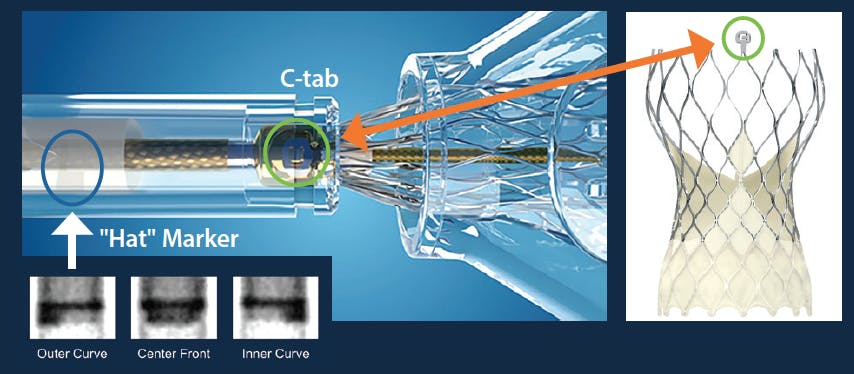
Figure 1. C-tab loaded 90° clockwise from the “Hat” marker in the Evolut TAVR system.
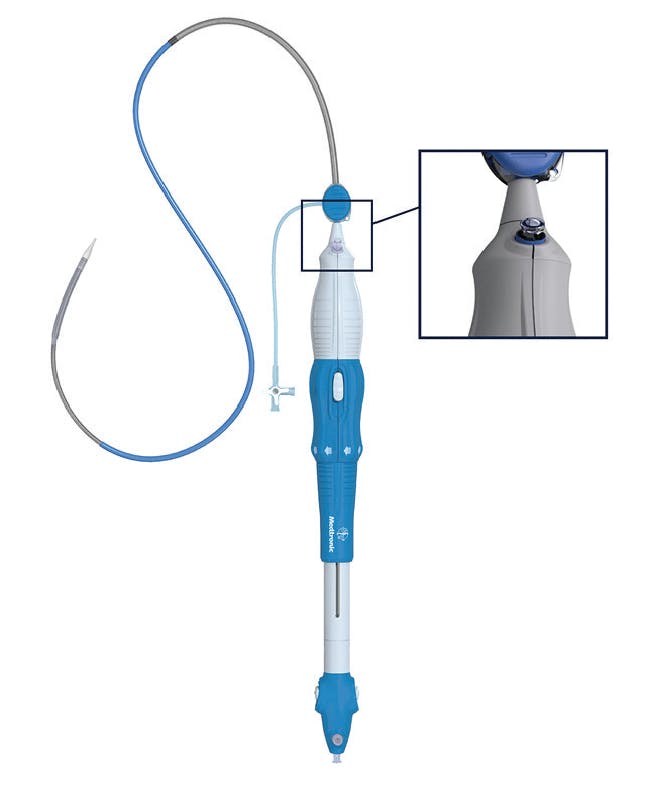
Figure 2. Flush port orientation on the Evolut delivery catheter should be pointed away from the operator (in the 3 o’clock position) on insertion to improve commissural alignment. Reprinted from JACC: Cardiovascular Interventions, Vol. 13/Issue 9, Tang GHL, Zaid S, Fuchs A, et al. Alignment of Transcatheter Aortic-Valve Neo-Commissures (ALIGN TAVR) Impact on Final Valve Orientation and Coronary Artery Overlap, Pages 1030-1042, 2020, with permission from Elsevier.
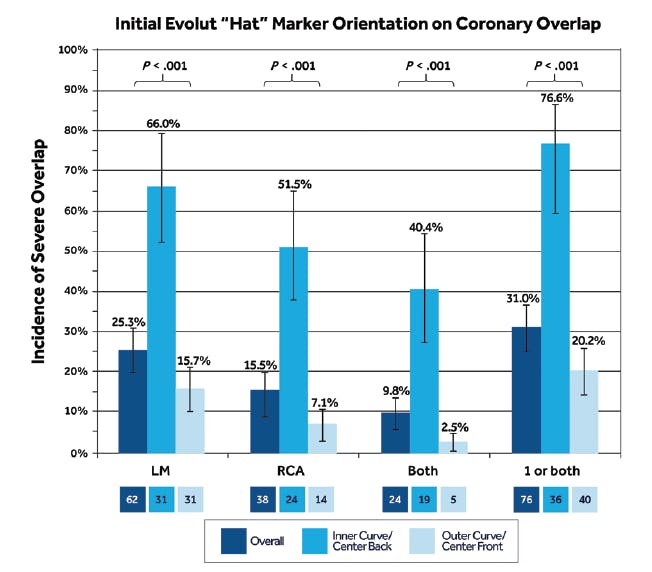
Figure 3. Results of Evolut “Hat” marker orientation on coronary overlap after TAVR. Reprinted from JACC: Cardiovascular Interventions, Vol. 13/Issue 9, Tang GHL, Zaid S, Fuchs A, et al. Alignment of Transcatheter Aortic-Valve Neo-Commissures (ALIGN TAVR) Impact on Final Valve Orientation and Coronary Artery Overlap, Pages 1030-1042, 2020, with permission from Elsevier.
CUSP OVERLAP IMPLANT VIEW TO MINIMIZE THE RISK OF INTERACTION WITH THE CONDUCTION SYSTEM
To increase the accuracy of implantation depth with Evolut valves, at our institution we obtain a cusp overlap view in addition to the three-cusp coplanar view. To do this, we obtained a more right anterior oblique (RAO) caudal view to overlap the left and right coronary cusps and position the “Hat” marker of the Evolut delivery catheter toward the CF during initial deployment.13 The valve is then deployed with contact from the non-coronary cusp to the overlapped left and right cusps, which enables higher implantation relative to the non-coronary cusp without valve “pop-out.”13 The approach in our facility is to optimize overlap without needing another arterial puncture, one pigtail can be placed in the right coronary cusp and another pigtail, a 0.035-inch J wire or an 0.018-inch nitinol wire in the left coronary cusp, which is then removed once the cusp overlap view is confirmed.13
With improved visualization of the nadir of the non-coronary cusp using the cusp overlap technique, permanent pacemaker implantation (PPI) can be reduced.
CLINICAL EXAMPLES
Case 1
A 72-year-old man presented with severe aortic stenosis. He was deemed a low surgical risk and appropriate for a 29-mm Evolut valve as part of the Evolut low-risk randomized trial. The delivery catheter was inserted with the flush port at the 3 o’clock position and the “Hat” marker was OC as seen in the left anterior oblique (LAO) 14°/caudal (CAU) 22° image (Figure 4A). The valve was implanted in the three-cusp view. Commissural alignment was confirmed on post-TAVR CT (Figure 4B). One week later, the patient returned with anginal symptoms. Secondary to commissural alignment, coronary access was straightforward and no coronary obstruction was identified in this case (Figure 4C).
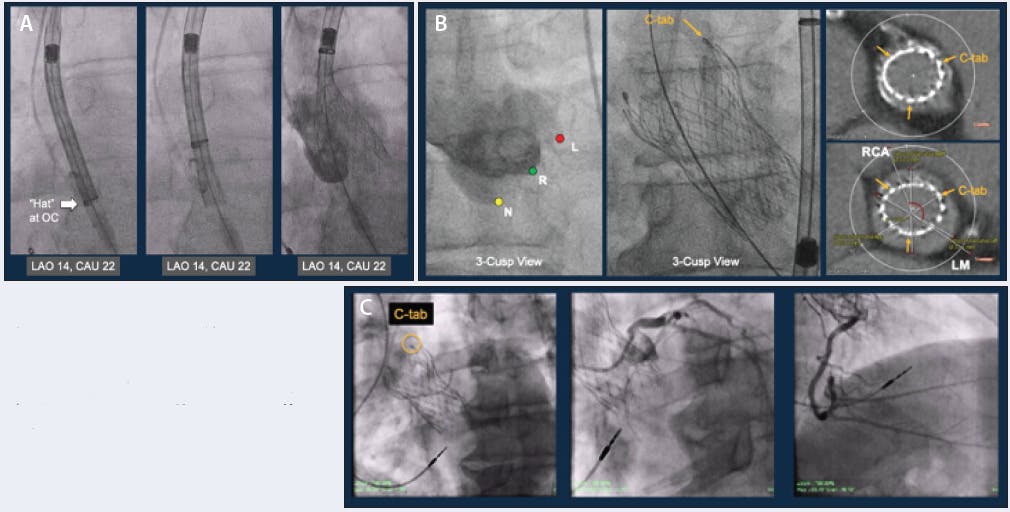
Figure 4. “Hat” marker in the OC position (A). Commissural alignment confirmed on post-TAVR CT (B). Straightforward coronary access with commissural alignment (C).
Case 2
An 81-year-old woman who presented with symptomatic severe aortic stenosis (AS) had favorable anatomy for implantation of a 23-mm Evolut Pro. Fluoroscopic images were obtained in both the three-cusp view (LAO 0°/CAU 9°) and the RAO cusp-overlap view (RAO 23°/CAU 26°). The “Hat” marker in the cusp-overlap view was in the CF position on cusp-overlap and the C-tab landed at the inner curve, with ideal commissural alignment after deployment (Figure 5A, B). Having the “Hat” marker at the OC position in the three-cusp view or CF in the RAO cusp-overlap view allows for optimal results.
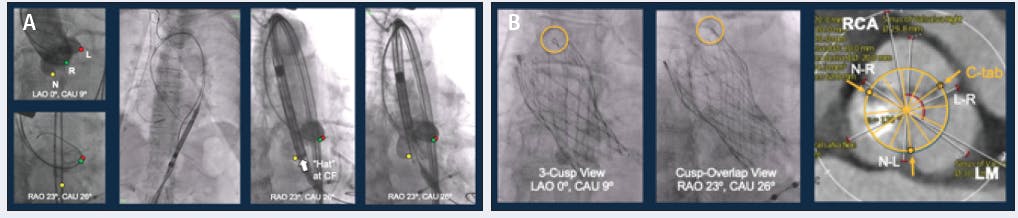
Figure 5. Three-cusp and cusp-overlap views. “Hat” marker at the CF position (A). C-tab at the inner curve with ideal commissural alignment (B).
CONCLUSION
Although the self-expanding Evolut valve has tall commissural posts, we have found a valve positioning methodology that lowers risk of coronary obstruction while reducing the risk of interaction with the conduction system. This is increasingly important in the lifetime management of lower-risk and younger patients. By inserting the flush port away from the operator, we are able to control the “Hat” marker in the OC/CF position > 90% of the time to facilitate future coronary engagement. Using the cusp overlap technique, we bring precision to valve deployment to achieve the target implantation depth, providing physicians the tools to reduce the risk of TAV interaction with the conduction system.
1. Buzzatti N, Romano V, De Backer O, et al. Coronary access after repeated transcatheter aortic valve implantation: a glimpse into the future. JACC Cardiovasc Imaging. 2020;13:508-515. doi: 10.1016/j.jcmg.2019.06.025
2. Rogers T, Greenspun BC, Weissman G, et al. Feasibility of coronary access and aortic valve reintervention in low-risk TAVR patients. JACC Cardiovasc Interv. 2020;13:726-735. doi: 10.1016/j.jcin.2020.01.202
3. Alexis SL, Zaid S, Sengupta A, et al. TAVR aortic root orientation: implications for future coronary access and redo TAVR. Ann Cardiothorac Surg. 2020;9:502-504. doi: 10.21037/ACS-2020-AV-10
4. Khan M, Senguttuvan NB, Krishnamoorthy P, et al. Coronary angiography and percutaneous coronary intervention after transcatheter aortic valve replacement with Medtronic self-expanding prosthesis: Insights from correlations with computer tomography. Int J Cardiol. 2020;317:18-24. doi: 10.1016/j.ijcard.2020.05.065
5. Yudi MB, Sharma SK, Tang GH, et al. Coronary angiography and percutaneous coronary intervention after transcatheter aortic valve replacement. J Am Coll Cardiol. 2018;71:1360-1378. doi: 10.1016/j.jacc.2018.01.057
6. Fuchs A, Kofoed KF, Yoon SH, et al. Commissural alignment of bioprosthetic aortic valve and native aortic valve following surgical and transcatheter aortic valve replacement and its impact on valvular function and coronary filling. JACC Cardiovasc Interv. 2018;11:1733-1743. doi: 10.1016/j.jcin.2018.05.043
7. Goel SS, Ige M, Tuzcu EM, et al. Severe aortic stenosis and coronary artery disease- implications for management in the transcatheter aortic valve replacement era: a comprehensive review. J Am Coll Cardiol. 2013;62:1-10. doi: 10.1016/j.jacc.2013.01.096
8. Ochiai T, Chakravarty T, Yoon SH, et al. Coronary access after TAVR. JACC Cardiovasc Interv. 2020;13:693-705. doi: 10.1016/j.jcin.2020.01.216
9. Vilalta V, Asmarats L, Ferreira-Neto AN, et al. Incidence, clinical characteristics, and impact of acute coronary syndrome following transcatheter aortic valve replacement. JACC Cardiovasc Interv. 2018;11:2523-2533. doi: 10.1016/j.jcin.2018.09.001
10. Abdelghani M, Landt M, Traboulsi H, et al. Coronary access after TAVR with a self-expanding bioprosthesis: insights from computed tomography. JACC Cardiovasc Interv. 2020;13:709-722. doi: 10.1016/j.jcin.2020.01.229
11. Tang GHL, Kaneko T, Cavalcante JL. Predicting the feasibility of post-TAVR coronary access and redo TAVR: more unknowns than knowns. JACC Cardiovasc Interv. 2020;13:736-738. doi: 10.1016/j.jcin.2020.01.222
12. Tang GHL, Zaid S, Fuchs A, et al. Alignment of Transcatheter Aortic-Valve Neo-Commissures (ALIGN TAVR): impact on final valve orientation and coronary artery overlap. JACC Cardiovasc Interv. 2020;13:1030-1042. doi: 10.1016/j.jcin.2020.02.005
13. Tang GHL, Zaid S, Michev I, et al. “Cusp-overlap” view simplifies fluoroscopy-guided implantation of self-expanding valve in transcatheter aortic valve replacement. JACC Cardiovasc Interv. 2018;11:1663-1665. doi: 10.1016/j.jcin.2018.03.018
Advertisement
Advertisement