Advertisement
Advertisement
January/February 2021 Supplement
Funding for this supplement provided by Medtronic
Cusp Overlap Technique in TAVR
TAVR implantation optimization—CT analysis and practical aspects of the cusp overlap technique.
By Xavier Armario, MD; Liesbeth Rosseel, MD; and Darren Mylotte, MB BCh, MD, PhD
Transcatheter aortic valve replacement (TAVR) is a safe and effective alternative to surgical aortic valve replacement for the treatment of symptomatic severe aortic valve stenosis across all surgical risk categories.1-7 In 2007, when TAVR was first commercialized in Europe, such a statement would have not seemed possible for a nascent technology that was plagued by high rates of three important complications: postprocedural paravalvular leak, vascular complications, and new permanent pacemaker implantation (PPI). Progressive iterations of transcatheter heart valve (THV) design, preprocedural planning, and implantation technique have seen these complications become less frequent. Higher rates of new PPI have been the most challenging issues to address due to the anchoring mechanism of most THV technology (radial force) and the proximity of the implantation site to the cardiac conduction system. Current rates of new PPI range from 2% to 36% depending on the THV design and the patient population studied.8 Although the clinical impact of new PPI after TAVR has been somewhat controversial, meta-analyses have suggested an increased risk of all-cause mortality at 1 year in patients receiving a new permanent pacemaker.9 Certainly, the requirement for PPI is associated with longer hospital stay and increased costs.10
The cusp overlap implantation technique has the potential to lower the risk of interaction with the conduction system by providing a more accurate assessment of THV depth. In this article, we review the rationale and practicalities of using this technique.
THE IMPORTANCE OF IMPLANTATION DEPTH
The proximity of the aortic valve and the cardiac conduction system explains the occurrence of new conduction disturbances with TAVR (Figure 1). The conduction system continues from the atrioventricular node toward the bundle of His and then splits into the left and right bundle branches. Located caudal to the commissure between the right (RCC) and noncoronary cusps (NCC), the bundle of His emerges at the surface of the interventricular membranous septum (MS), with the left bundle branch emerging and traversing the superficial crest of the interventricular septum within the interleaflet triangle separating the NCC and RCC. Kawashima et al described three variants of bundle of His anatomy: (1) the bundle courses within the right half of the MS in 50% of cases, (2) within the left half of the MS in 30%, and (3) coursing on to the MS just under the endocardium in 20%.11 The latter two anatomic variances would increase the risk of new conduction disturbances during TAVR.
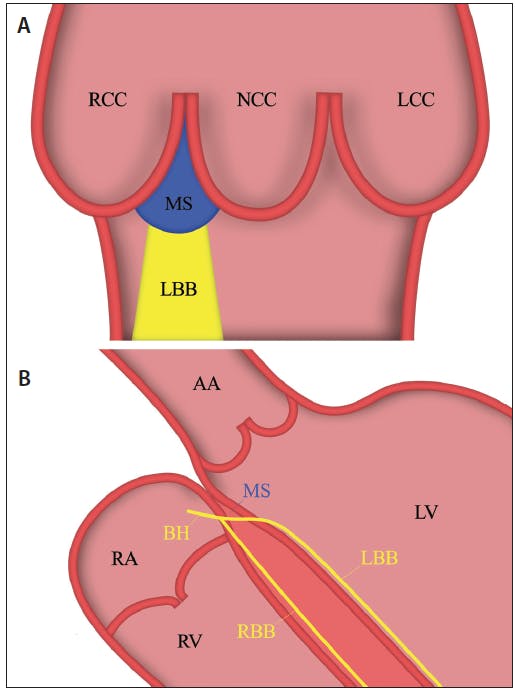
Figure 1. The aortic valve and conduction system. AA, ascending aorta; BH, bundle of His; LBB, left bundle branch; LCC, left coronary cusp; LV, left ventricle; MS, interventricular membranous septum; NCC, noncoronary cusp; RA, right atrium; RBB, right bundle branch; RCC, right coronary cusp, RV, right ventricle.
The depth at which a THV is implanted in the left ventricular outflow tract (LVOT) has been consistently associated with the requirement for new PPI for both balloon- and self-expandable THVs.12,13 This is axiomatic because the deeper the THV is implanted the greater the risk of contact between the THV and the conduction tissue. Such interaction induces either direct or indirect (localized edema, hematoma, etc.) injury to the conduction tissue. A shallower THV implantation in the LVOT is therefore among the simplest ways to reduce new PPI rates. It is, however, important to implant the THV at a sufficient depth to avoid pop-up of the valve into the aorta and to ensure anchoring and sealing. Each valve has specific guidance regarding implantation depth; for example, the recommended Evolut TAV (Medtronic) implantation depth is 3 mm depth below the aortic annulus. Because a few millimeters in implantation depth can make a big difference for PPI rates, accurate imaging of the aortic root during valve implantation is crucial to achieving the correct implantation depth and a low PPI rate. Recently, Jilaihawi et al described the Minimizing Depth According to the membranous Septum (MIDAS) approach for the deployment of self-expandable THVs, aiming for an implantation depth of less than the MS length, which in their experience reduced the incidence of new conduction disturbances and requirement of new PPI.14
S-CURVES, DOUBLE S-CURVE, AND CHAMBER ANATOMY
Device implantation is optimally performed in an angiographic projection that is perpendicular to the virtual plane of the aortic annulus and has parallax removed from the delivery system. In other words, it is recommended to implant in an angiographic view where there is no foreshortening of either the patient’s anatomy or the delivery system. Traditionally, with self-expandable devices that have a marker band at the distal tip of the delivery capsule, it was uncommon to have both the anatomy and device in plane together, and hence, there were two options: (1) implant in an angiographic view where the anatomy was in the correct imaging plane and accept that the device was not perfectly aligned, or (2) implant in an angiographic view where the device is in-plane and accept that the anatomy was not perfectly aligned. Neither of these implantation techniques is ideal because the presence of parallax in either the anatomy or the device renders the relationship between them (implant depth) unclear.
To address this problem, Piazza and Thériault-Lauzier developed the double S-curve implantation technique using bespoke multislice CT (MSCT) software (FluoroCT). Using this software program, the operator could construct the S-curve of the annular plane in the usual way and then construct the S-curve of the delivery catheter once it was sitting in the aortic root of the patient during the TAVR procedure. The software generates the delivery catheter S-curve once a left anterior oblique (LAO) and a right anterior oblique (RAO) projection (> 20º separation) with the delivery catheter in-plane are input into the system (Figure 2). The junction of the aortic annulus S-curve and the delivery catheter S-curve gives the angiographic projection where both the anatomy and delivery catheter are simultaneously in-plane. Thus, in this angiographic view, the distance between the base of the NCC (pigtail catheter) and the bottom of the THV (the implant depth) can be trusted to be accurate because there is no foreshortening of either structure. Importantly, in 90% of cases, the junction of these two S-curves (hence the title of double S-curve technique) was in an RAO-caudal projection, with the remaining cases being either an anteroposterior-caudal or a shallow LAO-caudal projection.15,16
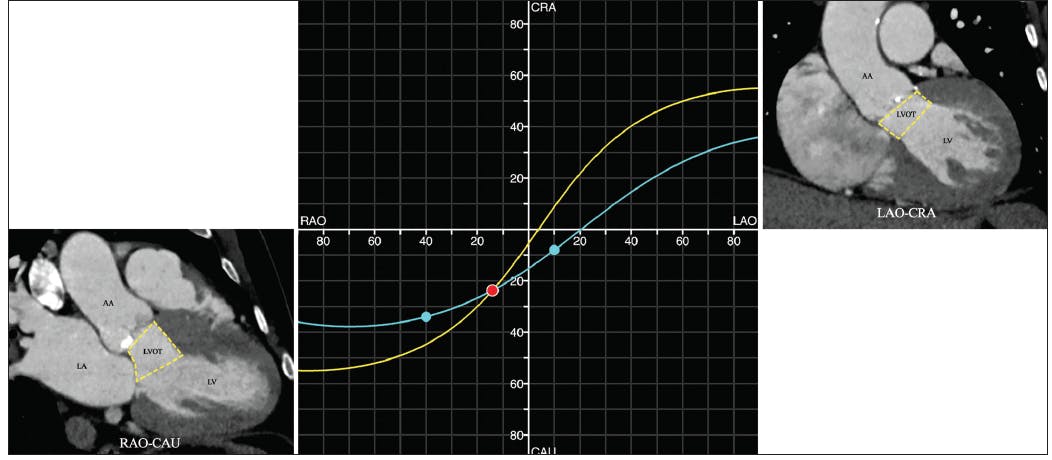
Figure 2. Double S-curve and chamber anatomy. The double-S curve gives a fluoroscopic projection where the aortic annulus is aligned and the delivery catheter parallax is removed. This fluoroscopic view corresponds to the point where the aortic annulus S-curve (yellow curve) and the delivery catheter S-curve (blue curve) cross and is usually obtained in an RAO-caudal view. The LAO-cranial view corresponds to a four-chamber view where the LVOT is foreshortened, while the RAO-caudal view corresponds to a 3-chamber view where the LVOT is elongated. AA, ascending aorta; CAU, caudal; CRA, cranial; LAO, left anterior oblique; LA, left atrium; LV, left ventricle; LVOT, left ventricular outflow tract; RAO, right anterior oblique.
Further understanding of the fluoroscopic anatomy of the heart, described as chamber anatomy, reveals why the RAO-caudal implantation view removes parallax from both the anatomy and the delivery catheter: in this projection, the heart is imaged in a three-chamber view (echocardiographic nomenclature) with the LVOT elongated (no foreshortening). On the other hand, in an LAO-cranial view, the heart is imaged in a four-chamber view with the LVOT foreshortened (Figure 2). Thus, if a catheter is placed in the LVOT, it is foreshortened in the LAO-cranial projection but not in the RAO-caudal projection. If the LAO-cranial view is used for THV implantation, the delivery catheter appears to be closer to the anatomy (represented by the NCC pigtail) than it actually is, and therefore, the depth of implantation appears to be less than it actually is. This does not occur if the RAO-caudal projection is used for THV implantation.17
Although the double-S technique was used successfully in several centers, the requirement for dedicated MSCT software and the time required to generate the S-curve of the delivery catheter in the LVOT during TAVR meant that widespread adoption of the double-S implantation technique did not occur.
CUSP OVERLAP TECHNIQUE
Because the double-S curve implantation view occurs in the RAO-caudal projection in 90% of cases, a “modified double-S” can be achieved by simply selecting an RAO-caudal implantation view from the annular S-curve and then adjusting this angle slightly during the procedure (if required) to ensure that the marker band at the base of the delivery catheter is in-plane.
More recently, Gada and colleagues recognized that in the RAO-caudal implant view, the RCC and the left coronary cusp (LCC) are superimposed on MSCT, leaving the NCC isolated. This two-cusp view, or cusp overlap view, is distinct from the traditional three-cusp view that is found usually in an LAO-cranial projection (Figure 3). This important observation affords TAVR operators the ability to efficiently and simply identify a suitable RAO-caudal implantation view without the need for dedicated MSCT software. The technique is performed by overlapping the RCC and LCC (cusp overlap view) and isolating the NCC while riding along the annular S-curve on the pre-TAVR MSCT.18 Similar to the double S-curve view, the cusp overlap view occurs in the RAO-caudal projection in the majority of cases.
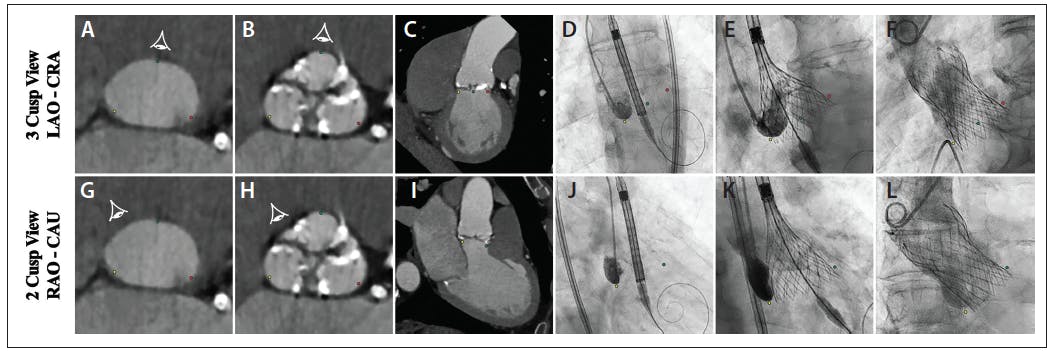
Figure 3. Cusp overlap technique. Traditional three-cusp view where all three cusps are visible, generally corresponding to an LAO-CRA view (A-C). In this view, the NCC (yellow dot) is on the left side, the RCC (green dot) is in the middle, and the LCC (red dot) is on the right side. THV positioning, deployment, and final assessment under a 3-cusp view (D-F). New 2-cusp view where the LCC and the RCC are overlapped and the NCC is isolated, generally corresponding to an RAO-CAU view (G-I). In this view, the NCC (yellow dot) remains on the left side while the RCC (green dot) and the LCC (red dot) are overlapped on the right side. THV positioning, deployment, and final assessment under a 2-cusp view (J-L). CAU, caudal; CRA, cranial; LAO, left anterior oblique; LCC, left coronary cusp; NCC, non-coronary cusp; RAO, right anterior oblique; RCC, right coronary cusp; THV, transcatheter heart valve.
CUSP OVERLAP TECHNIQUE: ADVANTAGES AND LIMITATIONS
The cusp overlap view, therefore, provides the correct implantation plane for assessment of THV deployment depth at the level of the NCC. There are also other advantages of deploying in this view: (1) the position of the wire in the left ventricle and the amount of tension on the wire can be easily assessed; (2) the delivery catheter appears vertical and thus implantation appears more straightforward; (3) the short axis of the aortic annulus is imaged in this plane, and therefore maximal constraint of the THV is best appreciated in this view; and (4) operators receive less radiation in an RAO projection (Figure 4).
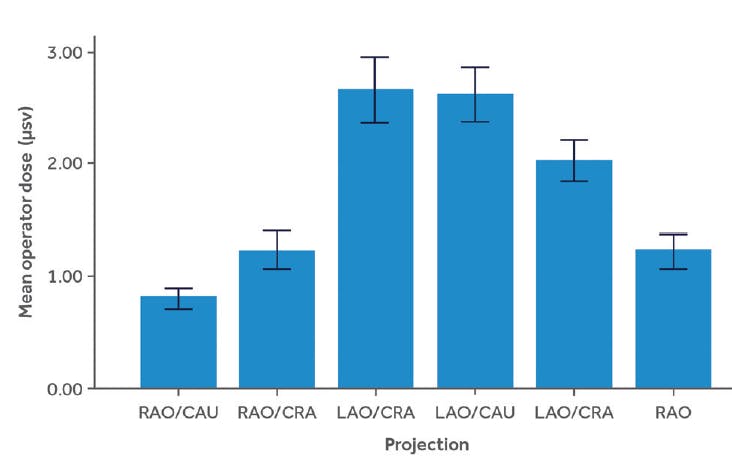
Figure 4. Beam projections and radiation exposure in transradial and transfemoral approaches during coronary angiography. Reproduced with permission from Tarighatnia A, et al. Anatol J Cardiol. 2017;18:298-303.
There are, however, two important drawbacks of the cusp overlap implantation view. First, the amount of tension and position of the delivery catheter on the inner or outer curvature of the aorta cannot be assessed in an RAO-caudal view. Hence, we recommend that once depth assessment is made in the cusp overlap view and the valve is deployed prior to the point of no recapture, an LAO projection (on the S-curve) be used to assess the delivery catheter position and final release. Second, infrequently, and particularly in the vertical annulus or in obese patients, the amount of RAO-caudal angulation required can be uncomfortable for the operator or lead to image degradation, respectively. In such cases, a less extreme RAO-caudal projection on the S-curve, situated between the cusp overlap view and the three-cusp view, should be considered as an alternative.
CUSP OVERLAP TECHNIQUE IN DAILY PRACTICE
While the transition from a traditional three-cusp view to the cusp overlap view for THV implantation is relatively straightforward, it can require several cases to become familiar with the technique. During this transition, we would suggest that operators start with patients with straightforward anatomy and good renal function so that additional aortography can be performed during implantation if required. In our daily practice with self-expanding THV, we will identify the cusp overlap view and an LAO-cranial view before starting the case. We then place the delivery system across the stenotic aortic valve. At this point, we perform our first aortography to assess the selected implantation view and initial device depth. A careful deployment of the THV, which starts at mid pigtail, is performed with occasional 3 to 5 mL contrast injections until annular contact on the left side is achieved. We then proceed to the point of no recapture, 80% of THV deployment, and assess implantation depth in the cusp overlap view before moving the C-arm to the predefined LAO-cranial view to assess depth on the LCC and the amount of tension in the delivery system, before performing final release.
CONCLUSION
The cusp overlap implantation technique has the potential to lower the risk of interaction with the conduction system. In an RAO-caudal view, identified simply using the cusp overlap technique, the relationship between the native anatomy and delivery catheter can be accurately determined and thus the true implant depth assessed. Large, prospective studies are being performed to confirm the risks and benefits of this new implant strategy.
1. Leon MB, Smith CR, Mack M, et al. Transcatheter aortic-valve implantation for aortic stenosis in patients who cannot undergo surgery. N Engl J Med. 2010;363:1597-1607. doi: 10.1056/NEJMoa1008232
2. Smith CR, Leon MB, Mack MJ, et al. Transcatheter versus surgical aortic-valve replacement in high-risk patients. N Engl J Med. 2011;364:2187-2198. doi: 10.1056/NEJMoa1103510
3. Adams DH, Popma JJ, Reardon MJ, et al. Transcatheter aortic-valve replacement with a self-expanding prosthesis. N Engl J Med. 2014;370(19):1790-1798. doi: 10.1056/NEJMoa1400590
4. Leon MB, Smith CR, Mack MJ, et al. Transcatheter or surgical aortic-valve replacement in intermediate-risk patients. N Engl J Med. 2016;374:1609-1620. doi: 10.1056/NEJMoa1514616
5. Reardon MJ, Van Mieghem NM, Popma JJ, et al. Surgical or transcatheter aortic-valve replacement in intermediate-risk patients. N Engl J Med. 2017;376:1321-1331. doi: 10.1056/NEJMoa1700456
6. Mack MJ, Leon MB, Thourani VH, et al. Transcatheter aortic-valve replacement with a balloon-expandable valve in low-risk patients. N Engl J Med. 2019;380:1695-1705. doi: 10.1056/NEJMoa1814052
7. Popma JJ, Deeb GM, Yakubov SJ, et al. Transcatheter aortic-valve replacement with a self-expanding valve in low-risk patients. N Engl J Med. 2019;380:1706-1715. doi: 10.1056/NEJMoa1816885
8. van Rosendael PJ, Delgado V, Bax JJ. Pacemaker implantation rate after transcatheter aortic valve implantation with early and new-generation devices: a systematic review. Eur Heart J. 2018;39:2003-2013. doi: 10.1093/eurheartj/ehx785
9. Faroux L, Chen S, Muntané-Carol G, et al. Clinical impact of conduction disturbances in transcatheter aortic valve replacement recipients: a systematic review and meta-analysis. Eur Heart J. 2020;41:2771-2781. doi: 10.1093/eurheartj/ehz924
10. Fadahunsi OO, Olowoyeye A, Ukaigwe A, et al. Incidence, predictors, and outcomes of permanent pacemaker implantation following transcatheter aortic valve replacement: analysis from the U.S. Society of Thoracic Surgeons/American College of Cardiology TVT registry. JACC Cardiovasc Interv. 2016;9:2189-2199. doi: 10.1016/j.jcin.2016.07.026
11. Kawashima T, Sato F. Visualizing anatomical evidences on atrioventricular conduction system for TAVI. Int J Cardiol. 2014;174:1-6. doi: 10.1016/j.ijcard.2014.04.003
12. De Torres-Alba F, Kaleschke G, Diller GP, et al. Changes in the pacemaker rate after transition from Edwards SAPIEN XT to SAPIEN 3 transcatheter aortic valve implantation: the critical role of valve implantation height. JACC Cardiovasc Interv. 2016;9:805-813. doi: 10.1016/j.jcin.2015.12.023
13. Gomes B, Geis NA, Chorianopoulos E, et al. Improvements of procedural results with a new-generation self-expanding transfemoral aortic valve prosthesis in comparison to the old-generation device. J Interv Cardiol. 2017;30:72-78. doi: 10.1111/joic.12356
14. Jilaihawi H, Zhao Z, Du R, et al. Minimizing permanent pacemaker following repositionable self-expanding transcatheter aortic valve replacement. J Am Coll Cardiovasc Interv. 2019;12:1796-1807. doi: 10.1016/j.jcin.2019.05.056
15. Thériault-Lauzier P, Andalib A, Martucci G, et al. Fluoroscopic anatomy of left-sided heart structures for transcatheter interventions: insight from multislice computed tomography. JACC Cardiovasc Interv. 2014;7:947-957. doi: 10.1016/j.jcin.2014.06.002
16. Thériault-Lauzier P, Spaziano M, Vaquerizo B, et al. Computed tomography for structural heart disease and interventions. Interv Cardiol. 2015;10:149-154. doi: 10.15420/ICR.2015.10.03.149
17. Piazza N, Mylotte D, Theriault Lauzier P. Fluoroscopic "heart chamber" anatomy - the case for imaging modality-independent terminology. EuroIntervention. 2016;18;12:Y9-Y15. doi: 10.4244/EIJV12SYA3
18. Tang GHL, Zaid S, Michev I, et al. "Cusp-overlap" view simplifies fluoroscopy-guided implantation of self-expanding valve in transcatheter aortic valve replacement. JACC Cardiovasc Interv. 2018;11:1663-1665. doi: 10.1016/j.jcin.2018.03.018
Advertisement
Advertisement