Advertisement
Advertisement
January/February 2021 Supplement
Funding for this supplement provided by Medtronic
Cusp Overlap Deployment Technique—The Manchester Experience
Technique rationale, clinical outcomes, and practical advice for implanters.
By Douglas G. W. Fraser, MB BChir, BA, DM, and Freidoon Keshavarzi, PGRAD, MD
To minimise the risk of interaction with the conduction system, precise sizing, positioning, and expansion of the Evolut valve (Medtronic) are required. An ideal valve position would include a position just below the annular plane, and coaxial alignment with the left ventricular outflow tract (LVOT). This would ensure the maximum expansion diameter within the annulus to minimise the risk of paravalvular leak, and a high implantation depth would reduce the chance of compression of the conduction system, and the subsequent need for a permanent pacemaker.
However, in practice, upward displacement of the valve can occur during release, due to systolic ejection, valve shortening during expansion, and melon seeding when the LVOT is narrow—and if the valve is placed too high at the outset, a ‘pop-out’ can occur. Furthermore, coaxial alignment may be difficult to achieve due to the differing axes of the ascending aorta (adopted by the valve) and the LVOT (of which the annulus is its proximal cross-section).
In practice, the best results are therefore achieved by minimising the depth of the device below the noncoronary cusp (the deepest cusp), whilst allowing for a small degree of upward movement during expansion. This requires precise positioning, as well as control of the device during deployment.
JUDGING THE PROSTHESIS DEPTH
Medtronic’s previous guidance for placement of the Evolut valve has been to first align the lowest points of the three cusps to create an annular plane three-cusp view. From transfemoral access, the device is often poorly aligned in this view, meaning that different sides of the expanded valve will occupy different depths with respect to a line joining the base of the cusps (the annular plane). It is, therefore, not possible in this view to be confident that the expanded valve will be below all three cusps. Medtronic’s guidance has therefore been to add either caudal angulation (common in the United Kingdom) or left anterior oblique (LAO) angulation (common in the United States) to this three-cusp view to achieve a device plane. Using these device plane projections, the operator can adjust the device position so that it is below the left and noncoronary cusps. These angulations have the effect of elevating the right coronary cusp (RCC) above the remaining left and noncoronary cusps and so, if the device is deployed below the still visible non-coronary cusp (NCC) and left coronary cusp (LCC), the operator can then be confident that the device will deploy below all three cusps, thereby minimizing the risk of a pop out.
However, the problem with this approach has been uncertainty regarding the true depth of the valve using off-annular plane projections. A potential solution was first proposed by Piazza et al, who realized that the annulus remained in-plane in a range of views with different relative cusp positions, described by an S curve, and that the device plane could similarly be imaged from different angiographic angles, described by a second S curve. From transfemoral access, Piazza et al described how these two S curves intersect in an RAO caudal view in most cases. This view, being the unique projection in which both the device and annulus are in-plane, allows the true device depth below the annulus to be assessed.1
Determining the S curve of the annulus is easily accomplished using computed tomography (CT) imaging software, such as 3mensio (Pie Medical Imaging BV) at the time of procedural planning. However, determining the S curve of the device requires image analysis at the time of the procedure and is not routinely available. This led to initial difficulties adopting this technique.
However, operators realized that the solution could be estimated by simply choosing an eccentric RAO caudal angle from the annular S curve generated from the CT data and that this view not only aligned the device and annular planes but frequently also overlapped the LCCs and RCCs along the annular plane, leading to the term cusp overlap view (COV). Medtronic has now adopted use of this view, in addition to other procedural tweaks, to create the current procedural guidance.
MANCHESTER EXPERIENCE
When we transitioned from a Sapien-only centre (Edwards Lifesciences) to include the Evolut R valve in 2015, we had been used to only implanting in the three-cusp annular plane view (as per Edwards Lifesciences instructions for use). We, therefore, felt uncomfortable coming off the annular plane and were attracted to ways to visualise both the valve and annulus in plane. After experimentation with RAO caudal annular projections predicted by the CT analysis, we similarly adopted the cusp overlap view as a convenient place to start. We were pleased by how often the cusp overlap technique aligned both the annulus and device and were struck by the low rate of pacemaker implantation, trending to be lower than our Sapien experience (N = 487; Evolut, 4.6%; Sapien 3, 8% pacemaker at 30 days) and the low rates of perivalvular leak (Figure 1).2,3
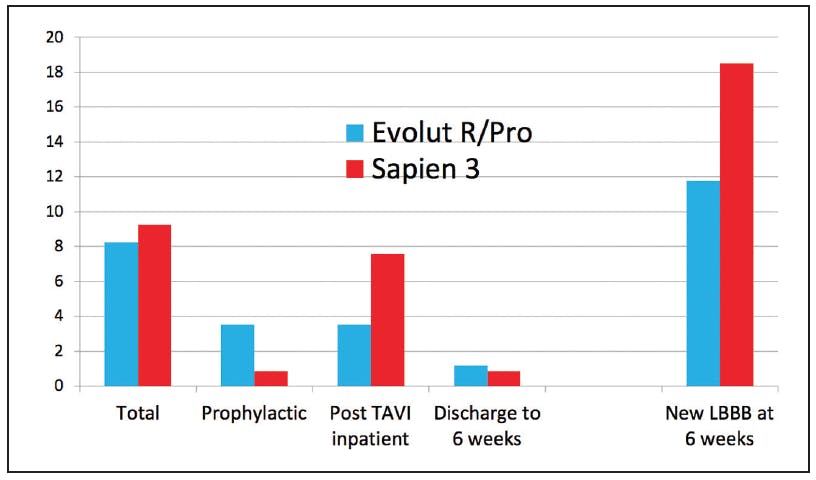
Figure 1. Single-centre experience (N = 487). Trend toward lower pacemaker (P = .13) and left bundle branch block (LBBB)rates using Evolut R in comparison to Sapien 3 valves.
In the lab, we have found that the COV has been a very workable view with both RAO and caudal angulations < 30° in roughly 80% of cases. In the remaining cases, we have found that a less extreme view derived from the CT annular S curve in between the three-cusp and cusp overlap views works well with good device alignment.
MANCHESTER CUSP OVERLAP TECHNIQUE PROCEDURAL STEPS
1. Image in three-cusp view to verify S curve angles from CT. Apply any difference from CT angle to all subsequent views.
2. Switch to COV. With the pigtail at the base of the NCC, slowly unsheath the valve (up to a point before annular contact) while keeping the base of the valve approximately 1 mm horizontally below the base of the pigtail. This will be approximately 3 mm below the annular plane, defined as the line joining the base of the NCC and LCC.
3. We then deploy the valve to 80% in the cusp overlap view, under rapid pacing to reduce cardiac output and minimize the likelihood of movement. During deployment aim to keep the valve 1 mm horizontally below the base of the pigtail held at the base of the NCC. Check valve depth below a line joining the NCC and LCC at 80%—aiming for 2-4 mm below this line. Consider recapture if < 1 or > 5 mm.
4. Assess expansion and depth below the LCC in this view.
5. Check in the LAO cranial view to judge tension on the valve before release, with the aim of a mid aortic position. Check device below LCC, risk of coronary obstruction, degree of aortic regurgitation in this view. Check degree of valve expansion in both views.
6. Do not release unless a good position is achieved. Recapture and reposition the valve, if necessary, to obtain an optimal position.
Furthermore, as the COV puts the lowest point of the NCC lateral to the valve, rather than behind the valve (as in the three-cusp view and modifications) visualisation of its position is further simplified (Figure 2). With the pigtail firmly at the base of this cusp, the device can be easily adjusted relative to the base of the pigtail. We have also been confident that when the valve is below the NCC in the COV it will be below all three cusps in almost all cases. As Medtronic now recommends, we aim to place the valve at a target implantation depth of 3 mm, with a range of 1 to 5 mm; shallower implantations may lead to pop-outs during postdilation, whereas deeper implants increase the pacemaker rates. This cusp overlap technique has allowed us to greatly simplify deployment (Figure 2).
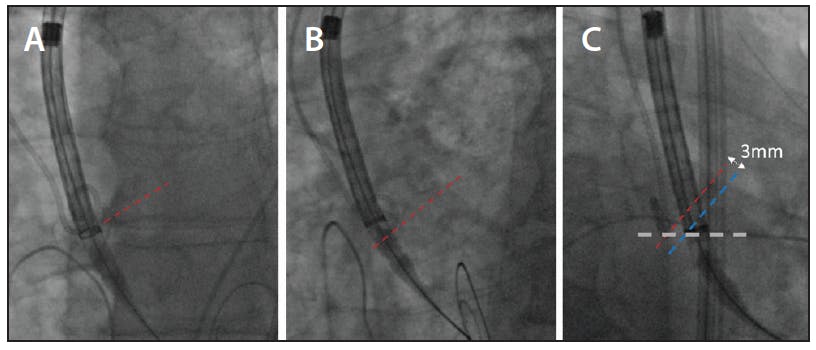
Figure 2. Valve ring level with the annulus (red line) in three-cusp view but valve not in plane (valve ring oval shape) (A). Following LAO angulation, valve in plane but now looks high relative to the pigtail and a line joining NCC and LCC (B). Valve at optimal height (blue line) 3 mm below the annular plane (red line) (C).
The effect of caudal and LAO angulation off the annular plane has been further examined in a modeling study.3 This study showed that the valve was elevated above the annular plane in a similar way with respect to the RCC whenever caudal or LAO angulation was applied (Figure 3). We've calculated that each 10° of caudal or LAO angulation off the annular plane, raised the valve an average of 1 to 1.5 mm, above a line joining the bases of the NCC and LCC. In practice, this effect means that a device that is, in reality, 3 mm below the annular plane may appear to be above the annular plane if 20° to 30° caudal or LAO is used to align the device. The operator response to this would likely be to advance the device distally by up to 4 to 5 mm, leading to a 7- to 8-mm depth on the NCC and perhaps a 12-mm depth on the LCC, when in fact the position was already optimal and would have deployed at 3 and 7 mm, respectively. This effect may be significantly more pronounced with large annuli. This effect is also readily visible in the lab.
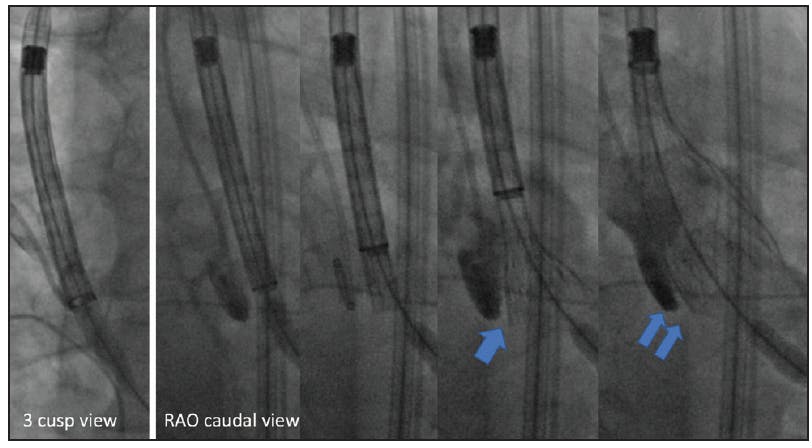
Figure 3. In the three-cusp annular plane view the valve is not in plane. However, in the RAO caudal views, both the valve and the device are in plane. The sheath is withdrawn, exposing the valve level with the base of the pigtail. Further withdrawal, flaring of the valve with its base 3 mm below the annular plane, is then followed by deployment to 80% (double arrow) under rapid ventricular pacing, and then subsequent release.
EXPERIENCE WITH CUSP OVERLAP TECHNIQUE IN THE UNITED KINGDOM
National data from the United Kingdom show significantly higher pacemaker rates (16%-18%) for the Evolut valve compared to those for the balloon-expandable Sapien valve (6%-8%).4 Currently, approximately one-third (16 of 46 centers) across the United Kingdom are using the cusp overlap technique, with most centers having started within the last 6 to 12 months and not all operators in these centers adopting the technique. Anecdotally we believe that the current adoption of the cusp overlap technique is low in the United Kingdom, but this is very likely to change in light of the recent (and ongoing) data and increased awareness of the technique.
ADDITIONAL RECOMMENDATIONS
Those new to the Evolut valve can follow the simplified scheme described previously, which allows rapid deployment with accurate results and is especially useful when hemodynamics are compromised during placement. It is recommended to start flaring the valve above the annulus and, once partially flared, advance to the desired position. This minimises interaction with the conduction system and helps sit the frame in the optimum position. If the LVOT size Is smaller than the annulus, some forward pressure can be applied to fix the valve in place.
For experienced implanters used to implanting at 0 to 1 mm in the caudal or LAO off annular views, it is important to be aware that the valve will look lower in the RAO caudal view and that 1 to 2 mm is the minimum depth in this view. Additional observations include the annular plane being more vertical in the COV, and that, following expansion, the valve may look more constrained as this view approximates more closely to the short diameter of the LVOT.
SUMMARY
LAO and caudal angulation from the three-cusp view leads to the valve looking higher In a similar way to the RCC. Failure to recognize this effect can contribute to a deep implantation. Using the cusp overlap technique (COT) the true depth of the device beneath the annular plane is seen by aligning both the annulus and the prosthesis in the same view. Deployment from 0% to 80% can be performed without moving from the COV, and a target 3-mm placement below the annular plane usually equates to 1 mm below a pigtail placed at the base of the NCC in this view. It is advised to consider recapture if the device is < 1 or > 5 mm below the NCC in this view. Following this, it is important to check in the LAO cranial view with the device aligned before final release. This technique simplifies deployment, has been associated with a reduction of pacemaker rates, and is now recommended by Medtronic.
1. Piazza N. Obtaining the correct depth of implant using the FluoroCT Double S curve. Presented at PCR London Valves 2015.
2. Pisaniello A, Makki H, Daniels M, et al. Low rates of permanent pacing are observed following self-expanding transcatheter aortic valve replacement using an annular plane projection for deployment. Circ Int. 2020 (expected publication Jan-Feb 2021).
3. Fraser D. Achieving single digit pacemaker rates in contemporary practice—Experience from Manchester, UK. Presented at PCR London Valves 2019.
4. Ludman P. National data extracted from BCIS dataset: http://www.bcis.org.uk/wp-content/uploads/2018/11/TAVI-slide-deck-to-2017-data-15-11-2018.pdf. Accessed January 8, 2021.
Advertisement
Advertisement