Advertisement
Advertisement
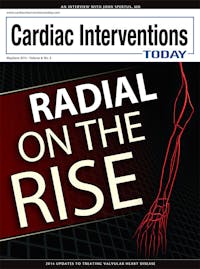
Radial access for catheterization and percutaneous coronary intervention (PCI) procedures has been growing steadily in the United Sates for several years. This issue characterizes the state of the art and discusses some of the challenges with the radial approach.
To open this issue, Carlos E. Alfonso, MD, and Mauricio G. Cohen, MD, provide a contemporary view of the transradial artery catheterization landscape in the United States and it’s continuing growth and evolution.
Next, we present a discussion with Sunil Rao, MD, and Timothy Sanborn, MD, about when they use femoral versus radial access and the role that closure devices and anticoagulants play in the treatment algorithm.
Ian C. Gilchrist, MD, FACC, describes how to complement transradial access with a peripheral vein approach to central venous access and right heart catheterization using the forearm, including tips for performing venous access in and out of the cath lab.
Although multiple randomized studies have shown a consistent reduction in bleeding with the use of transradial access for diagnostic and interventional procedures, unfortunately, no procedure is without complications. The most common complication of radial access is asymptomatic radial artery occlusion (RAO), which can render the radial artery unusable for repeat procedures or for use as a bypass graft. John T. Coppola, MD, FACC, discusses the pathogenesis of RAO, optimal use of anticoagulation, and techniques for preventing RAO at the beginning and end of each procedure.
In the hands of proficient operators, transradial PCI can be a viable and practical treatment for patients experiencing ST-elevation myocardial infarction. Kirk N. Garratt, MSc, MD, presents the data supporting this assertion, as well as some benefits of using radial over femoral access. Continuing the discussion on the benefits of radial versus femoral access, Matthew I. Tomey, MD, and Roxana Mehran, MD, take a look at the current best practices for PCI, from access to closure.
In addition to our radial coverage, Michael Reardon, MD, FACC, FACS; Paul Sorajja, MD, FACC, FAHA, FSCAI; Carl Tommaso, MD, FACC, FSCAI, FAHA, and I have participated in a roundtable discussion regarding the recently updated American College of Cardiology/American Heart Association Guideline for the Management of Patients With Valvular Heart Disease and the publication of a multisociety overview of transcatheter therapies for mitral regurgitation and what they will mean for your practice and valvular heart disease patients.
We conclude this issue of Cardiac Interventions Today with an interview with John Spertus, MD, Clinical Director of Outcomes Research at Saint Luke’s Mid America Heart Institute, regarding outcomes measuring and the creation and implementation of risk models to allow more personalized patient care.
We hope always to help keep you up to date and reduce the growing pile of journals on your desk to a few useful and concise reviews. Let us know if we are succeeding and if there are topics you would like to hear about in upcoming issues.
Ted E. Feldman, MD, FESC, FACC, FSCAI
Chief Medical Editor
Advertisement
Advertisement