Advertisement
Advertisement
July/August 2014
Mobile Device Apps for Interventional Cardiology
An overview of commonly used and clinically relevant medical apps that you can use to help facilitate and improve patient care.
By Justin P. Levisay, MD, FACC, FSCAI; Michael H. Salinger, MD, FACC, FSCAI; and Ted E. Feldman, MD, MSCAI, FACC, FESC
Computer and informational technology have advanced at a blistering pace over the past 50 years. Perhaps one of the easiest ways to conceptualize the extent of this change is by a comparison between one of the seminal technological achievements of the 20th century and a device that many of us carry in our pockets every day. The Apollo lunar lander guidance computer weighed 70 lbs, had 1-MHz processing speed, 4 kB of memory, and an estimated cost of $150,000. In contrast, the Apple iPhone 4s weighs 4.9 oz, has a processing speed of 800 MHz, up to 64 GB of memory, and can be purchased for $99 (with a 2-year contract, of course). The practice of medicine has been irrevocably changed on multiple fronts as a result. At a simplistic level, gone are the days of trudging to the library to find and copy articles. Even the venerable pager, once so closely associated with doctors, is rapidly giving way to new mobile technology
The widespread availability of affordable, sophisticated, and connected mobile devices has already changed the day-to-day lives of clinicians, consumers, and patients. There are now estimated to be well over 1 billion smartphones and tablets worldwide, with projections reaching 2 billion within the next year.1 A mobile application (app) is software designed to run on smartphones, tablet computers, and mobile devices. Apps are generally distributed by the owner of the mobile operating system, such as the Apple App Store, Google Play (Android), Windows Phone Store, and BlackBerry App World. The average worldwide smartphone user now has over 20 apps on his or her device.
ADOPTION OF MOBILE MEDICAL APPS
A recent report by the IMS Institute for Healthcare Informatics found that there were 43,689 mobile health care apps available for download through the United States Apple App Store as of June 2013, although only 54% were considered “genuine” health care apps. Of these, 69% targeted consumers and patients, whereas 31% were designed for use by clinicians.1 Most of the consumer health care apps were simple in design and found to do little more than provide information. Only 159 of the consumer apps were designed to capture or track specific user data.
Of the apps designed for clinicians, the most downloaded are generally used for reference purposes. The most popular are Epocrates, Medscape, Micromedex, WebMD, and UpToDate. Some of the most clinically relevant and sophisticated medical apps targeted at clinicians are not even necessarily available for download in “app stores.” The US Food and Drug Administration (FDA) has delineated a critical distinction between health apps and wellness apps. Wellness apps enhance or track the overall health of the user, whereas health apps are categorized as mobile software that diagnose, track, or treat disease. Health apps can monitor patients outside of the hospital, track vitals, or even analyze medical images for physicians. There are now more than 100 FDA-approved apps, with the FDA reviewing an additional 20 apps per year for approval.
Some of the more sophisticated FDA-approved apps require integration with existing hospital electronic medical record and imaging systems. Apps such as Mobile MIM and ResolutionMD allow remote viewing of radiology, nuclear medicine, neuroimaging, and cardiac imaging from smartphones and tablets. Because most processing is done outside the mobile device, no sensitive patient information is transmitted, making it a fundamentally secure process. AirStrip One allows for real-time integration of patient telemetry, electrocardiograms (ECGs; old and new), labs, and electronic medical records on a mobile device in a single view. In addition, participating emergency medical service units may transmit ECGs from the field, reducing door-to-balloon times.
Several apps are particularly useful for valve disease. EuroSCORE II is an up-to-date risk calculator. CardioValve (Digital Medical Networks) is a compendium of metrics and measurements on most of the mechanical and bioprosthetic heart valves that are in clinical use. Valve In Valve (UBQO Ltd) will identify most surgical valves and provide information regarding their suitability for treatment with transcatheter aortic valve replacement devices. EchoCalc (British Society of Echocardiography) includes formulas for everything imaginable from echo data.
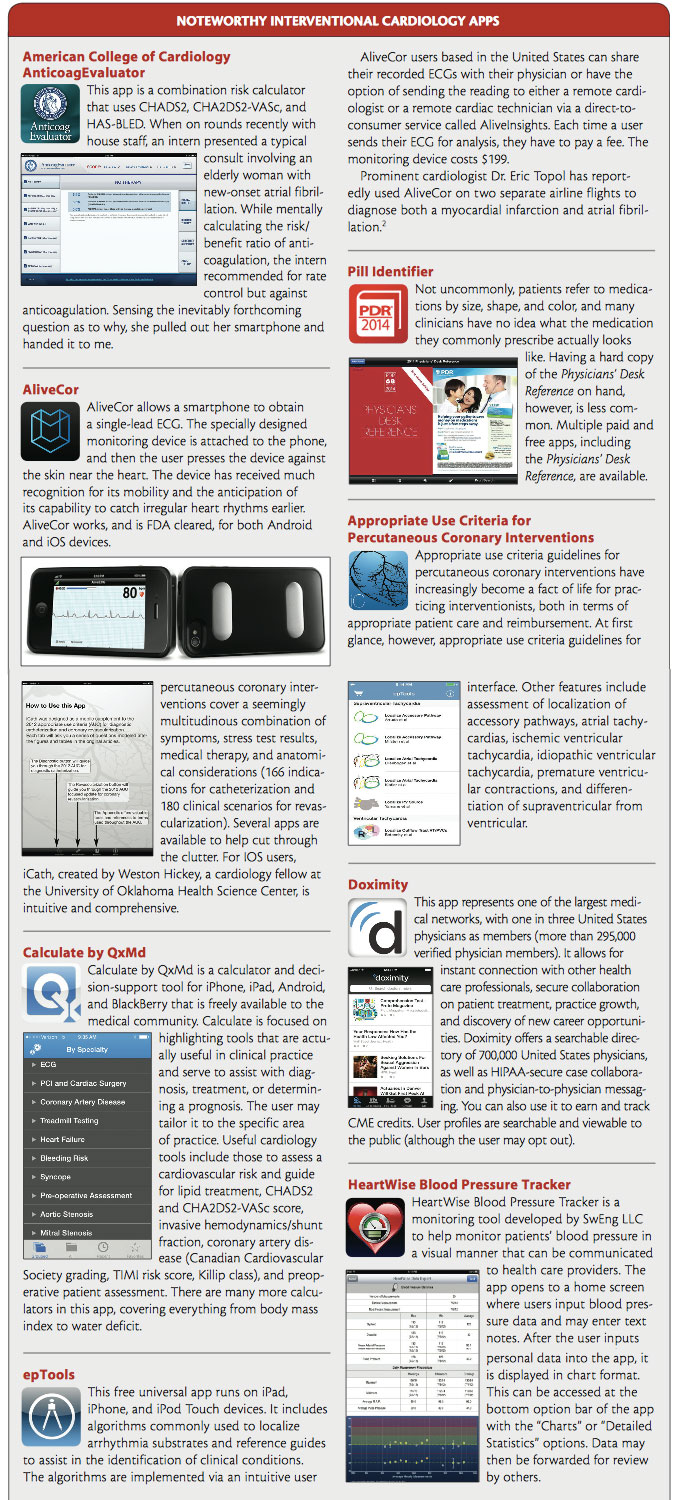
In the process of preparing this article, we conducted an informal survey of our cardiology colleagues to get a sense of which apps are commonly used. The majority used the aforementioned reference apps. In addition, a description of commonly used and interesting apps follow.
CONCLUSION
Health care apps, once considered a novelty, have increasingly become part of the everyday life of many physicians and patients. That said, apps have, in general, not reached the mainstream of health care delivery. This may be partially due to the fact that a large proportion of medical apps have traditionally been relatively limited, rudimentary, and unregulated.
Given the power and sophistication of some of the newer apps, one can clearly see the promise they hold. However, validation of efficacy will be required. The steady movement toward digitally assisted therapeutics seems inexorable and holds great promise for both promoting wellness and improving patient care. There is no doubt that we will continue to experience rapid expansion of the offerings in the app world and that our mobile devices will become an increasingly greater part of practice. The medical app is here to stay.
Justin P. Levisay, MD, FACC, FSCAI, is with the Cardiology Division, Evanston Hospital in Evanston, Illinois. He stated that he has no financial interests related to this article. Dr. Levisay may be reached at (847) 570-2250; jlevisay@northshore.org.
Michael H. Salinger, MD, FACC, FSCAI, is with the Cardiology Division, Evanston Hospital in Evanston, Illinois. He stated that he has no financial interests related to this article.
Ted E. Feldman, MD, MSCAI, FACC, FESC, is Director of the Cardiac Catheterization Laboratory at Evanston Hospital in Evanston, Illinois. He stated that he has no financial interests related to this article.
- IMS Institute For Healthcare Informatics. Patient apps for improved healthcare: from novelty to mainstream. http://www.imshealth.com/deployedfiles/imshealth/Global/Content/Corporate/IMS%20 Health%20Institute/Reports/Patient_Apps/IIHI_Patient_Apps_Report.pdf. Accessed June 16, 2014.
- Robbins G. Topol helps patient in second airline drama. U-T San Diego. March 5, 2013. http://www. bullhornreach.com/article/view/52808. Accessed June 16, 2014.
Advertisement
Advertisement