Advertisement
Advertisement
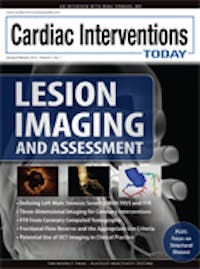
In our January/February issue, we offer reviews covering lesion assessment, appropriate use criteria, and several structural updates. Filippo Figini, MD, and Azeem Latib, MD, FACC, begin this issue by discussing the utility of fractional flow reserve and intravascular ultrasound as complementary tools for assessing the significance and anatomical characteristics of left main coronary artery stenosis. Three-dimensional imaging has also become a promising modality for improving the evaluation of coronary vasculature. Joel A. Garcia, MD, FACP, FACC, FSCAI, FCCP, explains how this technology enables many advanced applications that may have a profound impact on safety, outcomes, and operator training and performance.
FFR derived from resting coronary CT angiography, known as FFRCT, integrates advances in computational fluid dynamics and image-based modeling. Rekha Raju, MBChB, and Jonathon Leipsic, MD, describe the use of FFRCT to provide valuable guidance regarding the need for revascularization without any additional imaging, radiation, or medications to produce hyperemia.
Next, Manesh R. Patel, MD, explains the Appropriate Use Criteria for imaging assessment to guide interventionists in deciding which cases truly necessitate cardiovascular revascularization in an effort to standardize treatment and deliver appropriate and successful care. Daniel Chamié, MD, and Ricardo A. Costa, MD, PhD, then explore the possible uses of optical coherence tomography before, during, and after percutaneous coronary interventions by supplying information about atherosclerosis characterization, detecting vulnerable plaques, and assessing vascular response to intracoronary procedures.
In this issue, we also focus on the latest developments in treating structural heart disease. Thomas J. Forbes, MD, FACC, FSCAI, and Daisuke Kobayashi, MD, provide an over- view of treating coarctation of the aorta, including available treatment modalities and tips for avoiding complications and navigating complex aortic arch anatomy. Additionally, Steven J. Yakubov, MD, FACC, FSCAI, and Jonathan Forquer, DO, comment on the current status of left atrial appendage closure as a strategy to reduce the stroke risk in those affected by atrial fibrillation.
We also have a roundtable interview with Robert Sommer, MD, and John Rhodes, MD, concerning the recently presented results from the RESPECT trial and what they might indicate for the future of PFO closure to reduce cryptogenic stroke. In our Pharmacology section, Tarpan Patel, MD; Adam Bress, PharmD; Sahar Ismail, MD; and Adhir Shroff, MD, MPH, share their thoughts on high platelet reactivity in patients on dual- antiplatelet therapy and how to select those who should undergo platelet reactivity testing.
To conclude this issue, Renu Virmani, MD, recipient of the 2012 TCT Career Achievement Award, shares her perspective as a pathology expert on how the cardiology community can make improvements to move toward the next horizon of cardiovascular care.
As always, we strive to summarize the literature of the ever-growing stack of unread journals we all face. The splitting of some of the mainstay cardiology journals into multiple subsubjects has made the need for thoughtful reviews even greater. Please let us know if there are some topics you'd like to see included. Also of note, we received comments from readers on the cover photo from the September/October 2012 issue on “Access and Closure.” The photo showed an access needle poised to make a femoral puncture. Unfortunately, the skin had not been properly prepped, and this caught the attention of several readers. We apologize for the oversight. The photos come from an image bank, so we have no way to know if it had been staged or was actually taken during a real procedure.
Advertisement
Advertisement