Advertisement
Advertisement
May/June 2011
CHIEF MEDICAL EDITOR'S PAGE: We Are Only as Good as What We See
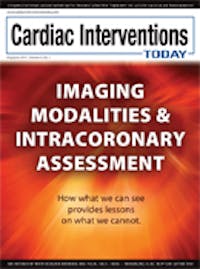
This issue highlights intracoronary assessment of morphology and physiology. We are only as good as what we can see. Imaging has led the way to better techniques for revascularization since F. Mason Sones, Jr, MD, performed the first selective coronary angiography. In this issue, we examine the well-established ultrasound imaging (IVUS) and fractional flow reserve technologies, as well as the less familiar optical coherence tomography (OCT) approach. Some of the lessons from these imaging modalities are illuminated by the examination of vulnerable plaque in the recent PROSPECT study.
We begin the issue by discussing the PROSPECT study with Principal Investigator Gregg W. Stone, MD, who shares his opinions on its design and outcomes, as well as the impact it could potentially have on the future of interventional cardiology.
OCT is a catheter-based technology that allows high-resolution imaging, showing important anatomic and device-related information. An overview of OCT by Mehmet Cilingiroglu, MD, FACC, FSCAI, and Marc D. Feldman, MD, FACC, FSCAI, presents the advantages and limitations of this novel technology and where it might take us in the future. Joshua Waggoner, MD, and Marc D. Feldman, MD, FACC, FSCAI, then examine the differences between OCT and intravascular IVUS and explain which modality is better suited for certain clinical applications.
We next take a look at fractional flow reserve as an important tool to guide interventionists in treating complex coronary artery disease. Aaron Peace, MD, PhD, and Emanuele Barbato, MD, PhD, discuss the importance of evidence- based decision making when selecting the mode of revascularization that will be most appropriate for each patient.
Even with the recent advances in coronary disease detection, there is room for improvement, as many cases result in future adverse events. Adnan Khalid, MD, and Steven P. Marso, MD, provide an overview of the clinical trial data on IVUS with virtual histology and its ability to assess vulnerable plaque, as well as other useful applications it offers.
We also have two fascinating Challenging Cases articles. First, Nazia Husain, MD, MPH, and Ralf J. Holzer, MD, MSc, FSCAI, share four cases of acute vascular thrombosis in children with congenital heart disease and how they were able to overcome a number of complications by choosing the proper strategy for the patient and having a wide variety of tools to choose from. The second article focuses on a life-threatening complication of transcatheter aortic valve implantation, and Jennifer Franke, MD; Marius Hornung, MD; Stephan Fichtlscherer, MD; Nina Wunderlich, MD; and Horst Sievert, MD, FESC, FACC, FSCAI, take you through their process of quickly determining the cause and treatment for such serious events.
In our Ask the OCT Imaging Expert section, Vasile Sirbu, MD, and Giulio Guagliumi, MD, explain how OCT can help guide accurate stent expansion. We close our issue with an interview with Roxana Mehran, MD, FSCAI, FACC, FAHA, Program Chair of the Society for Cardiovascular Angiography and Interventions' Women in Innovations initiative, about the lingering disparities faced by women who are working in the field of interventional cardiology and in terms of how women are treated as patients around the world.
Our goal is to help you digest the vast body of interventional literature in a concise and useful way. Please let me know if we are achieving our goal or if there are topics that you would like to read about. I hope you enjoy this issue!
Ted E. Feldman, MD, FSCAI
Chief Medical Editor
citeditorial@bmctoday.com
Advertisement
Advertisement