Advertisement
Advertisement
October 31, 2025
Radiation Exposure Reduction Studied With EggNest Complete System
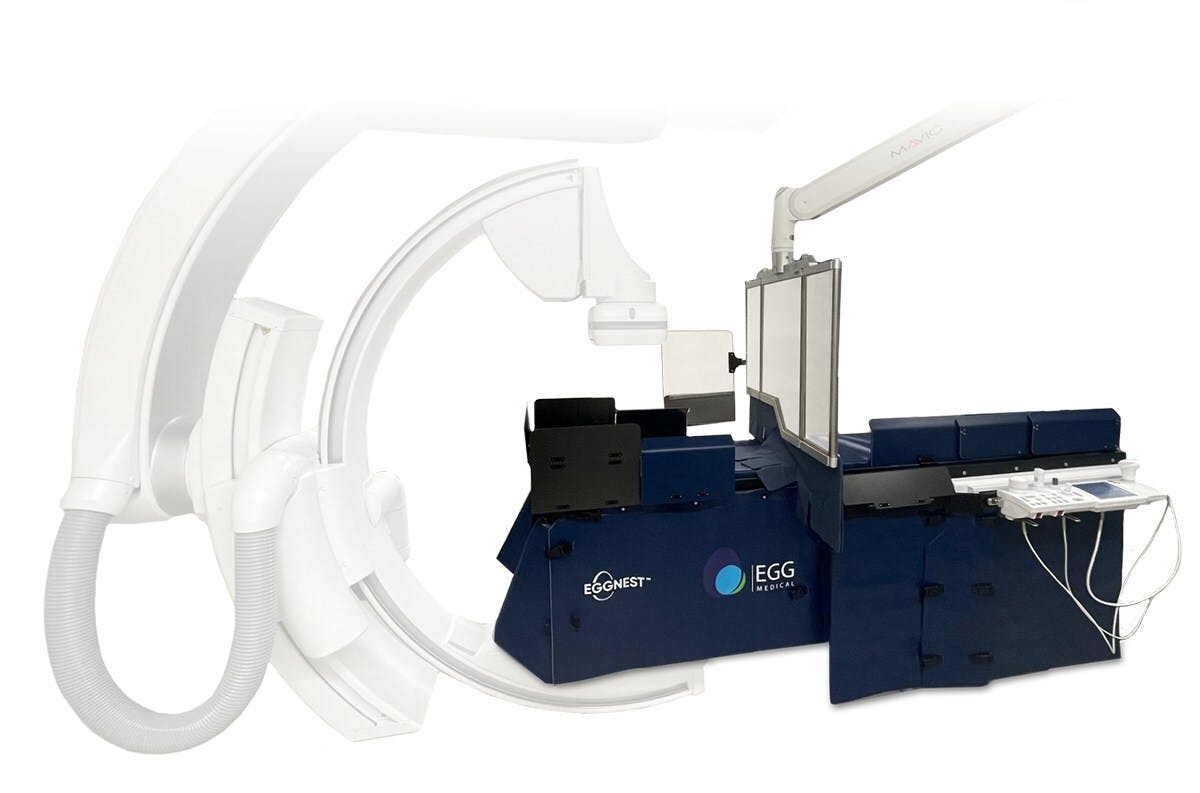 October 31, 2025—Egg Medical, Inc. announced the presentation of real-world studies demonstrating that the company’s EggNest Complete radiation protection system reduced radiation exposure for all members of the interventional team—including physicians, nurses, and technologists—compared to traditional shielding methods.
Jarrod Frizzell, MD, of The Christ Hospital in Cincinnati, Ohio, presented the findings at the TCT 2025 scientific symposium.
According to the company, the studies showed that the average operator scatter-radiation dose during coronary and percutaneous coronary intervention procedures using the EggNest Complete system was only 0.16 mRem per case.
For context, the annual occupational exposure limit in the United States is 5,000 mRem; an operator would need to perform > 31,000 cases before nearing that limit, and a typical interventionalist performs 300 to 500 cases annually, noted Egg Medical.
The company noted that the study also demonstrated teamwide protection, with nurses and technologists recording average exposures of 0.03 mRem per case, confirming the EggNest system’s ability to safeguard the entire room.
“Having a radiation protection system that consistently protects my entire team as well as or better than the heavy lead we wore in the past means we’re taking care of patients and ourselves,” commented Dr. Frizzell in Egg Medical’s press release.
Robert Riley, MD, an interventional cardiologist at Overlake Medical Center in Seattle, Washington, and Chief Scientific Advisor for Egg Medical added, “These real-world results reinforce what prior studies have shown—the EggNest complete system is the only solution proven to significantly reduce radiation exposure for every member of the team. By enabling staff to perform procedures with ultralight or no lead aprons, we can also dramatically reduce orthopedic injuries associated with traditional protection.”
Dr. Frizzell and colleagues are continuing their evaluation of the EggNest system in structural heart and electrophysiology procedures to expand the evidence base for its use across a broad range of X-ray–guided interventions, advised the company.
Advertisement
Advertisement