Advertisement
Advertisement
April 7, 2026
Philips’ DeviceGuide Cleared for Image Guidance in M-TEER With Edwards’ Pascal Ace System
KEY TAKEAWAYS
- Philips’ EchoNavigator R5.0 with DeviceGuide is an AI-enabled image guidance tool for transcatheter mitral valve repair procedures.
- The software integrates echocardiography and fluoroscopy to provide real-time visualization and device tracking during intervention.
- DeviceGuide is currently indicated for use with Edwards’ Pascal Ace mitral valve repair system.
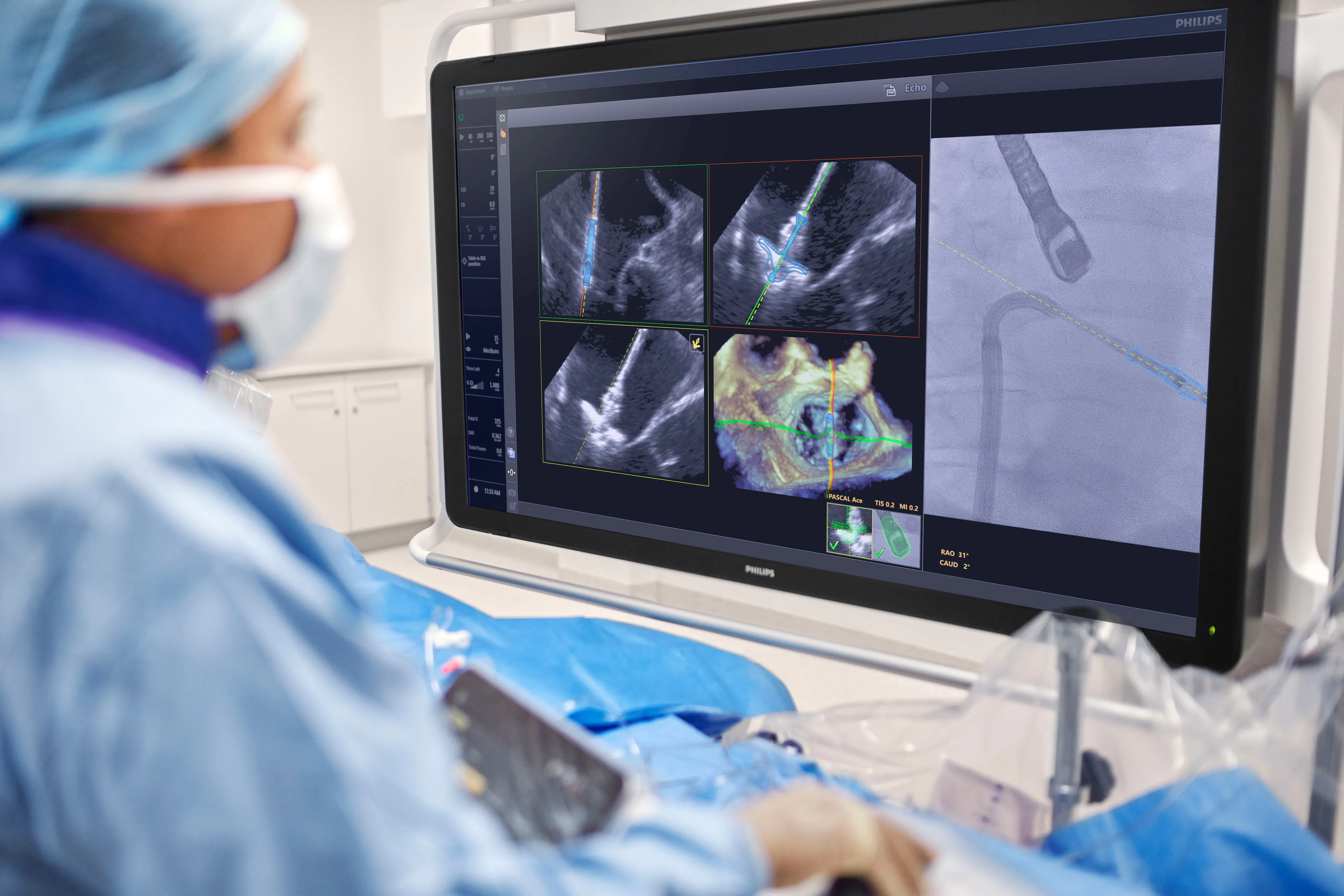 April 7, 2026—Royal Philips announced it has received FDA 510(k) clearance for EchoNavigator R5.0 with DeviceGuide, an artificial intelligence (AI)–powered software solution that assists interventionists in transcatheter repair procedures of mitral regurgitation.
According to Philips, DeviceGuide was developed in collaboration with Edwards Lifesciences, combining Philips’ imaging and AI expertise with Edwards’ expertise in valvular heart therapy development. The solution provides image guidance of mitral transcatheter edge-to-edge repair workflow to make these complex procedures more intuitive and streamlined.
DeviceGuide is currently intended for use with the Pascal Ace mitral valve repair system (Edwards Lifesciences), advised Philips.
The company stated that DeviceGuide is built on Philips’ EchoNavigator echofluoro fusion technology, which combines live echocardiography images from Epiq CVxi cardiovascular platform (Philips) with live x-ray images from the Azurion image-guided therapy system (Philips). The software’s AI algorithm automatically tracks and visualizes the Pascal Ace device, combining live ultrasound and x-ray images into a single, integrated view.
In developing DeviceGuide, Philips and Edwards worked with investigational sites in Europe and the United States, including a team at the Structural Heart and Valve Center at NewYork-Presbyterian/Columbia University Irving Medical Center, led by interventional cardiologist Susheel Kumar Kodali, MD, director, and Rebecca T. Hahn, MD, Director of Interventional Echocardiography.
“In helping to guide mitral repair procedures, one of my roles as an echocardiographer is to help the interventional cardiologist understand the complex anatomy of the valve, which will determine the orientation, trajectory, and position of the repair device relative to the target and the surrounding structures,” commented Dr. Hahn in the Philips press release. “Since AI auto-aligns imaging to the device in real time and continuously informs the interventionalist about the location of the device in space on the imaging screen, it minimizes unnecessary repositioning of the imaging window, streamlines procedural guidance, and may improve the precision of device implantation.”
Dr. Kodali added, “DeviceGuide provides me with a visual overlay, trajectory line, and orientation line of the therapy device in both live three-dimensional echo and fluoroscopic images during mitral valve repair procedures. Having a single, intuitive presentation of real-time target, orientation, and auto device-aligned views simplifies this procedure and improves team communication.”
Advertisement
Advertisement