Advertisement
Advertisement
September 7, 2022
Philips Continues Development of Spectral Angio CT Suite
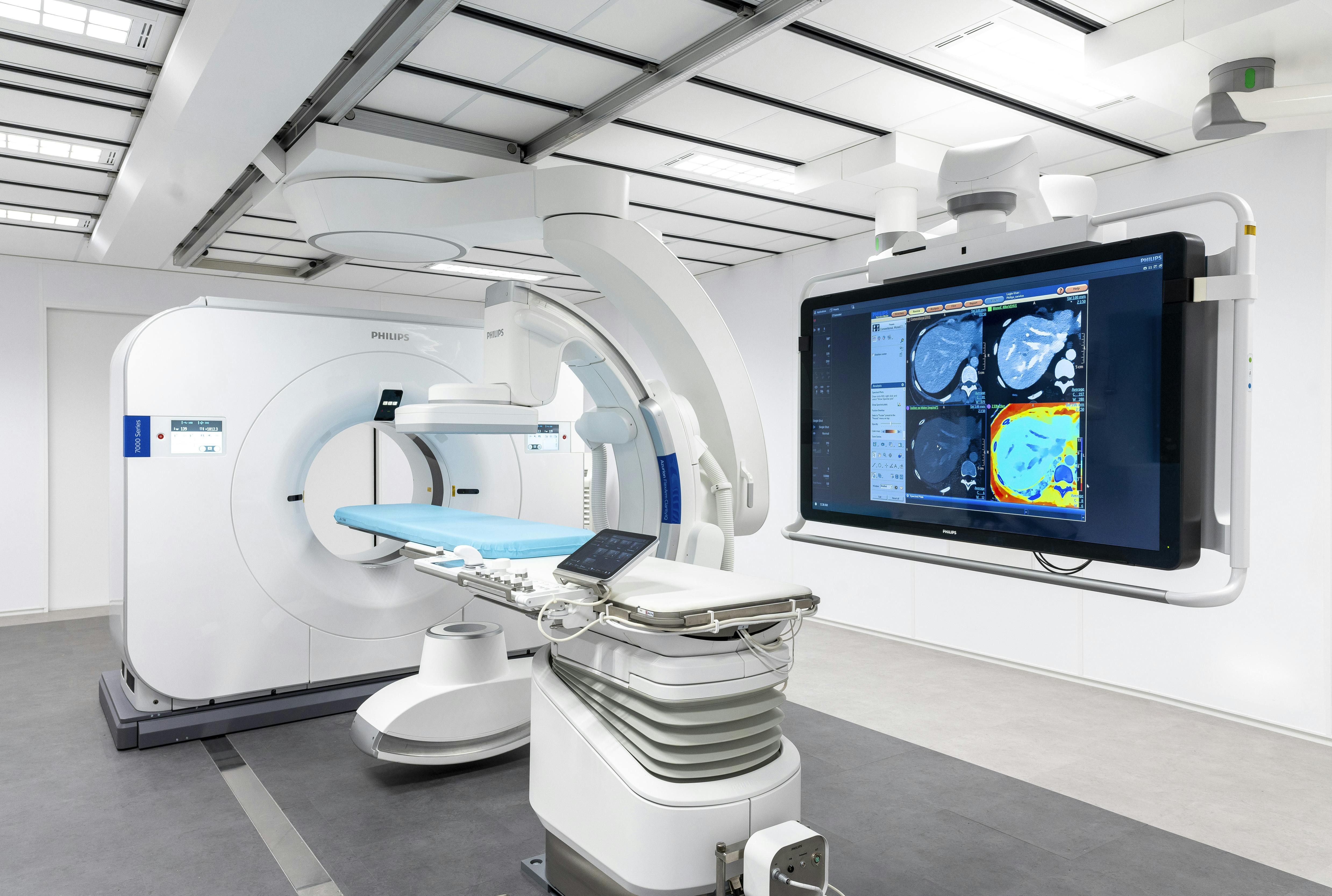 September 7, 2022—Royal Philips announced milestones achieved in the development of the company’s first spectral detector angio CT solution. The milestones include a new clinical partner and clinical studies that focus on the added value of using spectral CT imaging technology during interventional procedures.
Philips is developing the Spectral Angio CT suite to combine the company’s Spectral CT 7500 system and its image-guided therapy system—the Azurion with FlexArm—in a fully integrated interventional suite solution. The combination aims to give physicians immediate access to these two imaging modalities in a single room, enabling minimally invasive procedures in areas such as oncology, stroke, and trauma care.
The company noted that at CIRSE 2022, the Cardiovascular and Interventional Radiological Society of Europe’s annual congress held September 10-14 in Barcelona, Spain, Filippo Piacentino, MD, is delivering a presentation on the value of spectral CT-imaging guidance for performing high-confidence tumor biopsies. Dr. Piacentino is an interventional radiologist at the University of Insubria in Varese, Italy.
The results being presented at CIRSE 2022 illustrate the potential for Philips’ spectral CT technology to better guide biopsies by distinguishing between active and nonactive regions in a tumor, stated Philips.
In the company’s press release, Dr. Piacentino commented, “With conventional CT, large masses may appear as a largely uniform mass, making highly targeted biopsy difficult. By fusing images from Philips’ XperGuide live-needle guidance with images from spectral CT that are color-coded based on the effective atomic number of tissues and provide a large amount of additional information, we can now investigate the possibility of obtaining better-defined biopsy targets with a fewer number of inconclusive biopsies.”
Also, the company advised that Leiden University Medical Center (LUMC) in Leiden, the Netherlands, has joined Philips’ global network of clinical partners to investigate how its spectral detector angio CT solution could potentially offer new treatment opportunities and improve patient care.
Mark Burgmans, MD, Head of Interventional Radiology at LUMC, commented in the company’s press release, “We are excited to cocreate an innovation that could play a defining role in improving patient care in the space of interventional oncology. Adding spectral CT imaging to the interventional suite will enable us to offer new treatment opportunities, avoid moving patients from one imaging suite to another, and offer the unique benefits of spectral CT information when you need it.”
In November 2021, the company announced its collaboration with clinical partners, the Mayo Clinic in Rochester, Minnesota, and Baptist Health’s Miami Cardiac & Vascular Institute in Miami, Florida, on the development of the integrated interventional suite solution, which Philips presented at RSNA 2021, the Radiological Society of North America’s annual meeting that was held November 28 to December 2 in Chicago, Illinois.
Finally, Philips announced a research collaboration with the University of Pennsylvania in Philadelphia, Pennsylvania, to study the practicality of using spectral CT-based tissue temperature mapping to provide real-time feedback during tumor thermal ablation procedures to confirm its effectiveness before the patient leaves the room. This will potentially reduce the risk of localized tumor recurrence, stated the company.
According to Philips, its Spectral Angio CT suite combines the company’s latest diagnosis and treatment technologies. The Azurion with FlexArm integrates best-in-class imaging systems, software, and specialized diagnostic and therapeutic devices to support the most complex procedures. Adding the Spectral CT 7500 system allows physicians to use only one scan to capture all the spectral information required to differentiate and quantify different tissues.
Spectral CT enables improved detection, delineation, and quantification of lesions, to allow better-informed planning for minimally invasive procedures and more precise interventions. In other areas of oncology, it has demonstrated higher sensitivity in detecting malignant findings and improved readings of incidental findings.
Advertisement
Advertisement