Advertisement
Advertisement
November 16, 2025
Meril’s Myval THV Evaluated in 1-Year Data From LANDMARK RCT
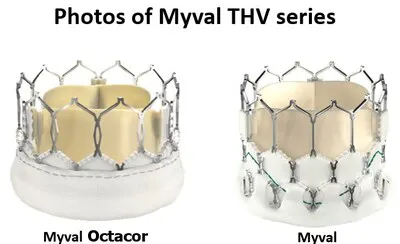 November 16, 2025—Meril Life Sciences announced 1-year results from the pivotal LANDMARK randomized controlled trial (RCT) comparing the company’s balloon-expandable Myval transcatheter heart valve (THV) series with both the balloon-expandable Sapien THV (Edwards Lifesciences) and the self-expanding Evolut THV (Medtronic) devices for transcatheter aortic valve replacement (TAVR) in patients with symptomatic severe aortic stenosis.
The findings were presented during the late-breaking trial sessions at PCR London Valves 2025.
According to Meril, at 1 year the multicenter study demonstrated the following:
- Comparable composite clinical efficacy—freedom from all-cause mortality, all stroke, and procedure- or valve-related hospitalization: 87% for Myval, 86.9% for Sapien, and 86.9% for Evolut.
- Comparable extended efficacy—freedom from mortality, stroke, hospitalization, and quality-of-life deterioration: 80.5% for Myval, 75.0% for Sapien, and 79.7% for Evolut.
- Myval demonstrated the lowest incidence of moderate aortic regurgitation (1.6%), supporting its hemodynamic stability at 1 year.
Additionally, a post hoc analysis in patients with a small aortic annulus showed comparable composite efficacy rates of 91% for both Myval and Evolut and 89% for Sapien.
Patient follow-up in the LANDMARK trial will continue for 10 years to evaluate long-term clinical stability and valve performance, advised the company.
The LANDMARK trial is led by Professor Patrick W. Serruys, MD, who serves as Chairman and Study Director, and Professor Andreas Baumbach, MD, serving as Global Principal Investigator.
“The LANDMARK trial continues to provide the global TAVR community with meaningful comparative insight,” commented Prof. Serruys in Meril’s press release. “By bringing together three leading THV platforms in a rigorously designed randomized study, we are able to better understand differences that matter clinically, particularly in valve stability and sustained hemodynamic performance.”
Prof. Serruys continued, “The 1-year findings reinforce the reliability of the Myval THV series, including its low rate of aortic regurgitation, which is of significant relevance for valve performance. These data support informed clinical decision-making and expand the conversation on how to personalize valve selection according to patient anatomy.”
Prof. Baumbach stated, “This study is unique in its ability to benchmark performance across balloon-expandable and self-expanding valves under identical trial conditions. The consistency seen in both standard and extended clinical efficacy endpoints demonstrates that the Myval THV series performs on par with established global systems. Its hemodynamic profile, combined with predictable deployment and sizing options, provides clinicians with a valuable and versatile treatment choice.”
Prof. Baumbach added, “As the study progresses over the coming years, it will further contribute to greater clarity on long-term valve performance, which is increasingly important given the demographic shift toward younger and lower-risk TAVR patients.”
Advertisement
Advertisement
