Advertisement
Advertisement
October 1, 2024
Elucid’s PlaqueIQ Image Analysis Software Receives FDA Clearance
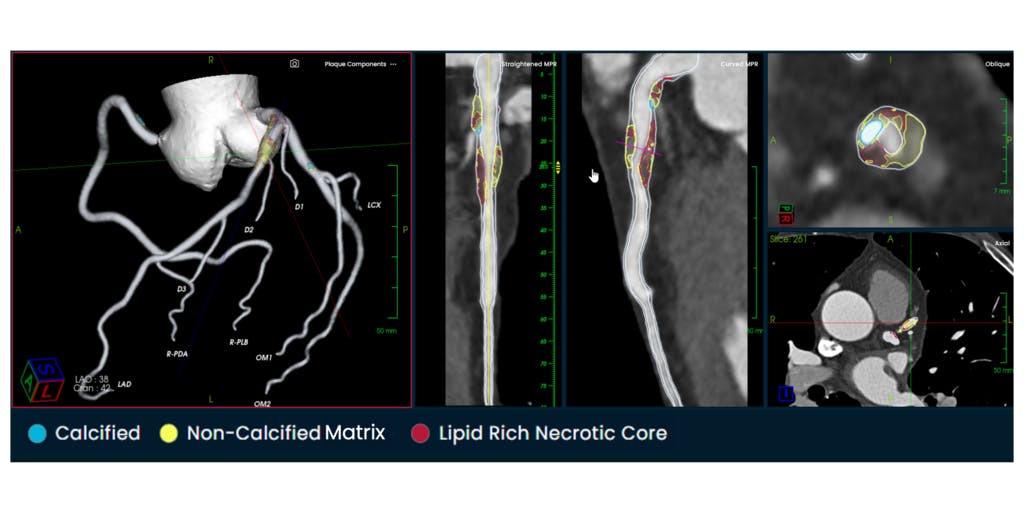 October 1, 2024—Elucid announced it has received FDA 510(k) clearance for its PlaqueIQ imaging analysis software for diagnosing cardiovascular disease (CVD), providing physicians with new, clinically validated information to help stratify patients and inform patient-specific treatment pathways.
The company is currently performing beta testing on PlaqueIQ and anticipates making the software available for limited release in Q4 2024. Elucid is also pursuing an indication for noninvasive measurement of fractional flow reserve CT, uniquely derived from its PlaqueIQ technology, to measure coronary blockages and the extent of ischemia.
According to the company, the noninvasive PlaqueIQ software is based on ground-truth histology. It quantifies and characterizes noncalcified plaque and its components such as lipid-rich necrotic core, giving potential insights into high-risk plaques that are key drivers of risk of myocardial infarction (MI) and stroke. PlaqueIQ utilizes first-line diagnostic coronary CT angiography and develops comprehensive, interactive reports to help physicians virtually “see” plaque at the vessel level.
Use of the software has the potential to enable earlier identification of higher-risk plaque before the presence of symptoms or major adverse events, stated the company.
Physicians send patient images to Elucid with a single mouse click, and then Elucid applies PlaqueIQ’s image-restoration algorithms to the file to mitigate motion and calcium blooming artifacts. Specially trained analysts segment the data creating a three-dimensional model of the patient’s coronary arteries. The software then identifies, classifies, and quantifies tissue structure and composition.
Elucid noted that the strongest predictor of future events caused by CVD, such as myocardial infarction (MI) and stroke, is the amount and type of plaque patients have in their arteries; however, approximately half of Americans ages 45 to 84 years have atherosclerosis and do not know it.
“The fact that low-risk, asymptomatic patients represent such a large portion of the population means that even a small fraction of them account for a substantial number of MIs,” commented Amir Ahmadi, MD, in Elucid’s press release. Dr. Ahmadi is Clinical Associate Professor of Medicine and Cardiology, Icahn School of Medicine at Mount Sinai, and co-director of the Cardiac Intensive Care Unit at Mount Sinai Fuster Heart Hospital at Morningside in New York, New York.
Dr. Ahmadi continued, “It’s time to shift our focus from merely estimating risk and treating the risk of MI to directly visualizing and treating the disease itself by looking at the coronary arteries. I believe that PlaqueIQ will enable physicians to better ‘see’ the disease—specifically plaque quantity and type—so that we can treat patients with greater precision and in a personalized manner, improve their quality of life, and ultimately prevent MI and stroke more effectively.”
Mark Rabbat, MD, added, “PlaqueIQ’s underpinnings in histology is a novel approach to the field of noninvasive coronary plaque classification. Armed with additional data on vulnerable plaque components, we can make more informed treatment decisions on drug therapy selection or the need to send the patient to the cath lab. I believe plaque quantification has the potential to greatly improve outcomes for patients while providing tremendous savings to the health care system.”
Dr. Rabbat is Professor of Medicine and Radiology, Director of Cardiac CT, and Director of Structural Heart Disease Interventional Imaging in the Division of Cardiology at Loyola University Chicago in Chicago, Illinois.
Advertisement
Advertisement
