Advertisement
Advertisement
October 19, 2023
Edwards Evoque Transcatheter Tricuspid Valve Replacement System Receives CE Mark Approval
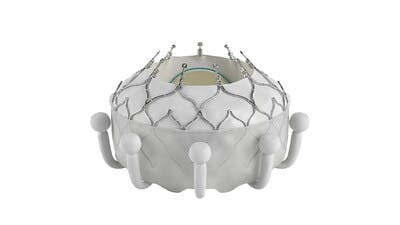 October 19, 2023—Edwards Lifesciences Corporation announced that the company’s Evoque tricuspid valve replacement system has received CE Mark approval for the transcatheter treatment of eligible patients with tricuspid regurgitation (TR) in Europe.
According to the company, the Evoque system is comprised of a nitinol self-expanding frame, intra-annular sealing skirt, and tissue leaflets made from the same bovine pericardial tissue as the company’s heart valves. The Evoque valve will be available in three sizes, all delivered through a low-profile transfemoral 28-F system.
“The Evoque system is able to fully replace the tricuspid valve, virtually eliminating TR in a wide range of anatomies,” commented Professor Philipp Lurz, MD, in the company’s press release. “The significant improvements in patients’ quality-of-life are remarkable, now offering a therapy to many patients who previously had no treatment options.”
Professor Lurz, who is Director of Cardiology at University of Mainz, Germany, serves as European Principal Investigator for the TRISCEND II pivotal trial of the Evoque system.
The company advised that results from the TRISCEND II study will be presented on October 26 during a late-breaking clinical trial session at TCT 2023, the 35th annual Transcatheter Cardiovascular Therapeutics scientific symposium to be held October 23-26 in San Francisco, California.
One-year results from the single-arm, prospective, global, multicenter TRISCEND study of the Evoque system were presented at the PCR London Valves 2022 course held November 27-29 in London, United Kingdom.
Edwards reported that the TRISCEND data demonstrated favorable safety and effectiveness outcomes and significant quality-of-life improvements. Key findings included high survival (90.1%) and high freedom from heart failure hospitalization (88.4%); significant and sustained TR reduction to mild or trace TR (97.6%); and significantly improved functional and quality-of-life outcomes (93% of patients in New York Heart Association Class I or II compared to 26% at baseline and a 26-point increase in Kansas City Cardiomyopathy Questionnaire score over baseline).
Advertisement
Advertisement
