Advertisement
Advertisement
September 29, 2025
CorWave LVAS Evaluated in FIH Implantation
September 29, 2025—CorWave announced the presentation of interim results from its first-in-human (FIH) study evaluating the company’s left ventricular assisting system (LVAS). The LVAS is a next-generation durable heart pump based on wave membrane technology, noted the company.
The findings were presented by the study’s Principal Investigator, Professor Chris Hayward, MD, in a late-breaking clinical science session at HFSA 2025, the annual scientific meeting of the Heart Failure Society of America. Prof. Hayward is Director of the Mechanical and Circulatory Support research program at St Vincent’s Private Hospital in Sydney, Australia.
The CorWave LVAS was implanted in a patient for the first time at St. Vincent’s Hospital by Paul Jansz, BMed, PhD, on May 28, 2025. The FIH study plans to enroll a minimum of four patients before the start of the pivotal trial phase, advised CorWave.
According to the company, Prof. Hayward reported the first patient experience with a focus on patient baseline, clinical course, and the device’s initial safety and effectiveness.
As summarized in the press release, the primary endpoint of the study was achieved with no device-related adverse events observed at 30 days—providing an early confirmation of the safety profile of the CorWave LVAS.
Additionally, functional status improved to New York Heart Association class I before discharge. At postoperative day 84, the patient successfully underwent a heart transplant. The CorWave device was explanted without complication and preliminary analyses of the pump and outflow graft revealed no thrombus.
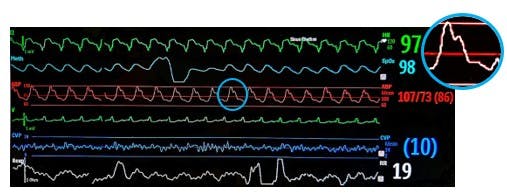
The company reported that the pump performed as expected, providing full support and restoring a cardiac index above 2.5L/min/m² (versus 1.6L/min/m², preoperative), efficiently unloading the left ventricle. The membrane technology preserved an aortic pulse pressure of 25.5 ± 6.1 mm Hg, periodically exceeding 40 mm Hg and allowed consistent aortic valve opening despite a postoperative left ventricular ejection fraction of 15%–20%.
The vital signs of the patient with physiological pulsatility are shown in the accompanying image from CorWave.
“The results of the CorWave device are very encouraging,” commented Prof. Hayward in the company’s press release. “The physiologic pulse that we observed in the first CorWave patient stands out from the results we have observed in patients assisted with continuous-flow left ventricular ejection devices, in use since the 2000s.”
Prof. Hayward added, “This first experience suggests that CorWave LVAS can be implanted safely and has the potential to offer significant benefits for patients with heart failure. Further clinical experience will be needed to confirm these promising findings.”
Advertisement
Advertisement