Advertisement
Advertisement
September 3, 2024
Biotronik Launches Guide Extension Catheters in Europe
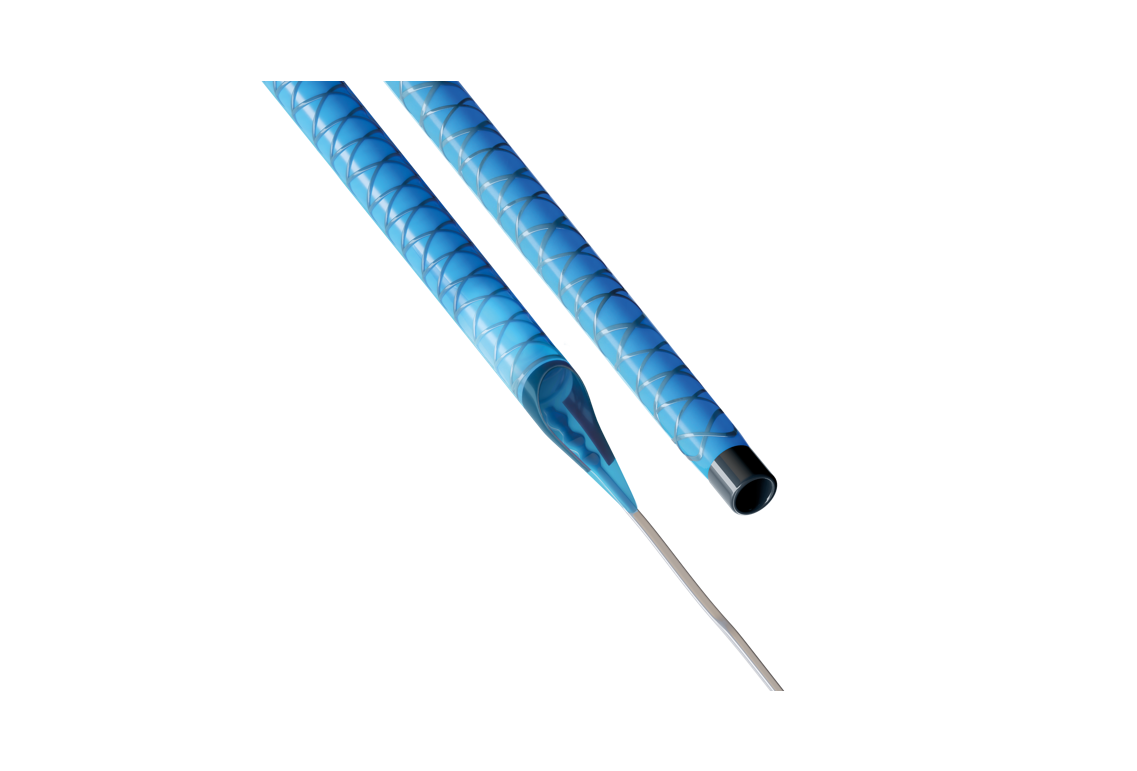 September 3, 2024—Switzerland-based Biotronik announced the launch of the FlowGuide and Guidion Short guide extension catheters in selected countries that accept CE Mark. The devices are designed and manufactured by IMDS (Interventional Medical Device Solutions), headquartered in Roden, the Netherlands.
According to Biotronik, these devices have been developed to offer enhanced support and facilitate the delivery of devices during complex vascular interventions. The catheters offer transradial access and a trapping-friendly design.
Biotronik stated that through its collaboration with IMDS, the FlowGuide and Guidion Short catheters expand its portfolio of devices dedicated to complex percutaneous coronary intervention (PCI), which includes TrapIT, NHancer Rx, and ReCross.
As noted in the press release, the FlowGuide catheter’s nine circumferential perfusion holes in the distal shaft are designed to maintain optimal blood flow to distal vessels and side branches, thereby reducing the risk of pressure damping and procedure-induced ischemia. The FlowGuide is optimized for transradial access procedures with its shorter, 15-cm distal shaft and a flexible section of the push rod called the “Guide Zone.” These two features offer conformability and ease of use, even with curved vessel configurations. Additionally, the catheter has a 1.3-mm radiopaque soft tip and a radiopaque marker in the transition zone.
The Guidion Short catheter is intended for procedures in which avoiding antegrade flow may be desired, such as chronic total occlusion (CTO) procedures. The device offers the same platform innovation as the FlowGuide catheter but without perfusion holes. The shorter distal shaft and radiopaque marker in the transition zone simplify the use of over-the-wire devices by facilitating trapping, while keeping the guide extension in place. It is compatible with the TrapIT device for CTO procedures.
“The FlowGuide and Guidion Short catheters are devices that respond to unmet needs in the cath lab, that we formerly had to accept or simply learn to deal with,” commented Stylianos Pyxaras, MD, in the company’s press release. “Maintaining a sufficient amount of coronary perfusion while using a guide extension catheter that in addition reduces challenges when transitioning a stent or balloon into the distal shaft is of added value, as is the crossability needed during challenging PCI.”
Dr. Pyxaras, who is with Klinikum Fürth in Fürth, Germany, continued, “The innovation that both tools introduce in daily practice is promising, thanks to their practicality from the operators’ perspective, but more importantly, for their potential to optimize patient care.”
Advertisement
Advertisement