Advertisement
Advertisement
2026 Digital Exclusive No. 1
Coronary Bifurcation Wishlists: Trials and Toolboxes
A look at the technology and research needs in coronary bifurcation disease, including more data on the safety and efficacy of drug-coated balloons, new trials on stenting strategies, and additional options for lithotripsy.
With Antonio Colombo, MD; Mirvat Alasnag, MD, FACC, FACP, FSCAI, FRCP; Salvatore Brugaletta, MD, PhD; and Jimmy L. Kerrigan, MD

Antonio Colombo, MD
Three of the most recent, impactful trials for bifurcation lesions are EBC MAIN, DKCRUSH-V, and DEFINITION II, which all evaluated the provisional stenting strategy compared to the double-kissing crush/two-stent technique (Figure 1).1-4
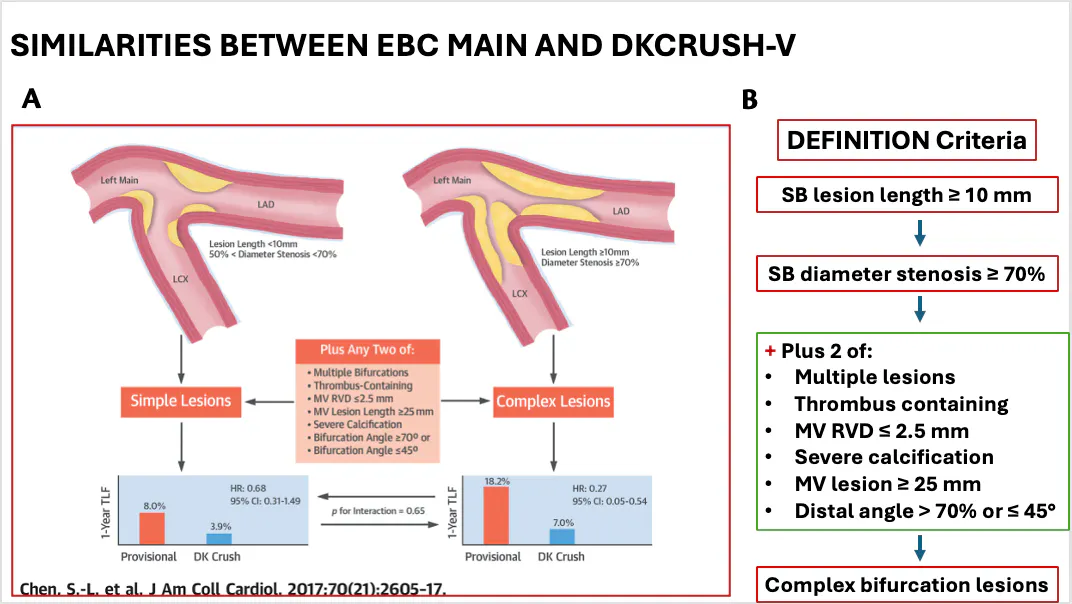
Figure 1. Stenting for left main bifurcations, as seen in the DKCRUSH-V trial, where patients with true distal left main coronary artery bifurcation lesions were randomized to the double-kissing crush stenting compared to provisional stenting (EBC MAIN) (A). Both techniques had similar relative reduction in 1-year target lesion failure in both simple and complex lesions; however, the absolute benefit was greater for more complex lesions. Categorization criteria for complex versus simple lesions, according to the DEFINITION study (B). Figure 1A reprinted from Journal of the American College of Cardiology, Vol 70, Chen SL, Zhang JJ, Han Y, et al, Double kissing crush versus provisional stenting for left main distal bifurcation lesions: DKCRUSH-V randomized trial, Pages 2605-2617, Copyright 2017, with permission from Elsevier. HR, hazard ratio; LAD, left anterior descending artery; LCX, left circumflex artery; MV, main vessel; RVD, reference vessel diameter; TLF, target lesion failure.
There are a few key messages from these three essential trials regarding technology and technique. First, for most focal side branch (SB) lesions, there is no need to stent. Second, when the SB has a long diseased area, two stents may occasionally be needed. In my view, these recommendations are for SBs ≥ 3 mm in diameter. Most SBs need to be “kept open,” and no intervention is needed. Presently, there is an emerging application of drug-coated balloons (DCBs) to treat the SB instead of additional stenting. For left main (LM) lesions, efforts should be made to limit stenting of the circumflex.
In terms of current imaging considerations, intravascular ultrasound (IVUS) or optical coherence tomography (OCT) should be used for main branch stenting. IVUS and OCT should always be used when implanting two stents for an optimal result in the main branch and SB (minimum final lumen areas: 4 mm2 for 2.5-mm vessel, 5 mm2 for 3-mm vessel, 7 mm2 for 3.5-mm vessel; 8 mm2 for 4-mm vessel).
In this article, physicians take this knowledge about today’s coronary bifurcation lesion landscape and consider their ideal trial design for coronary bifurcation and one game-changing technology they would add to their current coronary bifurcation toolkit.

Mirvat Alasnag, MD, FACC, FACP, FSCAI, FRCP
MY TRIAL WISH
The DCB-BIF trial, presented in 2024, was an interesting trial evaluating the role of DCBs for bifurcation lesions.5 At 1 year, there was a lower incidence of major adverse cardiac events in the DCB versus noncompliant group (7.2% vs 12.5%; P = .013), mostly driven by reduction in target vessel myocardial infarction. I would like to see outcomes of this technology in more complex lesions, such as LM, as well as calcified lesions requiring atherectomy.
MY TECHNOLOGY WISH
The concept of lithotripsy has certainly simplified plaque modification, but current devices are limited in terms of crossability. I am interested in a device that is both crossable and long enough to cover long, calcified lesions. Importantly, the cost-effectiveness of these technologies ought to be considered.

Salvatore Brugaletta, MD, PhD
MY TRIAL WISH
I would like to see a trial that evaluates the LM treated by one stent with kissing balloon compared to one stent with DCB. I think this might open the door to DCB for LM intervention.
MY TECHNOLOGY WISH
I would like to specifically see either a kissing balloon or balloon with an IVUS/OCT catheter incorporated that will give you a pullback as the balloon is inflated.

Jimmy L. Kerrigan, MD
MY TRIAL WISH
As we enter the era of use of DCBs in de novo coronary lesions in the United States, we will require data indicating efficacy and safety of DCBs/drug-eluting balloons in bifurcations that are at least on par with drug-eluting stents. My hope is that instead of noninferiority, those trials will show superiority in outcomes (stent failure, primarily) when we stent a main vessel and then provisionally use DCBs after appropriate lesion preparation in the daughter vessel. From my standpoint, that is the biggest need we have from a data perspective, at least in the United States.
MY TECHNOLOGY WISH
This is not necessarily specific to bifurcation, although it is potentially completely relevant given the rates of stent failure with bifurcation stent strategies. I wish we had a directional coronary atherectomy device in the United States approved for use for in-stent restenosis (ISR)—something that would not remove cobalt-chromium but would remove the neointimal hyperplasia and neoatherosclerosis to “shave out” failed stents and do so safely. Outside of that, approved atherectomy technologies that are effective for multilayer ISR to modify the stent above and beyond what we get from laser prior to adding drug would be of additional benefit, as well.
1. Hildick-Smith D, Egred M, Banning A, et al. The European bifurcation club left main coronary stent study: a randomized comparison of stepwise provisional vs. systematic dual stenting strategies (EBC MAIN). Eur Heart J. 2021;42:3829-3839. doi: 10.1093/eurheartj/ehab283
2. Chen SL, Zhang JJ, Han Y, et al. Double kissing crush versus provisional stenting for left main distal bifurcation lesions: DKCRUSH-V randomized trial. J Am Coll Cardiol. 2017;70:2605-2617. doi: 10.1016/j.jacc.2017.09.1066
3. Chen X, Li X, Zhang JJ, et al; DKCRUSH-V Investigators. 3-Year outcomes of the DKCRUSH-V trial comparing DK crush with provisional stenting for left main bifurcation lesions. JACC Cardiovasc Interv. 2019;12:1927-1937. doi: 10.1016/j.jcin.2019.04.056
4. Zhang JJ, Ye F, Xu K, et al. Multicentre, randomized comparison of two-stent and provisional stenting techniques in patients with complex coronary bifurcation lesions: the DEFINITION II trial. Eur Heart J. 2020;41:2523-2536. doi: 10.1093/eurheartj/ehaa543
5. Chen S. Comparison of noncompliant balloon with drug-coating balloon angioplasties for side branch after provisional stenting for patients with true coronary bifurcation lesions: the prospective, multicenter, randomized DCB-BIF trial late-breaking science. Presented at: TCT 2024; October 27-30, 2024; Washington, DC.
Advertisement
Advertisement
Latest Digital Exclusives