Advertisement
Advertisement
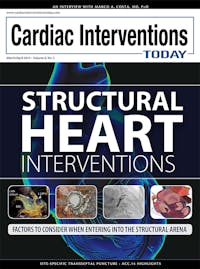
This edition of Cardiac Interventions Today will bring you up to date on many of the issues in the spectrum of structural heart interventions. Among these clinical problems, we cover the gamut from atrial septal defect (ASD), left atrial appendage (LAA), patent foramen ovale (PFO), and paravalvular leak (PVL). We also highlight important relevant techniques, such as transseptal puncture and imaging guidance.
First, Paul Poommipanit, MD, FSCAI, FACC, and Zahid Amin, MD, FSCAI, FAAP, FACC, FAHA, outline the factors to consider when planning an ASD closure procedure, including ways to prevent possible complications, identifying high-risk anatomy, and tips for using the available devices.
We then focus on the imaging tool of choice when performing endoluminal closure of the LAA: echocardiography. Nina C. Wunderlich, MD; Martin J. Swaans, MD; Harald Küx, MD; Roy Beigel, MD; and Robert J. Siegel, MD, FACC, explain why two- and three-dimensional transesophageal echocardiography are essential for pre-, peri-, and postprocedure assessments, including the relevant anatomy, puncture site, device deployment, and follow-up evaluation.
Clearly, PVL is an important complication to be cognizant of, especially with the exponential rise in prosthetic valve implantation. Sonnit Sharma, MB, BS; Chad Kliger, MD; Vladimir Jelnin, MD; and Carlos E. Ruiz, MD, PhD, describe the novel transapical approach to PVL closure by obstructing flow at the site of the leak with coils or occluders. Continuing this discussion, Justin P. Levisay, MD, FACC, FSCAI; Michael Salinger, MD, FACC, FSCAI; and Ted E. Feldman, MD, FESC, FACC, FSCAI, review the incidence of PVL after transcatheter aortic valve replacement, how this complication is best assessed, and the available treatment options.
In the pursuit of appropriate patient selection, David E. Thaler, MD, PhD, FAHA, shares how the RoPE score can assist in predicting those in the cryptogenic stroke population who will benefit most from PFO closure.
Eulogio García, MD, and Leire Unzué, MD, then discuss the use of an arteriovenous wire loop for structural heart interventions in order to facilitate the advancement and deployment of a closure device.
In our update on imaging, Michael J. Rinaldi, MD, FACC, FSCAI; Markus Scherer, MD, FACC, FSCCT; William Downey, MD, FACC, FSCAI; and Geoffrey Rose, MD, FACC, FASE, review the imaging modalities used to guide transseptal catheterization access for many types of structural heart interventions.
To conclude this issue, cardiovascular disease expert Marco A. Costa, MD, PhD, explains his preferred applications for imaging assessment tools, how hospitals can improve cost efficiency while providing excellent care, and more.
As always, we hope to help keep you up to date and reduce the growing stack of journals on each of our desks to a few useful and concise reviews. Let us know if we are succeeding and if there are topics you would like to hear about in upcoming issues.
Ted E. Feldman, MD, FESC, FACC, FSCAI
Chief Medical Editor
Advertisement
Advertisement