Advertisement
Advertisement
September/October 2010
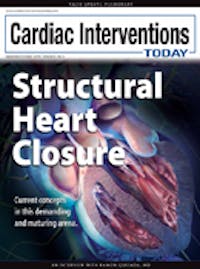
CHIEF MEDICAL EDITOR'S PAGE: Structural Heart Closure
There has been an explosion of interest in structural heart interventions, fueled most recently by trial results for percutaneous aortic valve replacement therapy. There are many other structural developments, and the area of shunt closure has matured greatly during the last several years. I hope you will enjoy our review of this subject.
Sudeshna Banerjee, MD, and John M. Lasala, MD, PhD, FACC, introduce this issue's feature with an overview of the indications and limitations associated with both percutaneous and surgical treatment options for treating atrial septal defect, ventricular septal defect, patent foramen ovale (PFO), and patent ductus arteriosus.
Next, Michael H. Salinger, MD, FACC, FSCAI; Mehmet Cilingiroglu, MD, FACC, FESC, FSCAI; Justin P. Levisay, MD, FACC, FSCAI; and I explore an abundance of trial data that support the concept that PFO closure reduces recurrent transient ischemic attack and stroke.
Although coronary artery fistulas and pulmonary arteriovenous malformations are rare presentations, they are imperative conditions to treat, and the treatment of choice seems to be percutaneous intervention. Thomas A. Farrell, MD, and I explain the techniques, tools, and outcomes associated with transcatheter embolization for treating these malformations.
Terry D. King, MD; Noel L. Mills, MD; and Nancy B. King, PNP, MBA, provide an overview of the history and evolution of atrial septal defect treatments, including a wide array of device developments.
To close our feature, we take a different look at PFO as Lars Thomassen, MD, PhD, and Ulrike Waje-Andreassen, MD, PhD, demonstrate the heart-brain connection that exists between PFO and neurologic events. As research is slowly being compiled that supports this link, we may find new ways to understand the cause of recurrent cerebral events and how to better treat patients.
In our Valve Update department, Wail Alkashkari, MD; Qi-Ling Cao, MD; Clifford J. Kavinsky, MD, PhD, FACC, FSCAI; and Ziyad M. Hijazi, MD, MPH, FSCAI, FACC, share how the progress of techniques and devices are improving outcomes for patients with right ventricular outflow tract defects who have previously undergone treatment. Then, Julie A. Vincent, MD, FACC, FSCAI, and William E. Hellenbrand, MD, FSCAI, discuss the percutaneous heart valves that are currently on the market, as well as important procedural considerations and risks involved in right heart percutaneous valve therapies.
Finally, we close this issue with our featured interview with Ramon Quesada, MD, who shares his thoughts on the growing acceptance of transradial access, the best ways to learn this new skill set, and the future of structural heart repair.
As always, we hope you find our effort to provide a synthesis of the ever-expanding interventional literature useful, and we welcome your suggestions for future subjects for review.
Advertisement
Advertisement